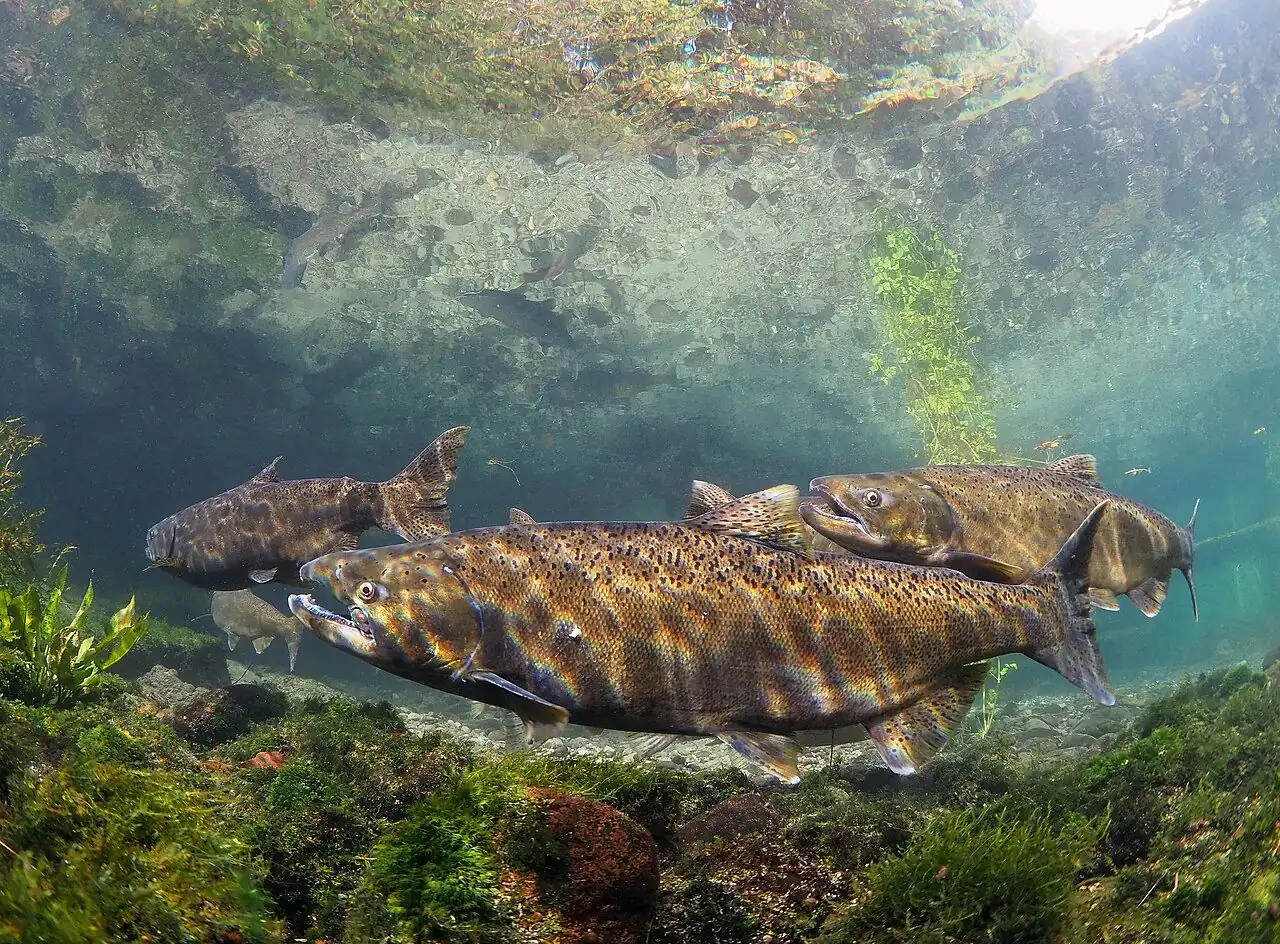
Chinook Salmon
Oncorhynchus tshawytscha
The biggest Pacific salmon, a fish that feeds for years at sea before returning to its home stream to spawn once and die.
Photo: U.S. Fish and Wildlife Service, Pacific Region / CC0
3 things to know
- Chinook are also called king salmon and blackmouth, for the black gum line of the lower jaw.
- Alaska chinook coming home after 2010 were on average 8 percent shorter than those before 1990.
- Chinook salmon are the main prey of the endangered Southern Resident killer whales.
- Scientific name
- Oncorhynchus tshawytscha
- Depth
- 0 m – 375 m
0 – 1,230 ft - Size
- Usually about 0.9 m (3 ft) at maturity; up to about 1.5 m (4.9 ft)
- Weight
- Usually about 14 kg (30 lb) at maturity; up to about 58 kg (129 lb)
- Lifespan
- Usually 3 to 4 years; up to 9 years reported; all die after spawning
- Diet
- At sea, mainly other fish, plus crustaceans and other invertebrates
- Where
- North Pacific and adjoining Arctic waters, from the Monterey Bay area of California to the Chukchi Sea off Alaska, and on the Asian side south to Japan
- IUCN status
- Least Concern
- Depth zones
- Sunlight · Twilight
Chinook are the largest Pacific salmon, hence the name king salmon. NOAA Fisheries says they can grow to about 1.5 meters (4.9 feet) and 58 kilograms (129 pounds), though a typical mature fish is closer to 0.9 meters (3 feet) and 14 kilograms (30 pounds). In the ocean a chinook is blue-green on the back with silver sides, a white belly and small black spots on the upper body and on both lobes of the tail. The gums of its lower jaw are black, which gives it another nickname, blackmouth.
Like other salmon, chinook are anadromous. They hatch in streams, and the young spend anywhere from 3 months to 3 years in fresh water before heading to sea, though most leave after about a year. Then come several years of feeding in the ocean, where they eat mainly other fish, along with crustaceans and other invertebrates. In North America they range from the Monterey Bay area to the Chukchi Sea, and on the Asian side of the Pacific they reach Japan. Most come home at 3 or 4 years old, though maturity can come anywhere from 2 to 7, and every chinook dies after spawning.
They are coming home smaller. Krista Oke and colleagues gathered 60 years of measurements, from 1957 to 2018, on 12.5 million salmon across Alaska. In their 2020 study in Nature Communications, all four species had shrunk, and chinook the most: average length fell 8 percent between the fish that returned before 1990 and those that returned after 2010, and about 10 percent in western Alaska and the Yukon and Kuskokwim region. The main cause was fish returning at younger ages, linked to climate and competition for food at sea. For chinook, they estimated the average fish now produces about 16 percent fewer eggs and is worth 21 percent less to fisheries.
Chinook are the main prey of the endangered Southern Resident killer whales. Under the Endangered Species Act, NOAA lists two chinook groups as endangered and seven as threatened, with dams, culverts and damaged rivers among the main threats. The Sacramento River winter run in California, which spawns in summer below Keswick Dam and depends on cold water released from Shasta Reservoir, is one of NOAA's Species in the Spotlight. Worldwide, the IUCN rated the chinook Least Concern in 2020.
Sources
- fisheries.noaa.gov/species/chinook-salmon
- fisheries.noaa.gov/species/chinook-salmon-protected
- fishbase.se/summary/Oncorhynchus-tshawytscha.html
- Study: doi:10.1038/s41467-020-17726-z
- uaf.edu/news/archives/news-archives-2010-2021/salmon-across-alaska-getting-smaller-impa…
- fisheries.noaa.gov/species/killer-whale



