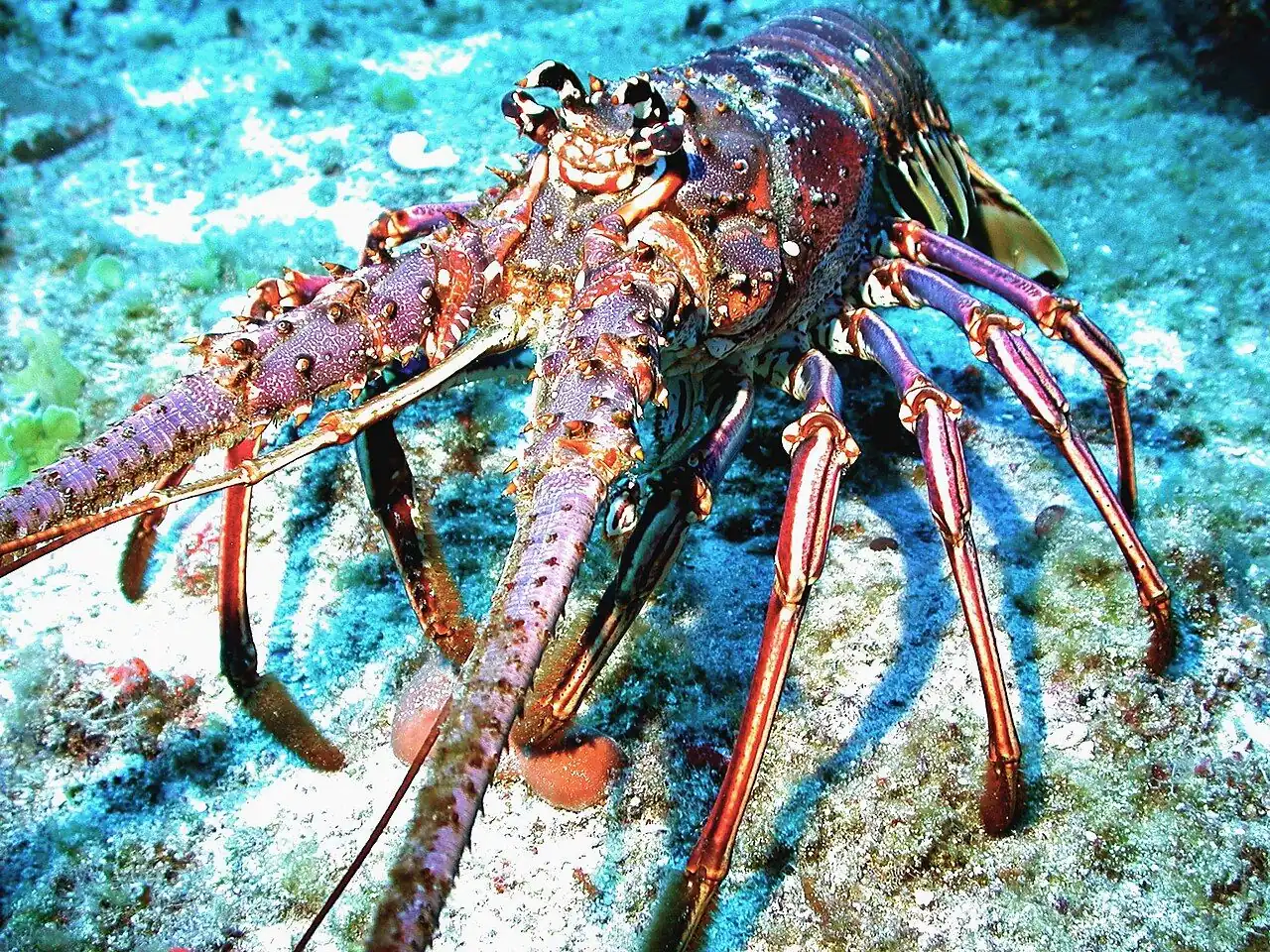
Caribbean Spiny Lobster
Panulirus argus
A clawless, spiny lobster of Florida and the Caribbean that migrates each autumn in single-file lines, each lobster touching the one ahead.
Photo: NOAA / Public domain
3 things to know
- It has no big claws and waves its long, horn-like antennae to scare off predators.
- Most spiny lobster larvae found in US waters come from upstream sources in the Caribbean.
- Lobsters walking in a single-file queue each face less drag than a lobster moving alone.
- Scientific name
- Panulirus argus
- Depth
- 0 m – 90 m
0 – 295 ft - Size
- Up to about 46 cm (18 in) long; commonly about 20 cm (8 in)
- Weight
- Up to about 6.8 kg (15 lb)
- Lifespan
- 15 years or more, though ageing is uncertain
- Diet
- Snails, crabs and clams
- Where
- North Carolina to Texas, Bermuda and the Caribbean; Brazilian spiny lobsters, once included, were named a separate species in 2016
- IUCN status
- Data Deficient
- Depth zones
- Sunlight
Unlike the American lobster, the Caribbean spiny lobster has no big claws. Forward-pointing spines cover its reddish-brown shell, which carries scattered dark spots and two large cream-colored spots on the second tail segment, and it scares off predators by waving two long, horn-like antennae. Shorter antennules sense movement and chemicals in the water. Most seafood sold as "lobster tail" comes from spiny lobsters.
It lives along the continental shelf from North Carolina to Texas, around Bermuda and through the Caribbean, from shallow water to about 90 meters (295 feet) and occasionally deeper. NOAA's range runs on south to Brazil, but in 2016 Bruno Giraldes and David Smyth described the Brazilian population, separated by the Amazon-Orinoco plume, as a new species, Panulirus meripurpuratus. NOAA Fisheries says most of the larvae found in US waters come from upstream sources in the Caribbean. Young lobsters settle in dense seaweed close to shore, then shelter in sponges, soft corals and solution holes before moving out to reefs, bays and seagrass. Adults hide in dens by day and hunt snails, crabs and clams at night. They can reach 46 centimeters (18 inches) and 6.8 kilograms (15 pounds), and may live 15 years or more, though their age is hard to measure.
The species is best known for how it travels. In 1969 William Herrnkind described autumn mass migrations in the journal Science in which thousands of lobsters moved by day in single-file queues, each keeping contact with the one ahead through its antennae and legs. Lines of up to 50 animals have been reported. Lobsters caught while migrating kept forming queues in the lab for up to several weeks. In 1976 Robert Bill and Herrnkind measured the drag on lobsters in formation and found that each lobster in a queue faced less drag than one moving alone at the same speed, which suggests the habit saves energy on the long walk. NOAA says the adults are heading for deeper water, away from cold and murky shallows.
Off Florida and the Gulf states the season is closed from April 1 through August 5 to protect spawning lobsters, and females carrying eggs may not be taken. On the IUCN Red List, in a 2009 assessment made before that split, the species is Data Deficient.



