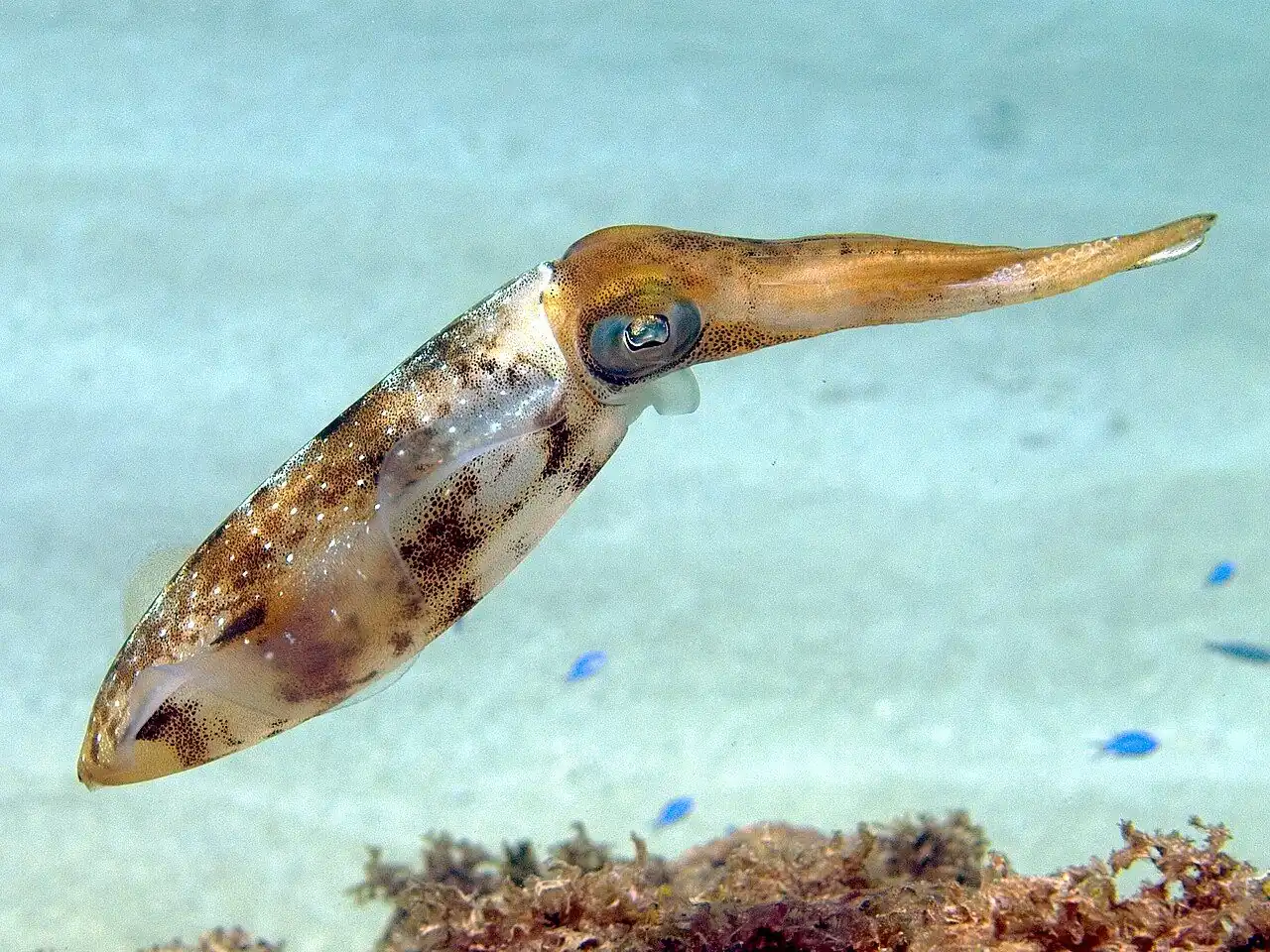
Caribbean Reef Squid
Sepioteuthis sepioidea
A shallow-reef squid of Florida and the Caribbean that travels in small schools and signals with fast-changing colors and patterns.
Photo: Nick Hobgood / CC BY-SA 3.0
3 things to know
- Its fins run along about 90% of its mantle in adults.
- An alarmed squid turns its brow ridges gold and its middle arms pale white.
- Females lay eggs only three or four to a capsule, sometimes inside queen conch shells.
- Scientific name
- Sepioteuthis sepioidea
- Depth
- 0 m – 20 m
0 – 66 ft - Size
- Mantle up to about 20 cm (8 in) long
- Weight
- Not well known
- Lifespan
- Not well known; females die soon after laying eggs
- Diet
- Fishes and shrimps
- Where
- Tropical western Atlantic, from Cape Canaveral, Florida, Bermuda and the Bahamas through the Caribbean to Venezuela
- IUCN status
- Least Concern
- Depth zones
- Sunlight
Schools of 4 to 50 squid, all about the same size, cruise over coral reefs, reef flats and the seagrass beds behind them. This is Sepioteuthis sepioidea, the Caribbean reef squid. Its fins run almost the full length of the body, about 90% of the mantle in adults, and the mantle grows to about 20 centimeters (8 inches). Its color changes with place and situation, from see-through with an iridescent sheen to greenish or deep reddish brown, sometimes with eyespots, bands or stripes, according to the Tree of Life Web Project account by Michael Vecchione and Richard Young.
Those colors carry messages. The University of Michigan's Animal Diversity Web, drawing on studies by Moynihan and Rodaniche, describes a social squid that uses many signals, including an alarm display in which the brow ridges turn gold and the middle arms go pale white.
It is strictly tropical, its range limited mainly by coral reefs and turtle-grass flats. The range runs from Cape Canaveral, the Florida Keys, the Bahamas and Bermuda through the Caribbean islands and Mexico's Yucatán coast to Venezuela. Shallow coral reefs are scarce in most of the Gulf of Mexico, and the squid appears to be absent from it. It lives from the surface to about 20 meters (66 feet), mostly between 3 and 7 meters (10 and 23 feet). It hunts fishes and shrimps; the Animal Diversity Web notes that most of the fish are schooling sardines.
Large adults tend to pair off, one male with one female. Squid mature at a mantle length of about 9 centimeters (3.5 inches), and breeding seems to go on all year. A female lays very yolky eggs about 5 to 6 millimeters long, only three or four to each jelly-like capsule, and attaches small clusters of capsules under rocks or inside queen conch shells. She dies soon after laying, and the exact lifespan is not well known.
SeaLifeBase notes that people catch it with spears, night lights and dip nets. The IUCN lists it as Least Concern, from a 2015 assessment that includes Florida and the US Virgin Islands in its range and names fishing and climate-driven habitat change among the pressures on it.



