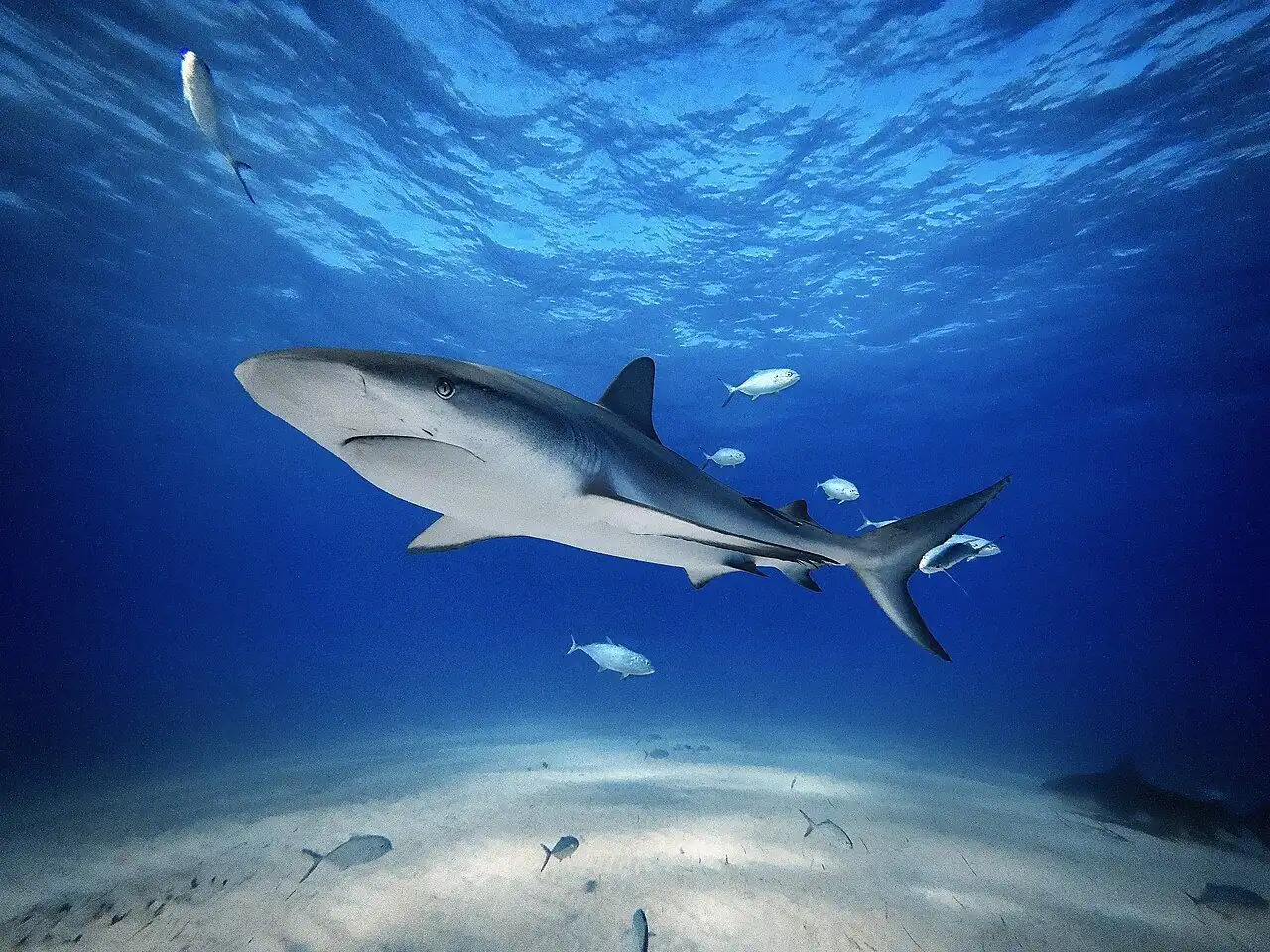
Caribbean Reef Shark
Carcharhinus perezii
The most common shark on Caribbean coral reefs, a gray hunter that satellite tags show can dive well over 300 m (1,000 ft) deep.
Photo: Dennis Hipp (Zepto) / CC0
3 things to know
- It can lie motionless on the bottom, and has been found resting this way in caves off Mexico.
- Satellite tags on large sharks at Glover's Reef, Belize, recorded depths down to 356 m (1,168 ft).
- Commercial fishers may not catch Caribbean reef sharks in US waters.
- Scientific name
- Carcharhinus perezii
- Depth
- 1 m – 65 m
3 – 213 ft - Size
- Up to about 3 m (9.8 ft); the Florida Museum gives a maximum recorded length of 2.95 m (9.7 ft)
- Weight
- Up to about 70 kg (154 lb)
- Lifespan
- Not well known
- Diet
- Mainly bony fishes
- Where
- Western Atlantic from Florida and Bermuda through the Gulf of Mexico, the Bahamas and the Caribbean to southern Brazil
- IUCN status
- Endangered
- Depth zones
- Sunlight
On reefs in the Caribbean, this is the shark divers are most likely to meet. It is a large gray or gray-brown shark, white or yellowish below, with a short, blunt snout, a small first dorsal fin and a low ridge running along the back between its two dorsal fins. Adults reach about 3 meters (9.8 feet) long.
It ranges from Florida and Bermuda through the Gulf of Mexico, the Bahamas and the Caribbean to southern Brazil, though the Florida Museum notes that it is extremely rare north of the Florida Keys. It patrols drop-offs on the outer edges of reefs and eats mainly bony fishes. It can also lie motionless on the seabed, and sharks have been found resting this way in caves off Mexico and around Brazil's Fernando de Noronha archipelago. Females give birth to live young, four to six in an average litter, after a pregnancy thought to last about a year.
It is usually found shallower than 30 meters (98 feet), but satellite tags showed that is only part of the picture. Demian Chapman and colleagues tagged large sharks at Glover's Reef atoll in Belize and recorded them using depths from the surface to 356 meters (1,168 feet), in water from 31°C down to 12.4°C (88°F to 54°F). Large sharks spent more of the night in the top 40 meters, and longline catches of large sharks in the shallow lagoon and on the fore-reef rose at night.
Glover's Reef later showed that reef sharks can decline even inside a reserve. A 2022 study using baited underwater cameras found that their relative abundance inside the no-take marine reserve fell from 2009 to 2019, which the authors suspect was caused by fishing along its edges, while nurse sharks, which are protected throughout Belize, held steady. In 2021, Belize created shark no-take zones reaching 2 nautical miles (3.7 kilometers) around each of its three atolls. In 2025, Mongabay reported that fishers and researchers say they are seeing more sharks again, and that some shark fishers are now hired to help with the research.
The IUCN lists the Caribbean reef shark as Endangered.
Sources
- floridamuseum.ufl.edu/discover-fish/species-profiles/carcharhinus-perezi
- fishbase.se/summary/Carcharhinus-perezi.html
- Study: doi:10.3354/meps06941
- Study: doi:10.3354/meps13954
- news.mongabay.com/2025/03/caribbean-reef-sharks-rebound-in-belize-with-shark-fishers-help
- api.gbif.org/v1/species/2418059/iucnRedListCategory
- iucnredlist.org/species/60217/3093780
- marinespecies.org/aphia.php



