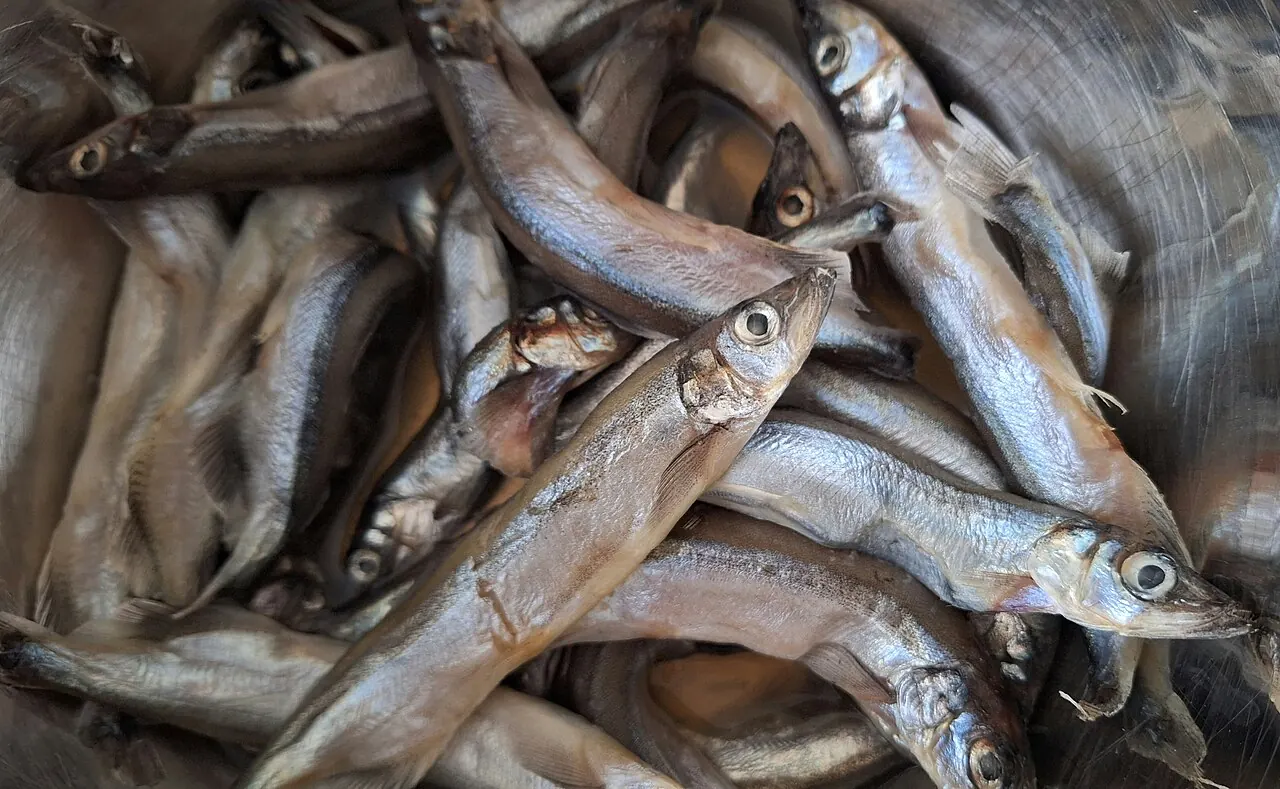
Capelin
Mallotus villosus
A small, silvery Arctic fish that rolls onto beaches to spawn and feeds the cod, seabirds and marine mammals of the North Atlantic.
Photo: Rakoon / CC0
3 things to know
- Some capelin spawn by rolling up onto sandy or fine-gravel beaches with the waves.
- Many die after spawning, especially males.
- Newfoundland's inshore fishery for roe-filled females, sold mainly to Japan, began in the late 1970s.
- Scientific name
- Mallotus villosus
- Depth
- 0 m – 200 m
0 – 656 ft - Size
- Mature fish usually 13–20 cm (5–8 in); the largest about 25 cm (10 in)
- Weight
- Up to about 40–45 g (1.4–1.6 oz); FishBase lists a maximum of 52 g (1.8 oz)
- Lifespan
- Rarely more than 5 years, according to Fisheries and Oceans Canada; FishBase gives a maximum reported age of 10 years
- Diet
- Zooplankton such as copepods, krill and amphipods, plus marine worms and small fish
- Where
- Cold Arctic and subarctic seas; in the western Atlantic from Greenland and Hudson Bay to the Gulf of Maine, in the east in the Barents, White and Norwegian seas; North Pacific capelin may be a separate species, Mallotus catervarius
- IUCN status
- Not Evaluated
- Depth zones
- Sunlight
Capelin are slender, silvery fish with a pointed snout, a slightly jutting lower jaw and a small fatty fin behind the dorsal fin, colored blue, green, olive or brassy brown above. Fisheries and Oceans Canada (DFO) puts mature fish at 13 to 20 centimeters (5 to 8 inches) and up to about 45 grams (1.6 ounces), and says they rarely live past 5 years. At spawning time males turn darker, grow longer fins and develop ridges of long scales along each side.
They live in cold northern water, mostly in the top 200 meters (660 feet), though FishBase records them as deep as 1,086 meters (3,560 feet) in Davis Strait. Capelin were long treated as one species circling the Arctic, but DFO says there is growing evidence for at least three in Canadian waters: Atlantic capelin, Pacific capelin (Mallotus catervarius) and one still unnamed. Atlantic capelin range from Greenland and Hudson Bay south to Maine and are most abundant around Newfoundland and Labrador.
They spend most of their lives offshore eating zooplankton, and they are a main link between that plankton and Atlantic cod, turbot, seabirds and marine mammals. In summer, many come inshore to spawn. DFO describes beach spawners rolling onto sand or fine gravel, more often at night and at high tide, where females and males release eggs and milt and the sticky eggs cling to the grains. Larvae emerge from beach sites 2 to 3 weeks later. Others spawn on the seabed in water less than 40 meters deep, and more do so when the beaches warm above about 12°C (54°F). Many adults die after spawning, males especially, though FishBase cites experiments suggesting beach spawners of both sexes can survive to spawn again while those spawning offshore do not.
Capelin numbers swing in boom-and-bust cycles. The stock off eastern Newfoundland and Labrador collapsed in the early 1990s, and since then more of it spawns off the beaches and the spawning fish are younger and smaller. The fishery for roe-bearing females, sold mainly to Japan, began in the late 1970s. For 2026 Canada kept the catch limit for eastern and southern Newfoundland and Labrador at 14,533 metric tons, unchanged from 2025, while capelin on the Grand Bank's Southeast Shoal have been under a fishing moratorium since 1995. The IUCN has not assessed the species.



