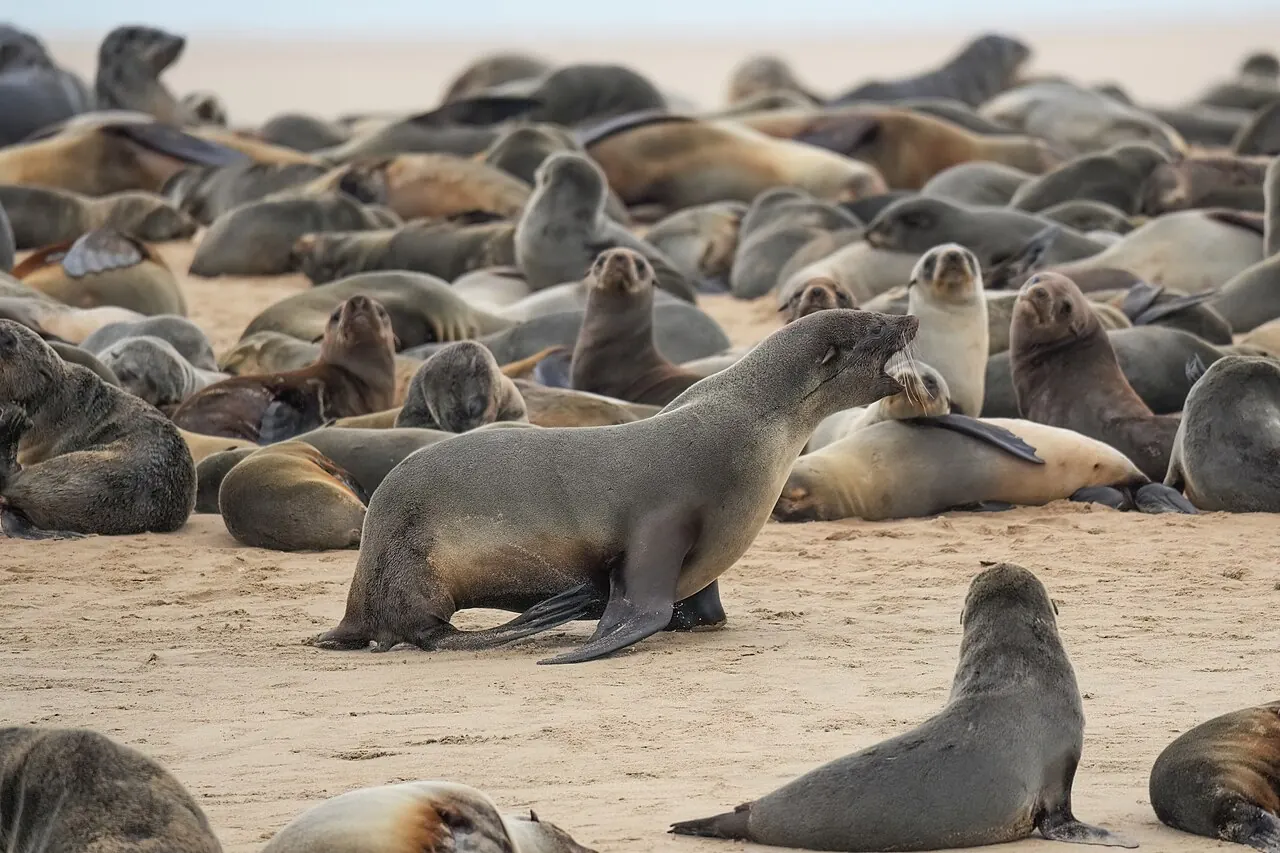
Cape Fur Seal
Arctocephalus pusillus pusillus
The fur seal of Namibia and South Africa's coasts and, since 2024, the first wild marine mammal population known to carry rabies.
Photo: Giles Laurent / CC BY-SA 4.0
3 things to know
- Bulls can weigh nearly three times as much as females.
- Most of its dives are shallower than 50 m (165 ft), but it can reach about 204 m (669 ft).
- A seal that fought with dogs on a Cape Town beach in May 2024 tested positive for rabies.
- Scientific name
- Arctocephalus pusillus pusillus
- Depth
- 0 m – 50 m
0 – 164 ft - Size
- Males average about 2.3 m (7.5 ft) long; females about 1.8 m (5.9 ft)
- Weight
- Males 200–350 kg (440–770 lb); females average about 120 kg (265 lb)
- Lifespan
- About 18 years on average in the wild, per Animal Diversity Web (figure for the species as a whole)
- Diet
- Mostly schooling fish, plus squid and some crabs; occasionally seabirds
- Where
- Coasts of southern Africa, from southern Angola and Namibia to Algoa Bay, South Africa
- IUCN status
- Least Concern
- Depth zones
- Sunlight
Cape fur seals are the African half of the brown fur seal species; the other subspecies lives in southeastern Australia. Bulls are gray to black, paler underneath, and average about 2.3 meters (7.5 feet) and 200 to 350 kilograms (440 to 770 pounds). Females are brown, about 1.8 meters (5.9 feet) and 120 kilograms (265 pounds) on average.
They breed in dense colonies on rocky islands and mainland beaches along the coasts of Namibia and South Africa. Bulls come ashore in mid-October to win territories by display, sparring and outright fights. A female mates about six days after giving birth, and the pregnancy lasts close to a year. Mothers then alternate trips to sea with nursing, and a returning mother answers only her own pup's call. At four to five months pups start eating crustaceans and fish, but they keep nursing until the next pup is born.
Fish make up about 70 percent of the diet, squid about 20 percent and crabs about 2 percent. S. P. Kirkman and colleagues put dive recorders on 32 adult females at the Kleinsee colony in South Africa between 2006 and 2008. Most dives were shallower than 50 meters (165 feet) and made at night, chasing small schooling fish that migrate vertically. Most females also dived to the seafloor, and those dives were the ones that pushed seals past their aerobic dive limit. The deepest recorded dive is about 204 meters (669 feet).
In May 2024 a seal that had fought with dogs at Big Bay Beach in Cape Town died on its way to a vet, and its brain tested positive for rabies. Chuene Ngoepe and colleagues later tested 216 seal brains collected along the South African coast from March 2023 to November 2025; 85 were positive, the earliest from Cape Town in September 2023. The virus's genes point to black-backed jackals as the source, followed by seal-to-seal spread across almost the whole South African range. The World Organisation for Animal Health calls it the first known establishment of rabies in a free-ranging marine mammal population.
The IUCN lists the species as Least Concern, in a 2015 assessment. South Africa banned commercial sealing in 1990, but Namibia still allows a yearly harvest; its quota in 2025 was 80,000 pups and 6,000 bulls.
Sources
- animaldiversity.org/accounts/Arctocephalus_pusillus
- Study: doi:10.1098/rsos.191369
- Study: doi:10.3201/eid3210.260179
- woah.org/en/rabies-detected-in-cape-fur-seals-highlights-an-unprecedented-shift-in-rabi…
- Study: doi:10.2305/IUCN.UK.2015-4.RLTS.T2060A45224212.en
- namibian.com.na/members-of-parliament-propose-seal-quota-increase-to-manage-population-…
- nationalgeographic.com/animals/article/wildlife-watch-cape-fur-seal-trade-Namibia



