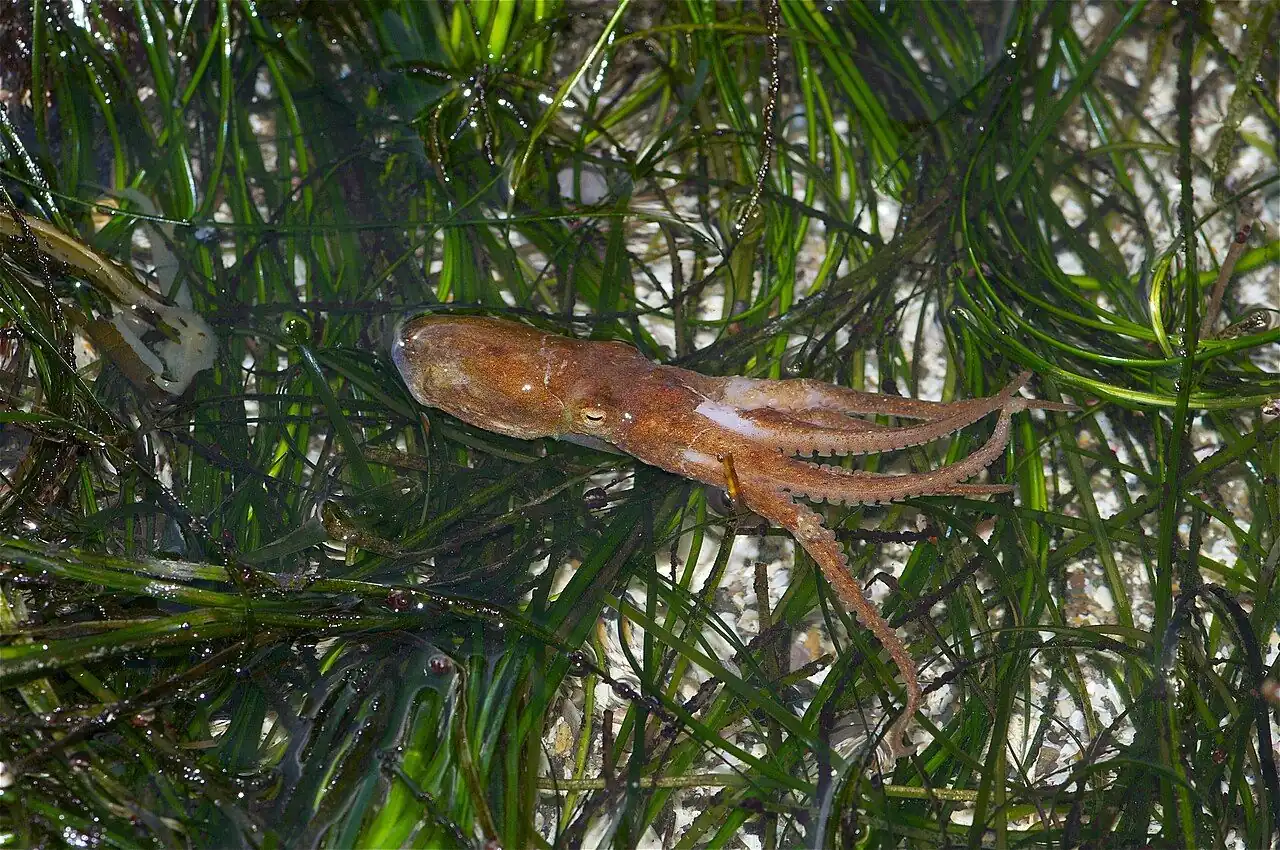
California Two-Spot Octopus
Octopus bimaculoides
A small Californian octopus with two blue false eyespots, the first cephalopod to have its genome fully sequenced.
Photo: Jerry Kirkhart / CC BY 2.0
3 things to know
- A false blue eyespot under each eye helps deter predators.
- In 2015 it became the first cephalopod with a fully sequenced genome.
- It typically lives about a year, and females die after brooding their eggs.
- Scientific name
- Octopus bimaculoides
- Depth
- 0 m – 20 m
0 – 66 ft - Size
- Mantle up to about 12 cm (4.7 in) long
- Weight
- Up to about 800 g (1.8 lb)
- Lifespan
- Typically about 1 year
- Diet
- Small fishes, mollusks and crustaceans
- Where
- Pacific coast from San Simeon, California, to Guerrero Negro on Mexico's Baja California peninsula
- IUCN status
- Least Concern
- Depth zones
- Sunlight
Below each eye of Octopus bimaculoides sits a false one, a blue spot that gives the California two-spot octopus its name. The Cabrillo Marine Aquarium in San Pedro, Los Angeles, says the two eyespots help deter predators. It is a small octopus, with a mantle up to about 12 centimeters (4.7 inches) long and a published maximum weight of 800 grams (1.8 pounds).
It lives along the Pacific coast from San Simeon, California, to Guerrero Negro on Mexico's Baja California peninsula, on rocky reefs and on sand and mud, from the intertidal zone down to about 20 meters (66 feet). It eats small fishes, mollusks and crustaceans. People take small numbers at places such as La Jolla for food and bait, and SeaLifeBase calls it a favored species in the aquarium trade.
In 2015 it became the first cephalopod to have its genome fully sequenced. Caroline Albertin, Clifton Ragsdale of the University of Chicago, Daniel Rokhsar and colleagues reported in Nature that the genome holds about 2.7 billion base pairs and more than 33,000 protein-coding genes. It contains 168 protocadherin genes, genes that regulate how nerve cells develop and had been thought to be greatly expanded only in vertebrates. "In this sense, then, our paper describes the first sequenced genome from an alien," Ragsdale said in the university's announcement.
Its life is short. Like other shallow-water octopuses, it typically lives about a year. After mating, a female broods her eggs, stops eating and declines quickly, sometimes injuring herself, until she dies. The optic glands, which work much like the pituitary gland of vertebrates, control this decline, and earlier experiments found that removing them reverses it. In 2022 Z. Yan Wang, Ragsdale and colleagues reported that after reproduction a female's optic glands ramp up at least three chemical pathways that make steroid hormones, including ones producing 7-dehydrocholesterol and bile acid building blocks, which had not been linked before to dying after a single breeding.
The IUCN lists the species as Least Concern, from a 2016 assessment covering California and Baja California.
Sources
- sealifebase.se/summary/Octopus-bimaculoides.html
- cma.recreation.parks.lacity.gov/marine-life/southern-california-species/invertebrate/tw…
- Study: doi:10.1038/nature14668
- pmc.ncbi.nlm.nih.gov/articles/PMC4795812
- news.uchicago.edu/story/landmark-sequencing-octopus-genome-shows-basis-intelligence-cam…
- Study: doi:10.1016/j.cub.2022.04.043
- iucnredlist.org/species/163004/963213
- Study: doi:10.2305/IUCN.UK.2018-2.RLTS.T163004A963213.en



