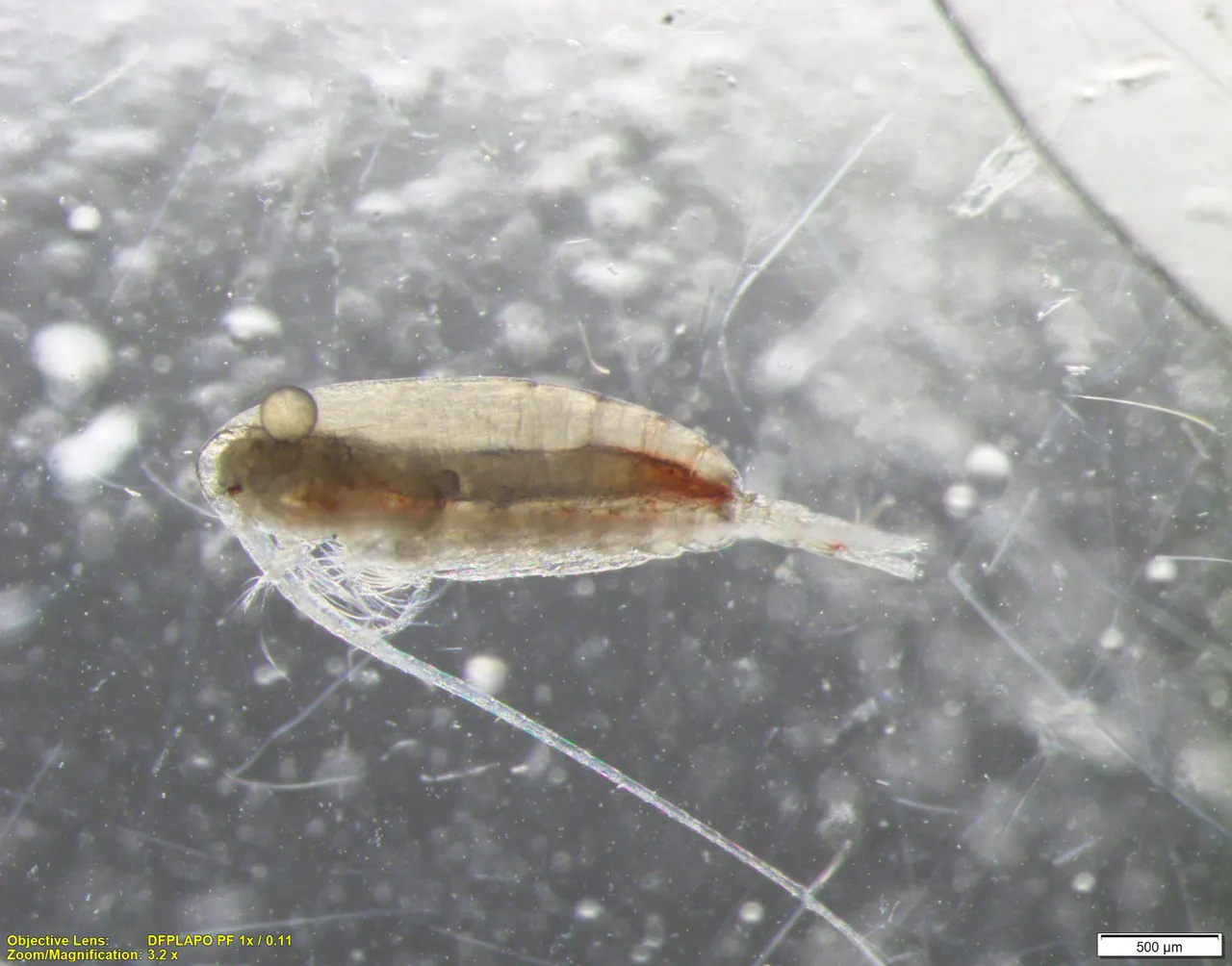
Calanus Copepod
Calanus spp. (mainly Calanus finmarchicus)
A rice-sized, fat-rich North Atlantic copepod that spends winter dormant in deep water and feeds right whales and herring.
Photo: Leïla Brunner / CC BY 4.0
3 things to know
- Each autumn it sinks 600 to 1,400 m (2,000 to 4,600 ft) to spend the winter dormant.
- Fat can make up more than half of its dry weight.
- It is the main prey of the North Atlantic right whale.
- Scientific name
- Calanus spp. (mainly Calanus finmarchicus)
- Depth
- 0 m – 1,400 m
0 – 4,593 ft - Size
- About the size of a grain of rice; overwintering C. finmarchicus have a prosome (main body section) about 2.2 to 2.6 mm (0.1 in) long
- Weight
- Not well known
- Lifespan
- About one year, from egg to spawning adult
- Diet
- Planktonic algae, mainly during the spring bloom
- Where
- North Atlantic, from the Gulf of Maine to north of Norway (C. finmarchicus)
- IUCN status
- Not Evaluated
- Depth zones
- Sunlight · Twilight · Midnight
Calanus finmarchicus is a copepod about the size of a grain of rice, one of the largest in the Gulf of Maine and very abundant across the subarctic North Atlantic, from the Gulf of Maine to north of Norway. It is a small crustacean, and in its later stages it carries a sac of oil inside its body. Its genus also includes C. helgolandicus, C. glacialis and C. hyperboreus, but C. finmarchicus is the most widespread of the North Atlantic species.
Its year runs on fat. It passes through six larval stages and six copepodite stages, the last of which is the adult, feeding and growing near the surface in spring and summer and turning the energy of the planktonic algae into wax esters rich in omega-3 fatty acids, which can make up more than half its dry weight. In late summer and autumn, the fifth-stage copepodites sink 600 to 1,400 meters (2,000 to 4,600 feet) and spend 4 to 9 months in a dormant state called diapause, in water of -1 to 8°C (30 to 46°F). In spring the survivors rise, become adults and start the next generation as the algae bloom.
Those fat-filled fifth-stage copepodites are the main food of the North Atlantic right whale, and herring, sand lance and capelin depend on them too. Tagging right whales in the summers of 2000 and 2001, Mark Baumgartner and Bruce Mate found that feeding whales dove to the depth where the copepods were most concentrated, somewhere between 80 and 175 meters (260 and 575 feet). In the Bay of Fundy, Baumgartner's team saw some of the copepods migrate up and down each day within the top 100 meters (330 feet), while most of the population stayed deeper, probably dormant. As the Gulf of Maine warms, a project led by Jeffery Runge of the University of Maine has been studying how the copepod persists there.
The winter descent also moves carbon. Jónasdóttir and colleagues estimated in 2015 that the fat C. finmarchicus burns at depth carries as much carbon into the deep North Atlantic as sinking dead material does, nearly doubling earlier estimates of biological carbon storage there. Norway set a harvest quota of 254,000 metric tons in 2020, against an estimated 33 million metric tons in the Norwegian Sea alone, but no catch was landed that year. The species has not been evaluated for the IUCN Red List.



