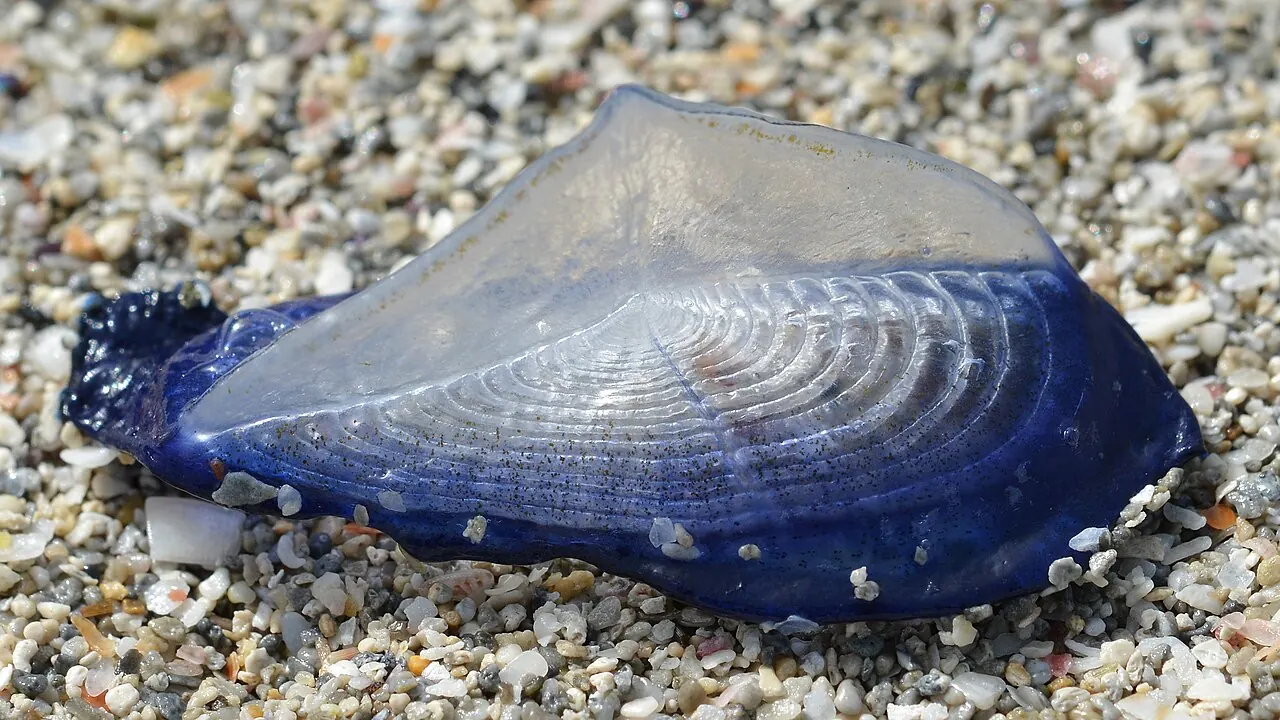
By-the-Wind Sailor
Velella velella
A small blue raft with a stiff sail that rides the wind at sea and, after warm winters, washes up along hundreds of miles of West Coast beach.
Photo: Ryan Hodnett / CC BY-SA 4.0
3 things to know
- Its sail is set at an angle, so the wind pushes it to one side of straight downwind.
- Left-angled sails are usually found in the Northern Hemisphere and right-angled ones in the Southern.
- Stranded ones dry out to the consistency of potato chips.
- Scientific name
- Velella velella
- Depth
- At the surface
- Size
- Float about 7–10 cm (3–4 in) long, with a sail about 5 cm (2 in) high
- Weight
- Unknown
- Lifespan
- Unknown
- Diet
- Plankton, mainly copepods; also fish eggs, krill eggs and other small drifting animals
- Where
- Surface of the open ocean; strands on beaches around the world, including the US West Coast
- IUCN status
- Not Evaluated
- Depth zones
- Sunlight
Velella velella spends its life on the surface film of the open ocean, with its sail in the air and its tentacles in the water. The body is a flat, oval float, bluish to purple and about 7 to 10 centimeters (3 to 4 inches) long, topped by a stiff, see-through sail roughly 5 centimeters (2 inches) high. Blue tentacles hang underneath and catch plankton, mostly copepods, along with fish eggs, krill eggs and other small drifting animals. Its stinging cells are rarely harmful to people.
It is related to jellyfish, corals and sea anemones, but it is not a true jellyfish; it is usually described as a floating hydroid colony. The National Park Service at Point Reyes, California, points out that the name oversells its skills. Velella does not steer. Its sail sits diagonally across the float, so the wind drives it at an angle: some sails angle left and carry the animal left of downwind, others angle right. Because of prevailing winds, the left-angled form is usually found in the Northern Hemisphere and the right-angled form in the Southern. Its few known predators include Glaucus sea slugs and Janthina purple snails, which also live at the surface.
When the wind turns onshore, by-the-wind sailors pile up on beaches, sometimes in the trillions. In a 2021 study in Marine Ecology Progress Series, Timothy Jones, Julia Parrish and Hillary Burgess of the University of Washington mined 20 years of beach surveys, 23,265 of them, made by volunteers in the COASST citizen-science program from Washington to northern California. Mass strandings showed up in 14 of those years, mostly in spring, with big runs in 2003 to 2006 and 2014 to 2019. In the later years, carcasses covered more than 1,000 kilometers (620 miles) of continuous coastline within a single two-week window between mid-March and mid-April. Strandings were more widespread after warmer-than-usual winters, which the team suggested let populations build up offshore before spring winds pushed them ashore. On the beach they quickly dry to the consistency of potato chips and their color fades to white.
It has not been assessed for the IUCN Red List.



