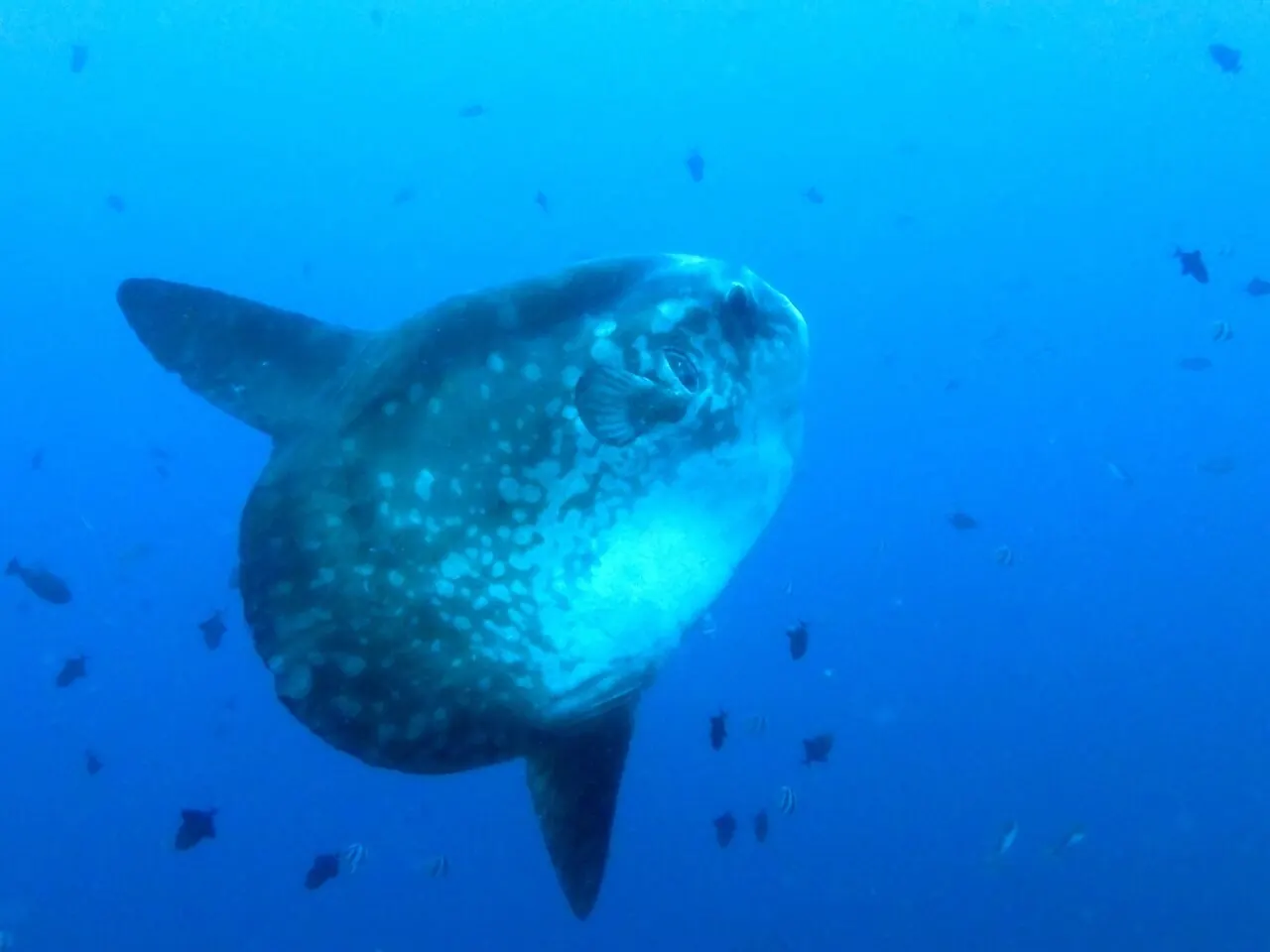
Bump-head Sunfish
Mola alexandrini
A giant, disk-shaped ocean sunfish with bumps on its head and chin, and the heaviest bony fish ever weighed.
Photo: Kai Squires / CC BY 4.0
3 things to know
- A bump-head sunfish found off the Azores in 2021 weighed 2,744 kilograms (about 6,050 pounds).
- The bumps on its head and chin develop as it grows.
- The smallest sunfish larva ever weighed was 3.7 milligrams.
- Scientific name
- Mola alexandrini
- Depth
- 0 m – 480 m
0 – 1,575 ft - Size
- Up to about 3.3 m (10.8 ft) long and 3.6 m (11.8 ft) tall from fin tip to fin tip
- Weight
- Record 2,744 kg (about 6,050 lb), the heaviest bony fish ever weighed
- Lifespan
- Unknown
- Diet
- Not well known for this species
- Where
- Warm and temperate oceans worldwide, except the polar regions
- IUCN status
- Not Evaluated
- Depth zones
- Sunlight · Twilight
As it grows, the bump-head sunfish develops a bulge on its forehead and another on its chin, among the marks that set it apart from its look-alike relatives. Like other ocean sunfishes, it is a deep, flattened disk of a fish, and a big one can be taller than it is long. The body ends at the back in a rounded flap called a clavus. Three species of Mola are recognized, and they can be hard to tell apart without a DNA test.
This species holds the record for the heaviest bony fish ever weighed. One found dead and floating near Faial Island in the Azores in December 2021 weighed 2,744 kilograms (about 6,050 pounds) and measured 3.25 meters (10.7 feet) long and 3.59 meters (11.8 feet) tall. José Nuno Gomes-Pereira's team needed a forklift and a crane to weigh it. The previous record, also a bump-head sunfish, was a 2,300-kilogram female caught in a set net off Kamogawa, Japan, in 1996.
Bump-head sunfish turn up in oceans around the world except near the poles, and they have been recorded down to 480 meters (1,575 feet). They seem to prefer warmer water than the common ocean sunfish, Mola mola: off Japan's Sanriku coast, they appear when the sea surface is 16.8 to 25.6°C (62 to 78°F). Little has been published on what this species eats. Its relative Mola mola feeds mainly 100 to 200 meters down by day, mostly on siphonophores, then returns to the surface to warm back up.
Sunfish grow from tiny beginnings. The smallest sunfish larva ever weighed came in at 3.7 milligrams, and Tierney Thys, a sunfish biologist, told Scientific American that the Azores giant represents a 700-million-fold gain over that. Thys also said Mola females release tens of millions of eggs at a time. How long bump-head sunfish live is unknown.
The IUCN has not yet assessed the bump-head sunfish, so it is listed as Not Evaluated, while Mola mola is listed as Vulnerable. The Azores record fish had a bruise near its head that may have come from a boat strike, but the scientists could not tell whether it happened before or after the fish died.



