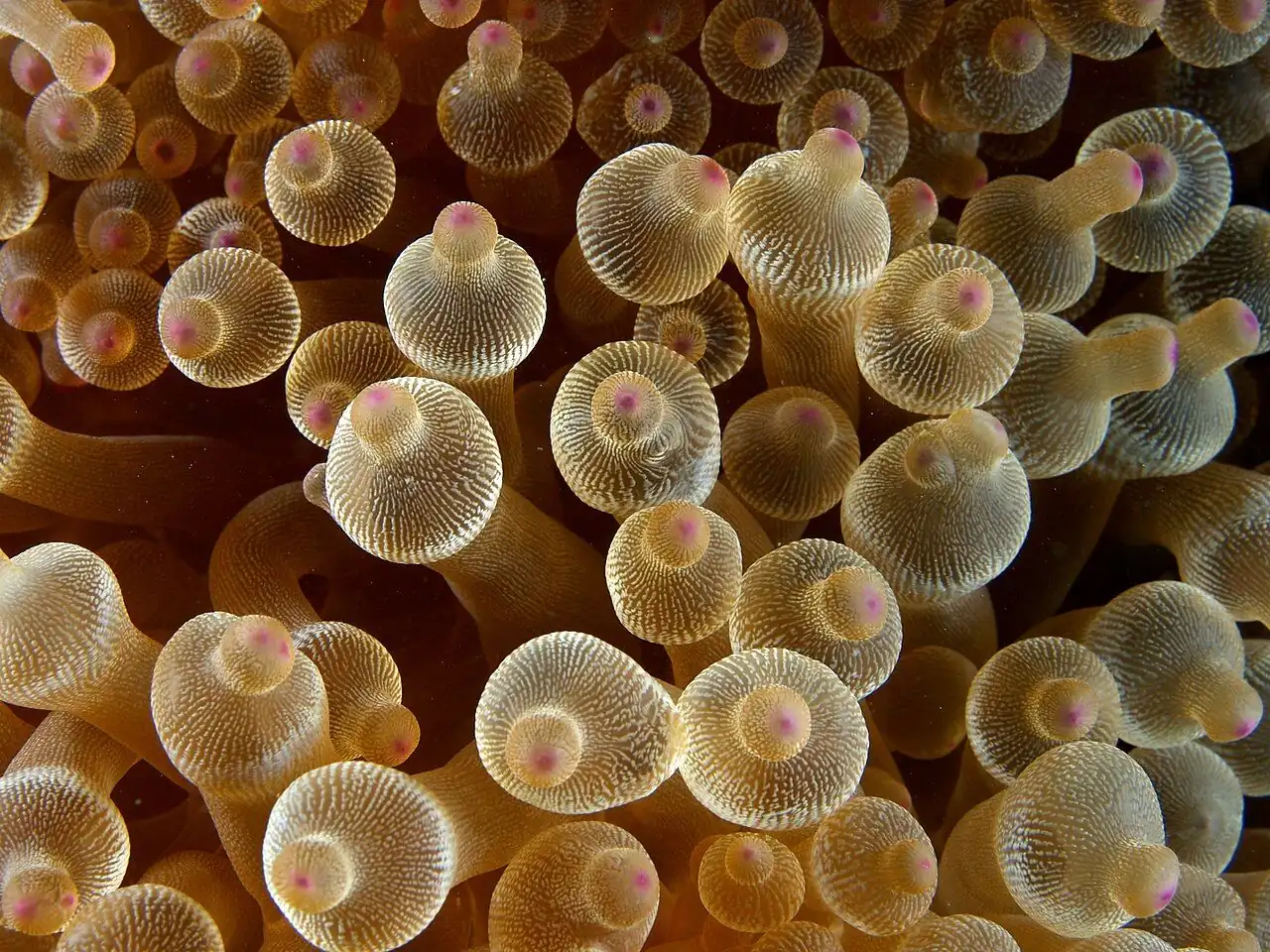
Bubble-Tip Anemone
Entacmaea quadricolor
A reef anemone with bulb-tipped tentacles that shelters 13 kinds of clownfish and is the only home of the spinecheek anemonefish.
Photo: Nick Hobgood / CC BY-SA 3.0
3 things to know
- The swollen bulbs on its tentacles may be absent, and have been linked to the presence of fish.
- The spinecheek anemonefish lives with no other anemone.
- Cut in half, most bubble-tip anemones survive and become two.
- Scientific name
- Entacmaea quadricolor
- Depth
- 0 m – 43 m
0 – 141 ft - Size
- Oral disc about 5 cm (2 in) across in shallow clusters, up to 40 cm (16 in) in large solitary anemones; tentacles up to about 10 cm (4 in)
- Weight
- Unknown
- Lifespan
- Unknown
- Diet
- Food made by algae living in its tissues
- Where
- Indo-Pacific, from the Red Sea and East Africa to Micronesia and Melanesia, and from Australia to Japan
- IUCN status
- Not Evaluated
- Depth zones
- Sunlight
On a bubble-tip anemone, many of the tentacles swell near the end into a round bulb, often with a red tip and a white band around its widest part. The tentacles reach about 10 centimeters (4 inches) and range from red to green to brown. The bulbs come and go. SeaLifeBase notes that they may be missing, leaving only a white ring where the bulb would be, and that they have been linked to the presence of fish. Usually only the tentacles show, because the anemone anchors its foot deep in a crevice or hole in the reef.
It is found across the Indo-Pacific, from the Red Sea and East Africa to Micronesia and Melanesia, and from Australia to Japan. Size depends on depth. In shallow water, small anemones with discs about 5 centimeters (2 inches) wide crowd together until they look like one field, while in deeper water single anemones grow to 40 centimeters (16 inches). Austin Dixon, Nanette Chadwick and colleagues surveyed it from the surface to 43 meters (141 feet) on a reef at Aqaba, Jordan, and found it most abundant at middle depths on the reef slope. Shallow anemones sat in shade; deeper ones carried four times as many algae in their tentacles, which helps them use the dimmer light. Those algae make food for it.
It is one of the busiest clownfish hosts. The Oregon Coast Aquarium says it shelters 13 species of anemonefish, and an analysis by Jeff Ollerton, Daphne Fautin, Gerald Allen and colleagues called it highly generalist, though it partners with only about half of the clownfish species even where their ranges overlap. One fish depends on it completely: the spinecheek anemonefish, long known as Premnas biaculeatus and listed by FishBase as Amphiprion biaculeatus, lives only in bubble-tip anemones.
Bubble-tips have separate sexes and spawn during a yearly breeding season, each female releasing several thousand eggs. They can also split lengthwise into two. Because host anemones fetch high prices in the aquarium trade, Anna Scott and colleagues at Southern Cross University in New South Wales, Australia, tested cutting them up on purpose. In two experiments published in 2014, 89 to 94% of anemones cut in half survived, as did 63 to 80% of those cut in quarters, which suggested farmed clones could supply aquariums or restock reefs.
The species has not been assessed for the IUCN Red List.
Sources
- sealifebase.se/summary/Entacmaea-quadricolor.html
- aquarium.org/animals/bubble-tip-anemone
- Study: doi:10.1017/S0025315413001719
- Study: doi:10.1098/rspb.2006.3758
- pmc.ncbi.nlm.nih.gov/articles/PMC1766375
- repository.naturalis.nl/pub/319315/ZM1997071017.pdf
- pmc.ncbi.nlm.nih.gov/articles/PMC4196916
- fishbase.se/summary/Premnas-biaculeatus.html
- api.gbif.org/v1/species/4339208/iucnRedListCategory



