Bryde's Whale
Balaenoptera edeni
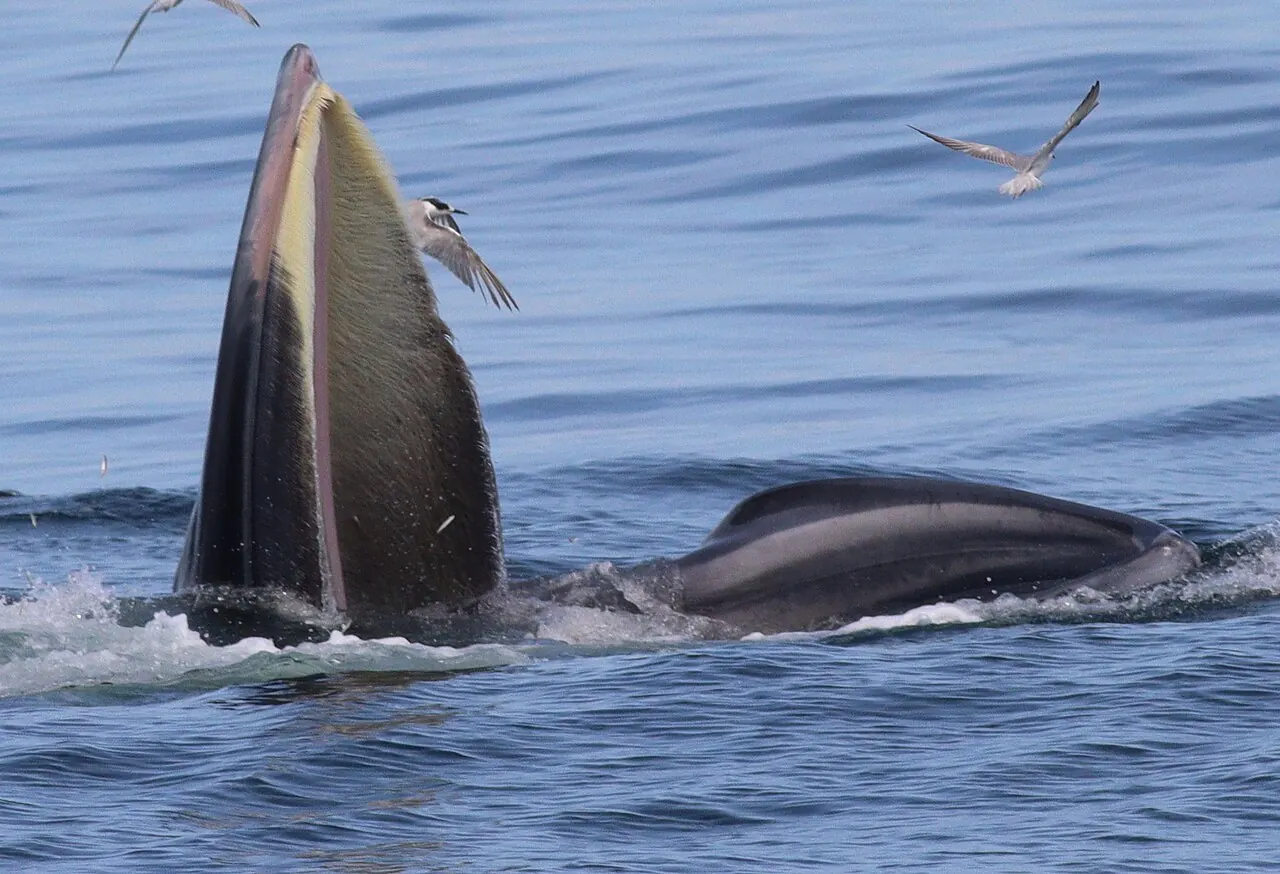
A warm-water baleen whale, pronounced 'broodus', that in the Gulf of Thailand feeds by holding its mouth open at the surface.
Photo: Jan Ebr / CC BY 4.0
3 things to know
- It has three ridges on top of its head, where most rorquals have one.
- Some populations migrate with the seasons and others stay put all year.
- In the Gulf of Thailand it hangs upright with its jaws open and lets anchovies pour in.
- Scientific name
- Balaenoptera edeni
- Depth
- 0 m – 300 m
0 – 984 ft - Size
- About 12–17 m (40–55 ft) long
- Weight
- About 41 metric tons (90,000 lb)
- Lifespan
- Unknown; sexually mature at about 9 years
- Diet
- Schooling fish such as anchovies, herring, mackerel, pilchards and sardines, plus krill, copepods, red crabs and shrimp
- Where
- Tropical, subtropical and warm temperate waters of the Atlantic, Indian and Pacific oceans, between about 40° south and 40° north
- IUCN status
- Least Concern
- Depth zones
- Sunlight · Twilight
Bryde's is pronounced "broodus." The whale is named for Johan Bryde, a Norwegian who built the first whaling stations in South Africa in the early 1900s. It looks like a smaller sei whale, but it has three prominent ridges on top of its head in front of the blowhole, where other rorquals have one. The head makes up about a quarter of the body. Adults are 12 to 17 meters (40 to 55 feet) long and weigh about 41 metric tons (90,000 pounds).
This is a warm-water whale, found in tropical, subtropical and warm temperate seas between about 40° south and 40° north. Some populations move with the seasons and others stay in one area all year, unusual among baleen whales. They spend most of the day within about 15 meters (50 feet) of the surface, but can dive to around 300 meters (1,000 feet). They eat anchovies, herring, mackerel, pilchards, sardines, krill, copepods, red crabs and shrimp, and feed by skimming, lunging and blowing bubble nets. In the central and western North Pacific they make a complex call known as the biotwang.
NOAA describes two forms: a smaller Eden's whale living mainly in coastal waters of the Indian and western Pacific oceans, and a larger Bryde's whale living mostly offshore. Researchers are still debating whether they are separate species. A third group, the whales of the Gulf of Mexico, was named a species of its own in 2021, Rice's whale, after genetic and skull studies. Fewer than 100 Rice's whales are likely left, and they are listed as endangered. Bryde's whales as a whole are listed as Least Concern by the IUCN. They are the third most commonly reported whale struck by vessels in the Southern Hemisphere, and some are still hunted under Japan's research whaling program.
In the upper Gulf of Thailand, Bryde's whales lunge after anchovies like other rorquals, but they also feed in a way researchers had not described before. A whale lifts its head above the surface, opens its mouth until the lower jaw touches the water, and holds still for several seconds while confused anchovies flow in on the current. Takashi Iwata and colleagues watched this 58 times, by 31 whales including eight mothers with calves, and in 2017 named it tread-water feeding. A tag on one whale showed it beating its tail fast to keep its head up.



