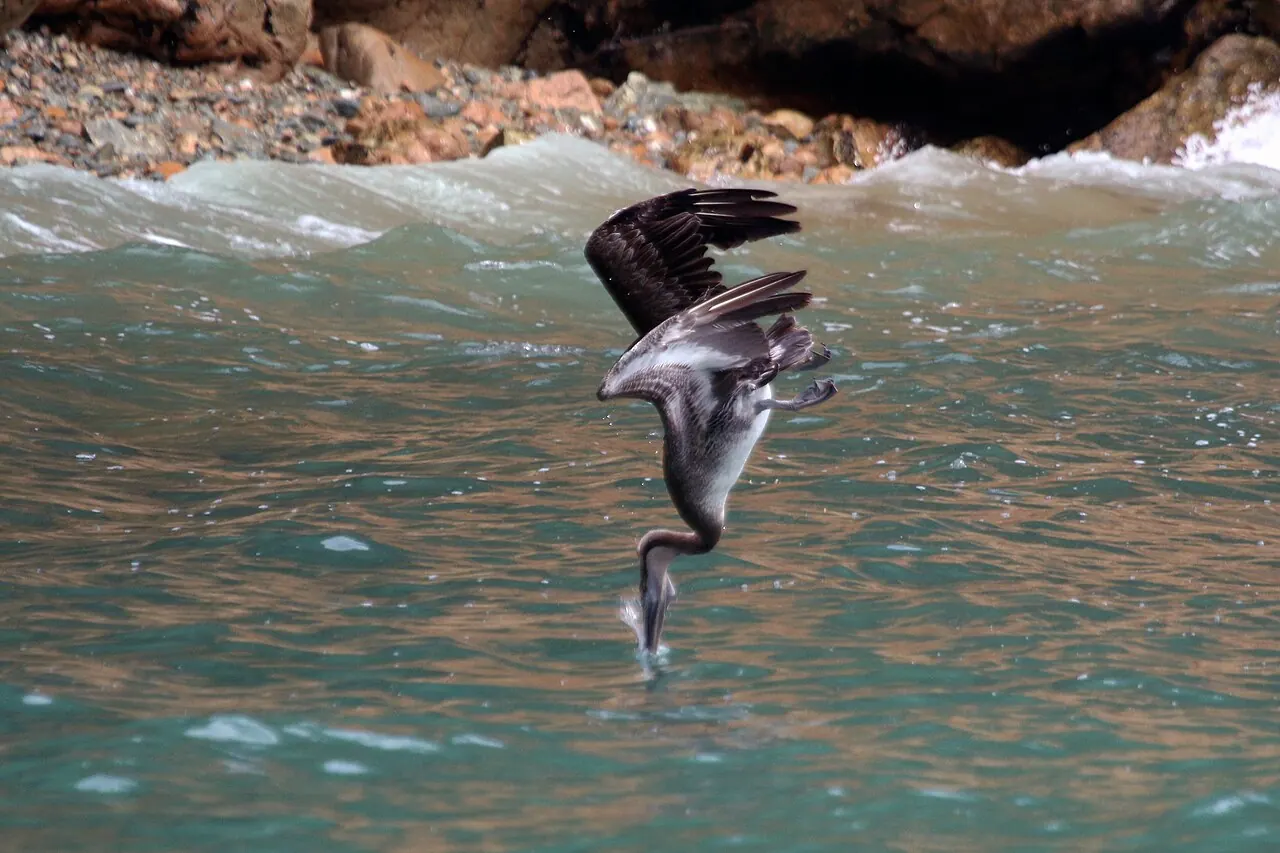
Brown Pelican
Pelecanus occidentalis
A coastal pelican that dives on fish from the air, nearly wiped out in the US by DDT and taken off the endangered list in 2009.
Photo: Charles J. Sharp / CC BY-SA 4.0
3 things to know
- It dives on fish from as high as about 18 m (60 ft) above the water.
- Louisiana lost all its brown pelicans by 1963 and restocked them with chicks from Florida.
- It was removed from the US endangered species list in 2009, 39 years after it was first listed.
- Scientific name
- Pelecanus occidentalis
- Depth
- 0 m – 9 m
0 – 30 ft - Size
- About 1–1.4 m (3.3–4.5 ft) long, with a wingspan of about 2 m (6.6 ft)
- Weight
- 1.8–4 kg (4–8.8 lb)
- Lifespan
- Up to about 30 years in the wild
- Diet
- Almost entirely fish, such as menhaden, mullet, sardines and anchovies; some crustaceans
- Where
- Coasts of the Americas: the US Atlantic and Gulf coasts, the Caribbean and West Indies south to Venezuela, and the Pacific from British Columbia to northern Peru, including the Galápagos
- IUCN status
- Least Concern
- Depth zones
- Sunlight
All eight pelican species scoop fish from the surface, but only the brown pelican and its sister species, the Peruvian pelican, also dive on them from the air. Adults are about 1 to 1.4 meters (3.3 to 4.5 feet) long, with wings spanning about 2 meters (6.6 feet), and weigh 1.8 to 4 kilograms (4 to 8.8 pounds). It has a very long bill with a stretchy throat pouch. Adults are grayish brown with a lot of white on the head and neck, and they first breed at about four years old.
A hunting pelican flies over the water, sometimes as high as 18 meters (60 feet), and drops bill-first on fish near the surface. Using high-speed cameras in Belize and the southern US, Wesley Shoop and Eric Tilson found that pelicans often roll upside down on the way down, hit the water inverted, then swing through a shallow half-loop and come up facing the way they came. In a 2022 paper they compared the move to the Split-S, a fighter-pilot maneuver for attacking a target below. Most of the underwater part happened at the surface, wing tips often still in the air. The National Park Service says pelicans can dive as deep as 9 meters (30 feet), but the dives Shoop and Tilson describe were far shallower.
Brown pelicans nest in large colonies on islands, either bare and rocky or covered with mangroves or other trees. A clutch is usually three eggs, sometimes two to four, and both parents incubate them for 28 to 30 days. Chicks first fly at roughly 9 to 12 weeks, and adults can live up to 30 years in the wild.
From the 1950s to the early 1970s, pesticides built up in the fish the pelicans ate. DDE, a breakdown product of DDT, interferes with calcium deposition as the eggshell forms, and thin shells cracked under incubating parents. By 1963 the brown pelican had disappeared from Louisiana, and in 1970 it was declared endangered. Between 1968 and 1980, 1,276 nestlings were moved from Florida to coastal Louisiana, and after the US banned DDT in 1972, numbers climbed. The US Fish and Wildlife Service took the Atlantic Coast, Florida and Alabama populations off the endangered list in 1985 and the rest of the species in 2009, citing a global population of more than 620,000 birds. The IUCN lists the brown pelican as Least Concern.



