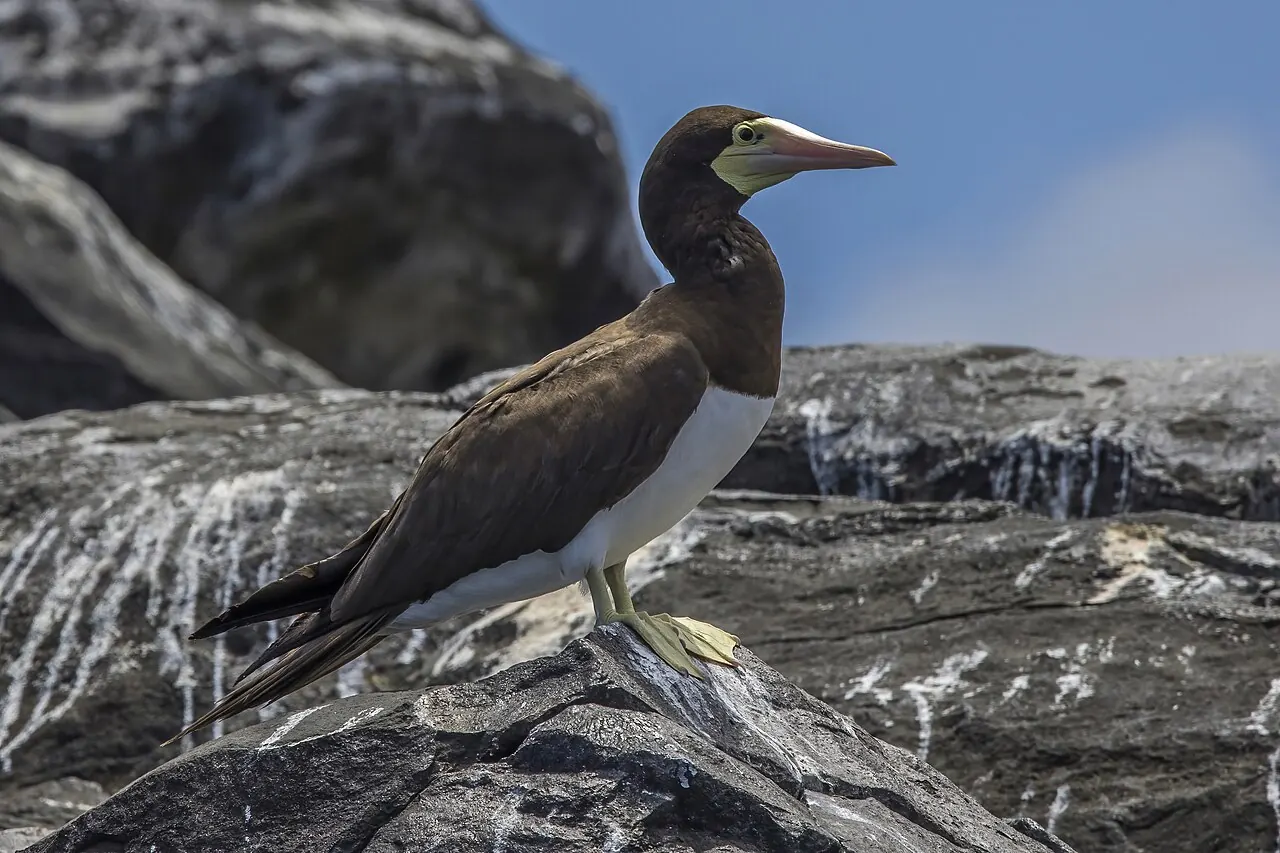
Brown Booby
Sula leucogaster
A tropical plunge-diving seabird that pushed its breeding range north and began nesting in California's Channel Islands in 2017.
Photo: Charles J. Sharp / CC BY-SA 4.0
3 things to know
- Its dives are short and shallow, averaging about 1 m (3 ft) deep in one study.
- Brown boobies first nested in Channel Islands National Park, California, in 2017.
- Of the ground-nesting boobies, it is the only one that regularly builds a substantial nest.
- Scientific name
- Sula leucogaster
- Depth
- 0 m – 4 m
0 – 13 ft - Size
- About 76–84 cm (30–33 in) long, with a wingspan of 1.4–1.5 m (4.5–5 ft)
- Weight
- About 1.3–2 kg (2.9–4.4 lb)
- Lifespan
- Adults typically 25–30 years; the oldest known bird was 32
- Diet
- Mainly fish and squid, such as flying fish, mullet, anchovies and sardines
- Where
- Tropical and subtropical oceans worldwide; nests in Hawaii and, since 2017, on Sutil Island in California's Channel Islands
- IUCN status
- Least Concern
- Depth zones
- Sunlight
Brown boobies are sharply two-toned: chocolate brown on the head, neck, back and wings, and clean white on the belly, with a yellowish bill and bright yellow feet. Adults are 76 to 84 centimeters (30 to 33 inches) long with wings up to 1.5 meters (5 feet) across, and females are slightly larger than males. Like all boobies and pelicans, they have webbing between all four toes.
They breed on tropical islands around the world and feed over warm seas, often where currents meet or water wells up and prey bunches together. Fishing is fast and shallow. A booby usually plunges in at an angle from low over the water, sometimes several times in quick succession; it also chases flying fish in the air and flies beside boats to grab fish fleeing the bow. When Ken Yoda and Hiroyoshi Kohno put data loggers on brown boobies raising chicks on Nakanokamishima Island, Japan, the average dive went about 1 meter (3 feet) deep and lasted under 2 seconds. The deepest reached 3.8 meters (12.5 feet).
Pairs lay one or two eggs, and when two chicks hatch the second rarely survives. Young birds keep coming back to the nest to beg for weeks after their first flight. A bird in Queensland, Australia, reached 32.2 years, the oldest on record, though Vincent Yap and colleagues suggest 25 to 30 years is a typical adult lifespan.
In the United States the brown booby was long known as a visitor around Florida's Dry Tortugas and a breeder in Hawaii. That changed in California. Channel Islands National Park recorded the species just 16 times between 1984 and 2014, then counted more than 170 at Santa Barbara Island in 2015. On November 3, 2017, biologists found four nests among 102 birds on tiny Sutil Island, and on August 24, 2019, they confirmed the park's first chick. The closest colony is on Mexico's Coronado Islands, which the birds reached after moving north from the Gulf of California in the 1990s, a shift the park links to warmer water and changing prey.
Worldwide, Cornell's All About Birds says the population is likely 90 percent lower than a century ago. Introduced rats, cats and other predators on nesting islands are a major cause. The IUCN lists the species as Least Concern, with a decreasing trend.
Sources
- allaboutbirds.org/guide/Brown_Booby/overview
- allaboutbirds.org/guide/Brown_Booby/lifehistory
- audubon.org/field-guide/bird/brown-booby
- Study: doi:10.2326/1347-0558(2008)7[5:PBICBB]2.0.CO
- digitalcommons.usf.edu/marine_ornithology/vol49/iss1/25
- nps.gov/chis/learn/news/pr110717.htm
- nps.gov/chis/learn/news/pr082919.htm
- nps.gov/articles/from-rare-visitor-to-breeding-resident.htm
- iucnredlist.org/species/22696698/132590197



