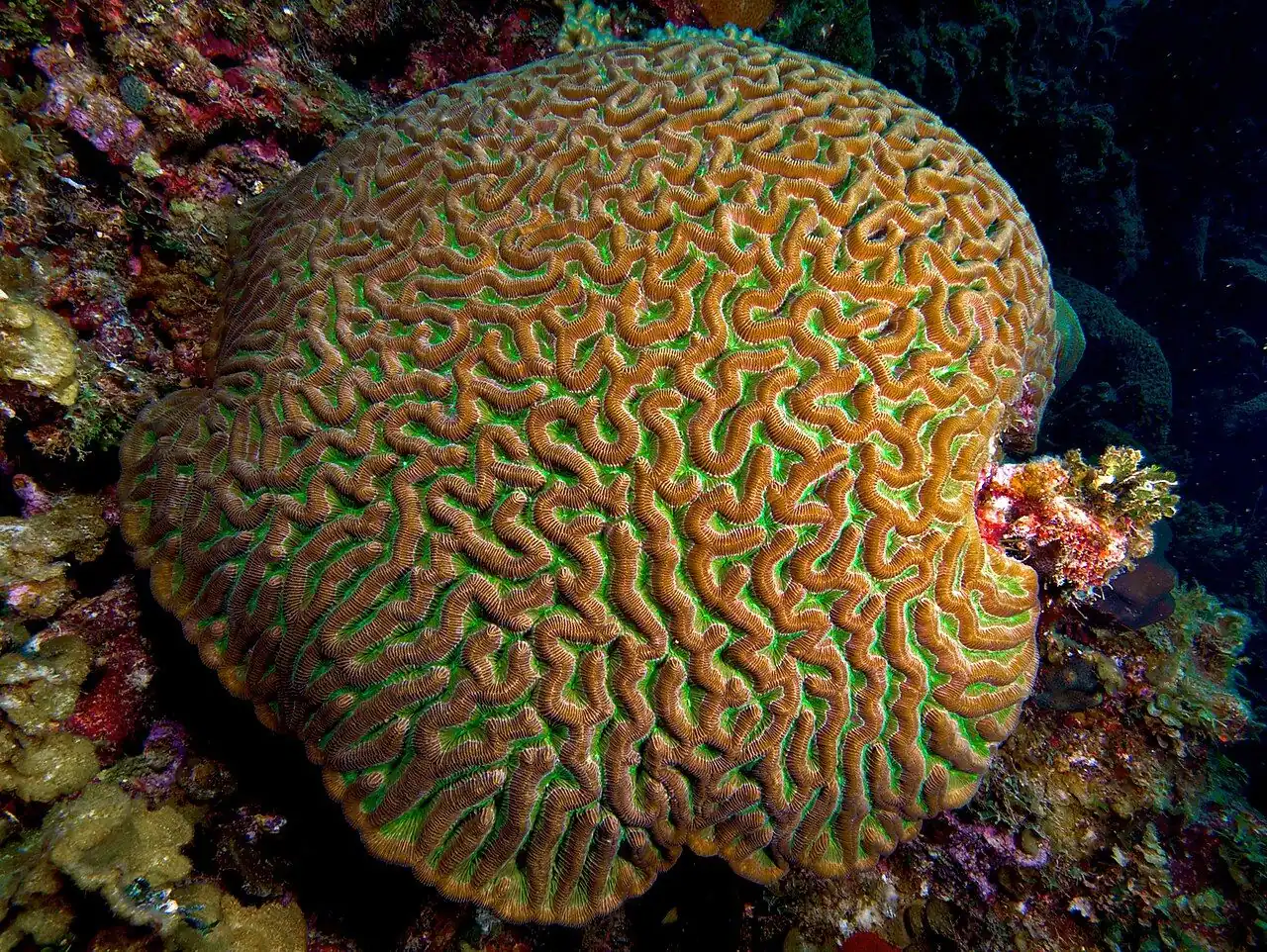
Brain Coral
Several genera, mainly in the families Faviidae (Atlantic) and Merulinidae (Indo-Pacific)
Slow-growing, dome-shaped reef corals with maze-like grooves. Some colonies live for centuries, and Florida's are hard hit by disease.
Photo: Nick Hobgood / CC BY-SA 3.0
3 things to know
- NOAA says brain corals can grow 6 feet (1.8 m) tall and live up to 900 years.
- Their polyps share connected tissue, so nutrients and disease both travel easily across a colony.
- Stony coral tissue loss disease, first reported off Miami in 2014, has affected more than 20 of Florida's roughly 45 reef-building coral species, brain corals among them.
- Scientific name
- Several genera, mainly in the families Faviidae (Atlantic) and Merulinidae (Indo-Pacific)
- Depth
- 0 m – 55 m
0 – 180 ft - Size
- Colonies can grow about 1.8 m (6 ft) tall
- Weight
- Unknown
- Lifespan
- Up to about 900 years, according to NOAA
- Diet
- Food made by algae living in their tissues
- Where
- Tropical reefs of the western Atlantic, Caribbean and Indo-Pacific
- IUCN status
- Varies by species (grooved and symmetrical brain corals Critically Endangered; boulder brain coral Vulnerable)
- Depth zones
- Sunlight
Brain coral is a name for a shape, shared by several kinds of stony coral. The colonies grow as domes or boulders covered in winding ridges and valleys that look like the folds of a brain. In the Caribbean the best known are grooved brain coral (Diploria labyrinthiformis), symmetrical brain coral (Pseudodiploria strigosa) and boulder brain coral (Colpophyllia natans). In the Indian and Pacific oceans, brain-like Platygyra corals belong to a different family.
Their polyps are unusually closely joined. In brain corals, the tissue of neighboring polyps runs together without skeleton walls between them, NOAA's National Ocean Service explains. That lets a colony pass nutrients, hormones and oxygen from polyp to polyp, but it also means a disease that reaches one polyp can spread quickly across the rest. Like other reef-building corals, brain corals get much of their food from algae living in their tissues, which also give them their color.
They grow slowly but build massive, strong structures that act as foundations for reefs. According to NOAA, brain corals can grow 6 feet (1.8 meters) tall and live for up to 900 years. The Caribbean species have been recorded from the surface down to about 45 to 55 meters (150 to 180 feet).
Disease has hit them hard in Florida. Stony coral tissue loss disease was first reported in the fall of 2014 near Virginia Key, off Miami-Dade County. It has since spread along Florida's reef and into the Caribbean, affecting more than 20 of the roughly 45 species of reef-building corals in Florida. Within some species, 66 to 100 of every 100 colonies surveyed showed the disease. The Florida Keys National Marine Sanctuary has published images of the disease spreading rapidly across a symmetrical brain coral, and the sanctuary says the search for the cause is ongoing. Brain corals also bleach in marine heat waves, and NOAA lists black band disease, white plague and bleaching among the causes of mass deaths.
Their status depends on the species. In the IUCN's most recent assessments, made in 2021, grooved and symmetrical brain corals are Critically Endangered, boulder brain coral is Vulnerable and knobby brain coral (Pseudodiploria clivosa) is Near Threatened. The Indo-Pacific Platygyra daedalea was assessed as Least Concern in 2023.
Sources
- oceanservice.noaa.gov/facts/brain-coral.html
- floridakeys.noaa.gov/coral-disease/disease.html
- floridadep.gov/rcp/coral/content/stony-coral-tissue-loss-disease-response
- floridakeys.noaa.gov/coral-bleaching-faqs.html
- sealifebase.se/summary/Diploria-labyrinthiformis.html
- sealifebase.se/summary/Pseudodiploria-strigosa.html
- sealifebase.se/summary/Colpophyllia-natans.html
- sealifebase.se/summary/Platygyra-daedalea.html
- api.gbif.org/v1/species/8377035/iucnRedListCategory
- marinespecies.org/aphia.php
- iucnredlist.org/species/133257/165799250
- iucnredlist.org/species/133155/165745174
- iucnredlist.org/species/132884/165613226
- iucnredlist.org/species/133377/165857974
- iucnredlist.org/species/133468/165905286



