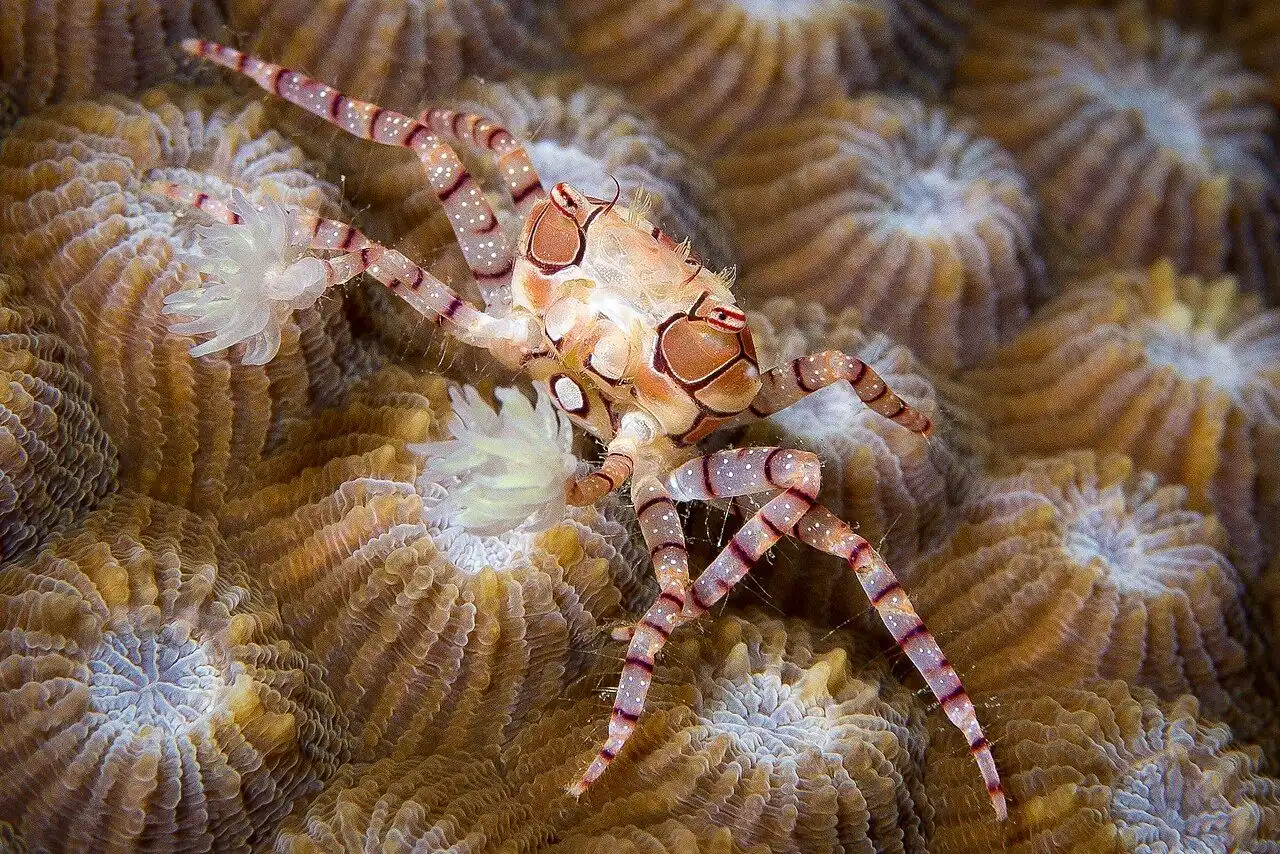
Boxer Crab
Lybia spp. (genus Lybia, family Xanthidae)
Tiny reef crabs that carry a sea anemone in each claw, use them to gather food and will split one in two if they lose the other.
Photo: Eliot Ferguson / CC BY-SA 3.0
3 things to know
- Boxer crabs hold a small sea anemone in each claw, like pom-poms.
- A crab that loses one anemone tears the other in half, and both halves regrow.
- Hawaii has its own species, found nowhere else, called kūmimi pua, or inedible flower crab.
- Scientific name
- Lybia spp. (genus Lybia, family Xanthidae)
- Depth
- 1 m – 30 m
3 – 98 ft - Size
- Small; the Hawaiian pom-pom crab grows to about 25 mm (1 in)
- Weight
- Unknown
- Lifespan
- Unknown
- Diet
- Small prey and food particles, much of it taken from the anemones they carry; the Hawaiian species also eats detritus
- Where
- Shallow warm reefs of the Indo-Pacific, including the Red Sea, East Africa and Hawaii
- IUCN status
- Not Evaluated (for the species we checked)
- Depth zones
- Sunlight
A boxer crab goes almost everywhere with a tiny sea anemone in each claw, held up like boxing gloves or a cheerleader's pom-poms. The crabs belong to the genus Lybia, small reef crabs of the Indo-Pacific, and the partnership appears to be obligatory, at least for the crab. The anemones help with food. The Aquarium of the Pacific says the crabs use them to sting and stun prey, then take the catch for themselves.
Hawaii has a species found nowhere else, Lybia edmondsoni, which grows to about 25 millimeters (1 inch). It hides in rubble, among rocks and under coral in shallow water, and SeaLifeBase records it down to 30 meters (98 feet). Its Hawaiian name, kūmimi pua, means "inedible flower crab," and its anemones are usually Triactis producta. Lybia tessellata, another species, lives on reefs from Somalia to Madagascar and the Cocos Islands.
The crabs control their partners closely. In 2013, Yisrael Schnytzer and colleagues showed that boxer crabs regulate how much food their anemones get and so keep them small, which the team described as "bonsai" anemones. In a 2017 study in PeerJ, the same Israeli group worked with Lybia leptochelis from Eilat on the Red Sea, whose Alicia anemones have never been found living on their own. When the researchers took one anemone away, the crab tore the remaining one into two similar halves, and each grew back into a complete anemone. A crab with no anemones, put together with one carrying a pair, fought it and almost always stole a whole anemone or a piece, then split that too. DNA fingerprinting showed that the two anemones in a crab's claws were genetically identical, as were most pairs held by different crabs. The authors describe this as a unique case of one animal making another reproduce asexually.
Females of the Hawaiian species carry their eggs for 13 to 15 days, and the young start life drifting as plankton before settling on the bottom. How long boxer crabs live is unknown, and none of the species we checked has been assessed by the IUCN.
Sources
- Study: doi:10.7717/peerj.2954
- Study: doi:10.1016/j.jembe.2013.07.011
- aquariumofpacific.org/onlinelearningcenter/species/pom_pom_crab
- sealifebase.se/summary/Lybia-edmondsoni.html
- sealifebase.se/summary/Lybia-tessellata.html
- api.gbif.org/v1/species/4377870/iucnRedListCategory
- marinespecies.org/aphia.php
- en.wikipedia.org/wiki/Lybia



