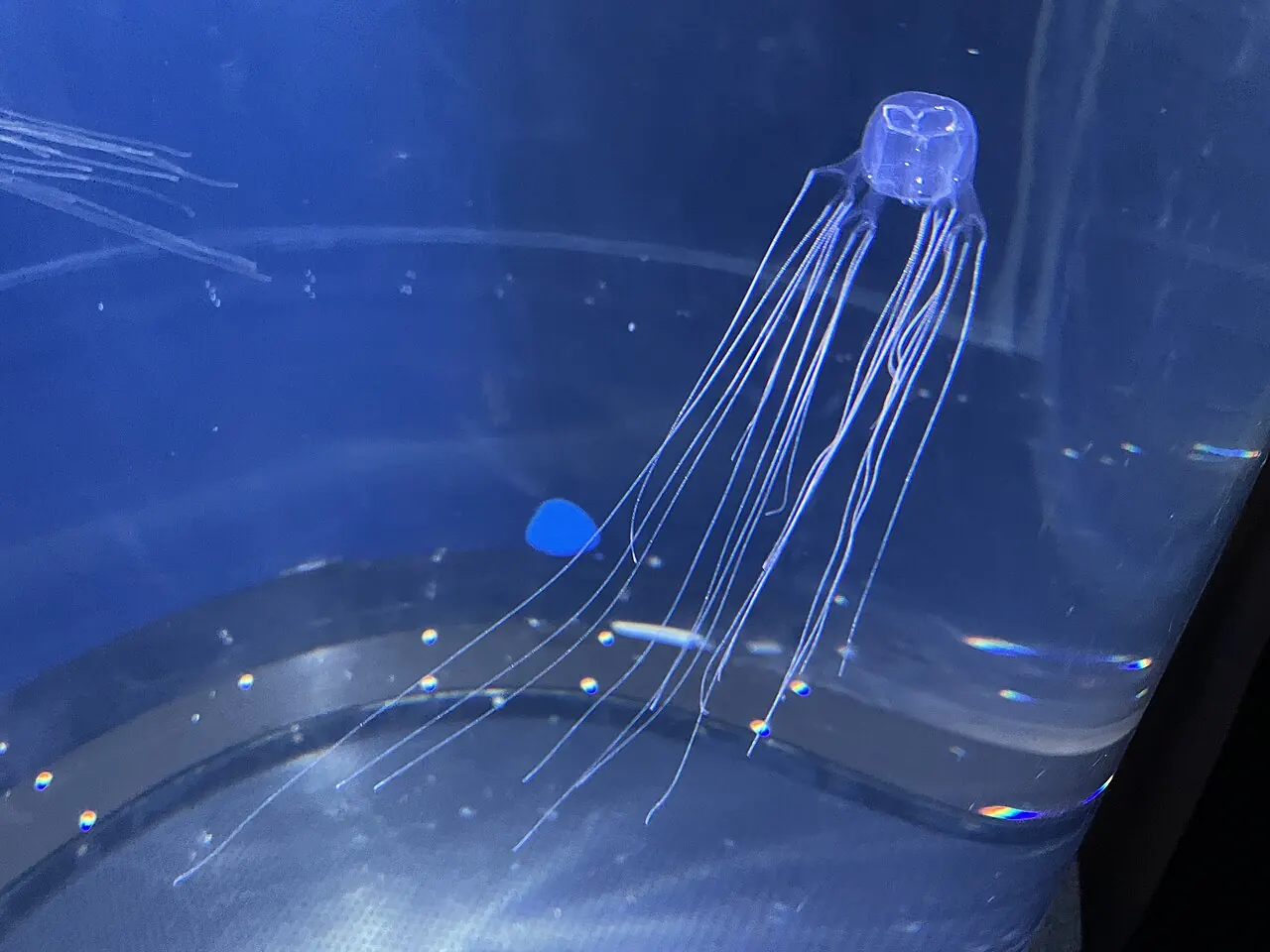
Box Jellyfish
Chironex fleckeri
A nearly see-through jellyfish of northern Australian coasts whose sting can kill within minutes, and which swims and steers using 24 eyes.
Photo: Totti / CC BY-SA 4.0
3 things to know
- It has 24 eyes in four clusters, and some of them have lenses.
- Unlike most jellyfish, it swims instead of drifting, at up to about 4 knots (7 km/h).
- In a 13-year study in Australia's Northern Territory, 83% of confirmed stings happened in water 1 m (3 ft) deep or less.
- Scientific name
- Chironex fleckeri
- Depth
- 0 m – 5 m
0 – 16 ft - Size
- Bell usually 16–24 cm (6–9 in) across, occasionally up to 35 cm (14 in); tentacles up to about 3 m (10 ft)
- Weight
- Up to about 2 kg (4.4 lb)
- Lifespan
- Probably under a year
- Diet
- Prawns and small fish
- Where
- Coastal waters of northern Australia, Papua New Guinea, the Philippines and Vietnam
- IUCN status
- Not Evaluated
- Depth zones
- Sunlight
Chironex fleckeri is close to invisible in the water. Its pale, see-through bell is shaped like a box, usually 16 to 24 centimeters (6 to 9 inches) across and occasionally 35 centimeters (14 inches). From each of its four corners hangs a bunch of up to 15 tentacles, as many as 60 in all, and each can stretch to about 3 meters (10 feet). The tentacles carry millions of nematocysts, microscopic stinging capsules.
It lives along the coasts of northern Australia and north to Papua New Guinea, the Philippines and Vietnam, usually in shallow water around creeks and mangrove outlets, and mature adults stay near shore in water less than 5 meters (16 feet) deep. Each one starts life as a polyp only 1 to 2 millimeters across, stuck to the underside of a rock in a river or mangrove channel. The polyp turns into a small medusa that travels to the sea and grows. Adults spawn in rivers and die soon afterward, so a box jellyfish probably lives less than a year.
Unlike most jellyfish, it swims rather than drifts, at up to about 4 knots, and it catches prawns and small fish with its tentacles. It has no brain, but it has 24 eyes in four clusters, and it steers away from dark shapes. Dan-Eric Nilsson and colleagues reported in 2005 that box jellyfish lenses are finely tuned to form a nearly flawless image, though the retina does not sit where that image is sharp.
The sting has caused more than 60 deaths in a century, most of them children and young adults. When Bart Currie and Susan Jacups of the Menzies School of Health Research in Darwin followed jellyfish stings in Australia's Northern Territory from 1991 to 2004, they confirmed 225 as Chironex stings. Most were not life-threatening, and 83% happened in water a meter (3 feet) deep or less. Those who die, the authors wrote, usually suffer cardiopulmonary arrest within minutes. Queensland's government tells anyone stung to call an ambulance and pour vinegar on the sting, and to swim inside stinger nets where they are provided.
Hawaii has box jellyfish too, but a different species, Alatina alata. Angel Yanagihara's team at the University of Hawaiʻi has long tracked how they gather on Oʻahu's leeward shores to spawn, 8 to 10 days after each full moon. The IUCN has not assessed Chironex fleckeri.
Sources
- animaldiversity.org/accounts/Chironex_fleckeri
- sealifebase.se/summary/Chironex-fleckeri.html
- en.wikipedia.org/wiki/Chironex_fleckeri
- Study: doi:10.5694/j.1326-5377.2005.tb00062.x
- Study: doi:10.1038/nature03484
- qld.gov.au/emergency/safety/dangerous-marine
- hawaii.edu/news/2022/05/25/lunar-cycle-jellyfish-spawn



