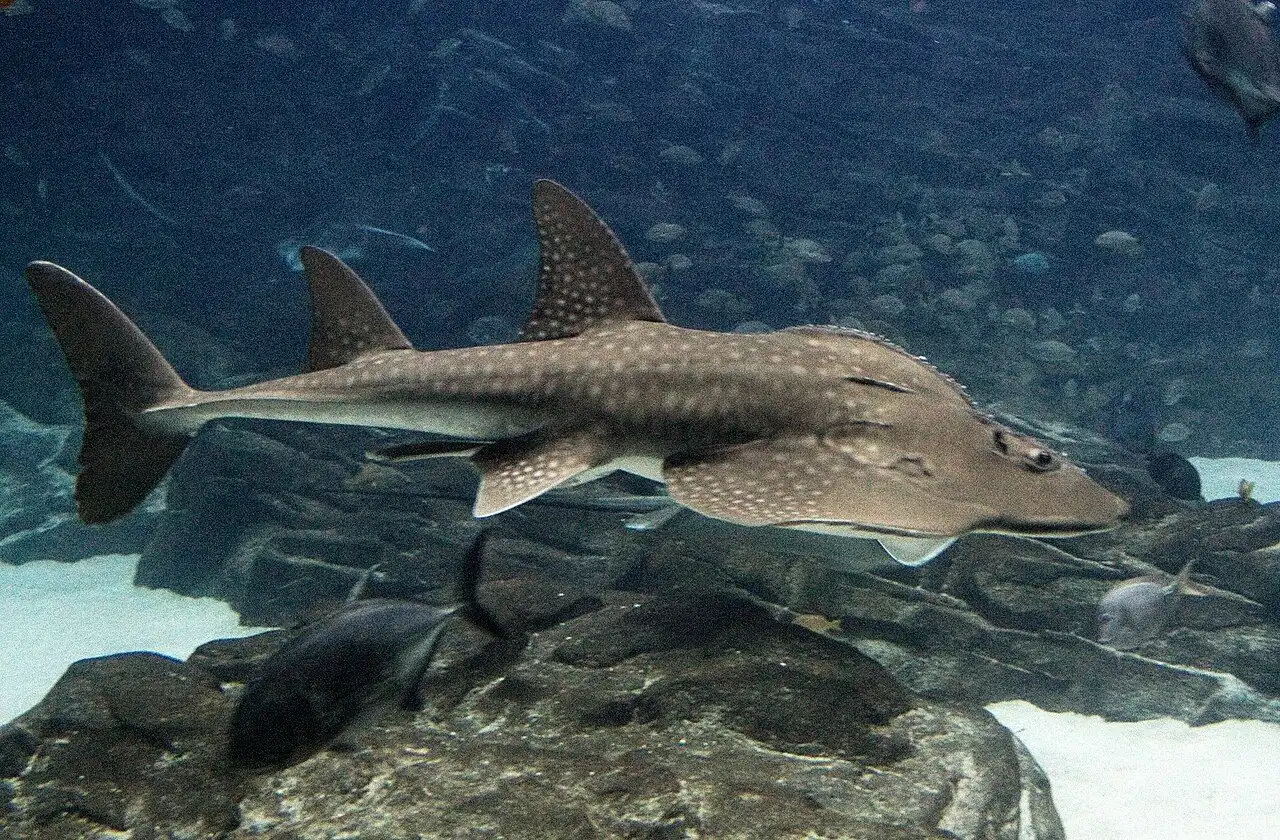
Bowmouth Guitarfish
Rhina ancylostomus
A spotted, thorn-ridged ray built like a shark, from the Indo-West Pacific, now Critically Endangered by fishing for meat and fins.
Photo: Brian Gratwicke / CC BY 2.0
3 things to know
- Ridges of large thorns over its eyes and shoulders can be used for butting.
- Its jaws are lined with ridged, crushing teeth set in wavy rows.
- Its family, the wedgefishes, and the giant guitarfishes are now the most threatened marine fish families on Earth.
- Scientific name
- Rhina ancylostomus
- Depth
- 3 m – 90 m
10 – 295 ft - Size
- Up to about 3 m (9.8 ft) long
- Weight
- Up to 135 kg (298 lb)
- Lifespan
- Unknown
- Diet
- Bottom fishes such as croakers, crabs, prawns, bivalves and cephalopods
- Where
- Tropical Indo-West Pacific, from South Africa and the Red Sea to Japan and Australia
- IUCN status
- Critically Endangered
- Depth zones
- Sunlight
From the front, a bowmouth guitarfish looks like a ray, with a broad, rounded snout and big, high pectoral fins. From behind it looks like a shark, with two tall dorsal fins and a large tail. Heavy ridges of spiky thorns run over its eyes, along the middle of the nape and across the shoulders, and FishBase notes that these spines are defensive and can be used for butting. It is gray or brownish above, with numerous white spots on the body, fins and tail, with black spots on the head and shoulders. The largest reach about 3 meters (9.8 feet) and 135 kilograms (298 pounds). It is also called the shark ray.
Bowmouths live in the tropical Indo-West Pacific, from South Africa and the Red Sea to Japan and Australia, along coasts and on offshore coral reefs, usually over sand and mud between 3 and 90 meters (10 and 295 feet) deep, and sometimes swim up into the water column. Its jaws hold heavily ridged, crushing teeth set in wavy rows, and it eats bottom fish such as croakers, along with crabs, prawns, bivalves and cephalopods.
Pups develop inside the mother, first on yolk and then on a nourishing uterine fluid, and are born about 45 centimeters (18 inches) long in litters of 2 to 11. They mature at roughly 1.5 to 1.8 meters (5 to 6 feet) long. How long they live is unknown.
The bowmouth belongs to the wedgefishes, family Rhinidae. In a 2020 study, Peter Kyne of Charles Darwin University in Australia and colleagues applied the IUCN's criteria to all 10 wedgefishes and the 6 giant guitarfishes. These rays have overtaken sawfishes as the most threatened marine fish families in the world, and all but one of the 16 species face an extremely high risk of extinction. Their shallow habitat overlaps some of the world's most intense coastal fisheries, driven by demand for meat and the trade in high-value "white" fins. Bowmouths are caught commonly in bottom tangle nets and sometimes in trawls and on longlines, and trawl crews find them a nuisance because their rough, spiky bodies are hard to handle and can damage the rest of the catch.
The IUCN's 2018 assessment lists the bowmouth guitarfish as Critically Endangered, with a decreasing population, and international trade in it is monitored under CITES Appendix II.



