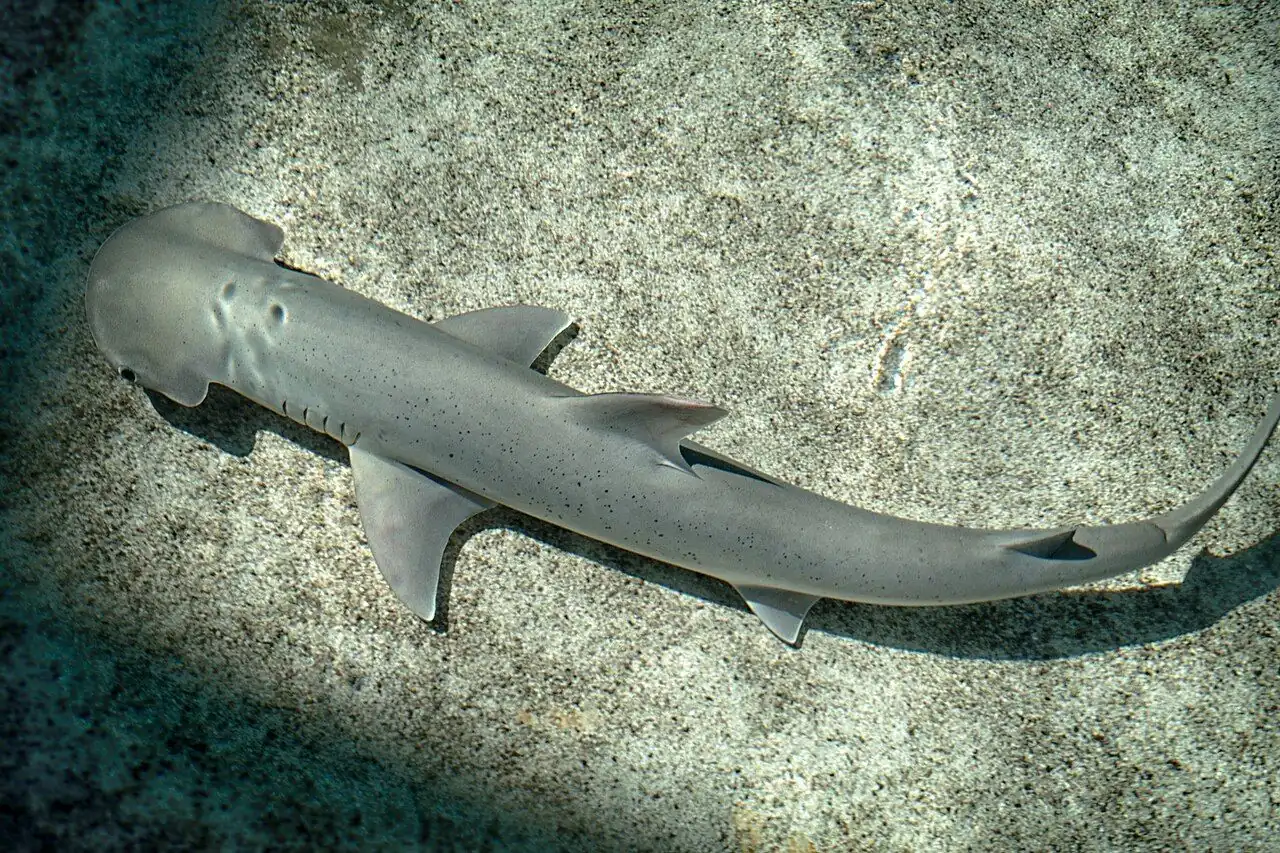
Bonnethead
Sphyrna tiburo
The smallest hammerhead shark, with a rounded, shovel-shaped head, and the first shark shown to digest the seagrass it swallows.
Photo: Eric Kilby / CC BY-SA 2.0
3 things to know
- Seagrass has made up as much as 62 percent of the gut contents of bonnetheads by weight.
- In 2001 a captive female at Omaha's Henry Doorly Zoo had a pup with no father, the first virgin birth in a shark confirmed by DNA.
- In 2024 scientists split the species and named bonnetheads from Belize to Brazil as a new one, Sphyrna alleni.
- Scientific name
- Sphyrna tiburo
- Depth
- 0 m – 90 m
0 – 295 ft - Size
- Usually 90–120 cm (3–4 ft); up to about 150 cm (5 ft)
- Weight
- Up to about 10.8 kg (24 lb)
- Lifespan
- Estimated at about 18 years for females and 16 for males
- Diet
- Mainly crabs (especially blue crabs), shrimp, mantis shrimp, mollusks and small fish; also seagrass
- Where
- Western Atlantic coasts of the United States, Mexico and the Bahamas, including the Gulf of Mexico (bonnetheads from Belize to Brazil and in the eastern Pacific are now treated as separate species)
- IUCN status
- Endangered
- Depth zones
- Sunlight
Its head is the giveaway. The bonnethead is the smallest of the hammerhead sharks, and instead of a wide, flat hammer it has a smooth, rounded head shaped like a shovel or a bonnet, with an eye at each end. It is gray to gray-brown above and white below, and usually measures 90 to 120 centimeters (3 to 4 feet), with a maximum around 150 centimeters (5 feet).
Bonnetheads live in shallow coastal water over seagrass flats, mud and sand, in estuaries and bays and on reefs, down to about 90 meters (295 feet). They prefer water warmer than 21 °C (70 °F), so they move with the seasons: in summer they are common off the Carolinas and Georgia, and off Florida and in the Gulf of Mexico from spring through fall. They usually swim in small groups of up to 15, but migrating schools can number in the hundreds or thousands. Their main food is crustaceans, especially blue crabs, shrimp and mantis shrimp, plus mollusks and small fish.
They also swallow a lot of seagrass, as much as 62 percent of their gut contents by weight in earlier work. Samantha Leigh and Donovan German of the University of California, Irvine, with Yannis Papastamatiou of Florida International University, fed captive bonnetheads seagrass labeled with a traceable form of carbon. They reported in 2018 that the sharks digested about half of the seagrass organic matter, built its carbon into their own tissues and carried enzymes in the hindgut that break down cellulose.
On December 14, 2001, keepers at the Henry Doorly Zoo in Omaha, Nebraska, found a newborn bonnethead in a tank holding three adult females. They had been caught near the Florida Keys before they matured and had lived without males for about three years. DNA tests by Demian Chapman, Mahmood Shivji and colleagues, published in 2007, showed it carried genes from one female and none from a male, the first genetic evidence of a virgin birth in any shark, ray or chimaera.
Chapman was also an author on a 2024 study that split the species: bonnetheads from the United States, Mexico and the Bahamas keep the name Sphyrna tiburo, those from Belize to Brazil became Sphyrna alleni, and eastern Pacific bonnetheads are treated as Sphyrna vespertina. The IUCN's 2019 assessment, made before that split, covered bonnetheads in all three regions and lists the species as Endangered.
Sources
- floridamuseum.ufl.edu/discover-fish/species-profiles/bonnethead
- fishbase.se/summary/Sphyrna-tiburo.html
- iucnredlist.org/species/39387/205765567
- Study: doi:10.1098/rspb.2018.1583
- Study: doi:10.1098/rsbl.2007.0189
- sciencenews.org/article/virgin-birth-shark-has-daughter-without-dad
- Study: doi:10.11646/zootaxa.5512.4.2



