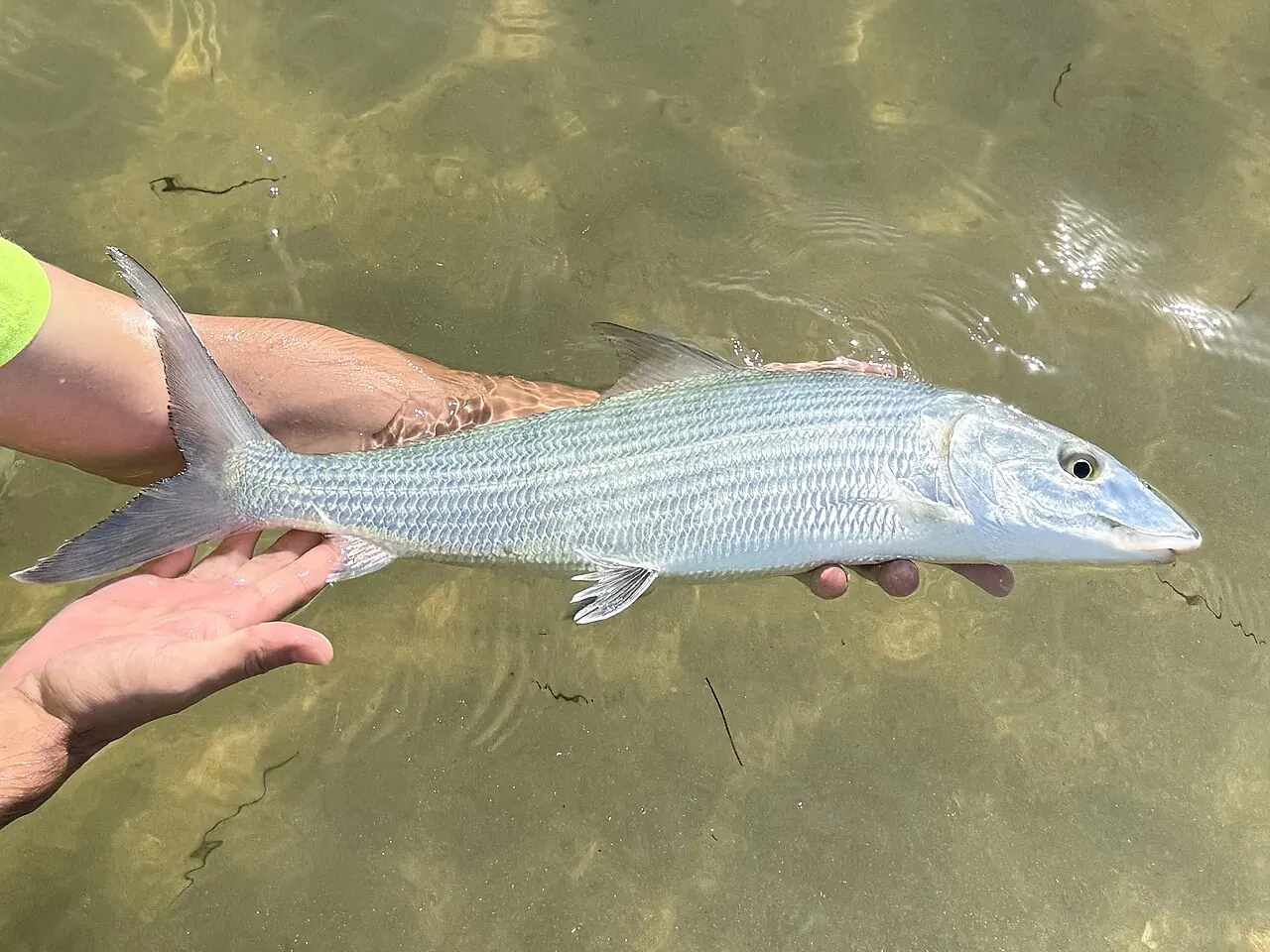
Bonefish
Albula vulpes
A silver fish of shallow tropical flats that swims out to the edge of the shelf and dives to about 137 m (450 ft) to spawn.
Photo: James-LaFontaine / CC BY 4.0
3 things to know
- Its larva shrinks to about half its length as it turns into a juvenile.
- Bonefish tracked off Abaco in the Bahamas dove to about 137 m (450 ft) before spawning, a 2020 study reported.
- Bonefish sampled in South Florida carried an average of seven pharmaceuticals each.
- Scientific name
- Albula vulpes
- Depth
- 0 m – 50 m
0 – 164 ft - Size
- Up to about 77 cm (31 in) long in the western Atlantic
- Weight
- Usually 1.8 to 2.7 kg (4 to 6 lb); the Florida record is 7.3 kg (16 lb 3 oz)
- Lifespan
- May exceed 19 years
- Diet
- Crabs, shrimp, clams, snails, worms and small fish dug from the bottom
- Where
- Western Atlantic: Florida, the Bahamas and Bermuda through the Caribbean to Brazil, with strays north to North Carolina and beyond
- IUCN status
- Near Threatened
- Depth zones
- Sunlight
Bonefish feed on flats so shallow that the water is often less than 30 centimeters (1 foot) deep. They are silvery with a bluish or greenish back and dark streaks along the upper sides, and the long snout hangs over the lower jaw. Schools push onto the flats on the rising tide and root through sand and seagrass with that snout, crushing crabs, shrimp, clams and snails with strong teeth in the throat. When the water runs low in oxygen, a bonefish can gulp air into a lung-like swim bladder.
The IUCN maps the species from Florida and the Bahamas through the Caribbean to Venezuela, and the Florida Museum adds Bermuda and Brazil. Bonefish elsewhere were once lumped with this one: FishBase treats the West African form as a separate species, Albula goreensis, and notes genetic work showing that Hawaiian bonefish are distinct too. In the Caribbean and western Atlantic, the Florida Museum gives a maximum of about 77 centimeters (31 inches), though most Florida and Bahamas fish weigh 1.8 to 2.7 kilograms (4 to 6 pounds). The Florida record, caught near Islamorada, weighed 7.3 kilograms (16 pounds 3 ounces). They may live more than 19 years.
Like tarpon and eels, they start life as a see-through, ribbon-like leptocephalus larva. At about 63 millimeters (2.5 inches), the larva starts to shrink, and over 10 to 12 days it loses about half its length before it becomes a tiny bonefish.
Adults leave the flats to spawn. Off Abaco in the Bahamas, Steven Lombardo, Matt Ajemian and colleagues from Florida Atlantic University's Harbor Branch and Bonefish & Tarpon Trust tracked a pre-spawning school with acoustic tags and sonar, reporting in 2020. According to the university's release, at sunset the fish gulped air at the surface, swam out along the edge of the shelf, then dove to about 137 meters (450 feet). They stayed below about 100 meters (325 feet) for two hours before spawning in a rush up to about 67 meters (220 feet). Pre-spawning schools can number 5,000 to 10,000 fish.
The IUCN lists the bonefish as Near Threatened, with numbers falling. In Florida, researchers at Florida International University and Bonefish & Tarpon Trust sampled 93 fish in Biscayne Bay and the Keys from 2018 and found an average of seven pharmaceuticals per bonefish, and 17 in one fish. Such drugs most often reach the sea in human wastewater.
Sources
- floridamuseum.ufl.edu/discover-fish/species-profiles/bonefish
- myfwc.com/wildlifehabitats/profiles/saltwater/bonefish
- fishbase.se/summary/Albula-vulpes.html
- iucnredlist.org/species/194303/2310733
- Study: doi:10.1007/s00227-020-03799-3
- sciencedaily.com/releases/2020/12/201207091250.htm
- news.fiu.edu/2022/pharmaceutical-contaminants-discovered-in-south-florida-bonefish
- commons.wikimedia.org/wiki/File:Albula_vulpes_-_James-LaFontaine_-_601558048.jpeg



