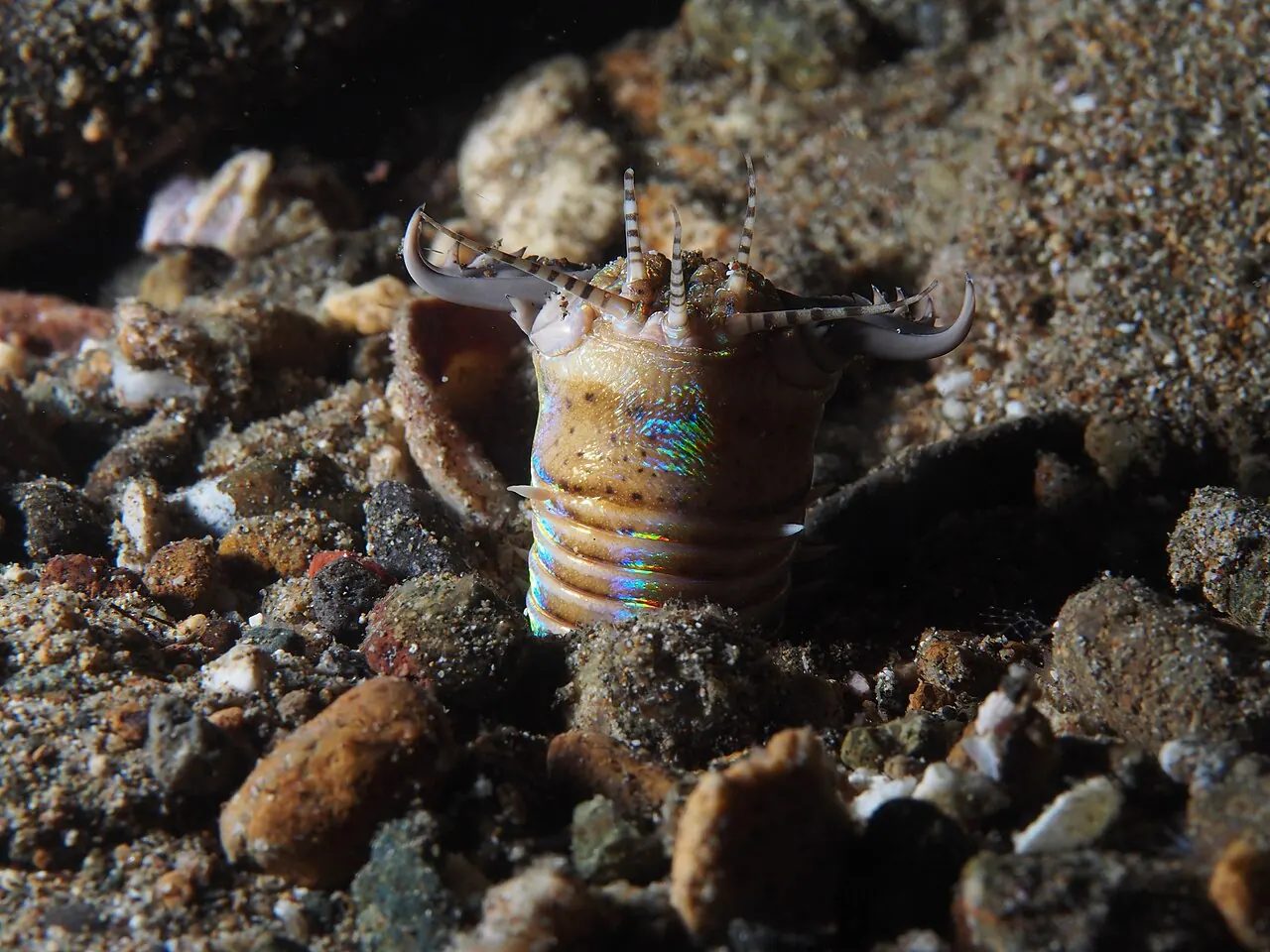
Bobbit Worm
Eunice aphroditois
A giant marine worm, up to about 3 m long, that hides in the seafloor and snaps up passing fish with scissor-like jaws.
Photo: Rickard Zerpe / CC BY-SA 2.0
3 things to know
- It can grow to about 3 m (10 ft) long but shows only its head above the sand.
- Off Indonesia, small reef fish gang up on it and blast it with jets of water.
- Fossil burrows in Taiwan suggest giant ambush worms like it lived about 20 million years ago.
- Scientific name
- Eunice aphroditois
- Depth
- 1 m – 200 m
3 – 656 ft - Size
- Up to about 3 m (10 ft) long and 2–2.5 cm (about 1 in) thick
- Weight
- Unknown
- Lifespan
- Unknown
- Diet
- Fish, clams and other worms, ambushed from a burrow
- Where
- Warm seas of the Indo-Pacific and Atlantic
- IUCN status
- Not Evaluated
- Depth zones
- Sunlight
Almost all of a bobbit worm stays out of sight. The worm is a polychaete, a segmented marine worm, and one of the largest of its family, reaching about 3 meters (10 feet) long and 2 centimeters (almost an inch) thick. It lives in a burrow in the seafloor with only its head showing: five antennae and a set of powerful, scissor-like jaws. When a fish swims too close, the worm lunges up, grabs it and drags it down into the sediment while it is still alive. Fish, clams and other worms are on the menu. The worm's body is iridescent, though few people ever see more than the head.
SeaLifeBase lists the species from the Indo-Pacific and the Atlantic, at depths of 1 to 200 meters (3 to 660 feet). Its appearance in the BBC series Blue Planet II in 2017 brought it a wide audience. Its identity is less settled than its fame. A 2011 review by Salazar-Vallejo and colleagues noted that giant Eunice worms longer than 2 meters (6.6 feet) are known from tropical and temperate seas, but that the original species descriptions are brief and type specimens are often missing. The authors called for new collections and DNA studies to sort out the confusion.
The worm has enemies that fight back. In the Lembeh Strait off Sulawesi, Indonesia, Jose Lachat and Daniel Haag-Wackernagel of the University of Basel spent 90 dives between 2012 and 2016 watching a reef fish, Scolopsis affinis, find hidden bobbit worms and blow sharp jets of water at them. Others of the same species then joined in. The mobbing episodes lasted about 21 seconds on average, and some worms pulled their antennae in or withdrew completely into their burrows. The authors described it in 2016 as a new kind of mobbing behavior.
Worms like this have hunted the same way for a long time. In 2021, Yu-Yen Pan and colleagues described 319 fossil burrows in sandstone at Yehliu Geopark and Badouzi in northeast Taiwan, about 20 million years old. Each is an L-shaped tunnel up to 2 meters long and 2 to 3 centimeters wide, with feather-like disturbances near the top that the team read as signs of prey being dragged under. Soft-bodied worms rarely fossilize, so the case for bobbit-like makers rests on the burrows themselves.
The bobbit worm has not been evaluated for the IUCN Red List.



