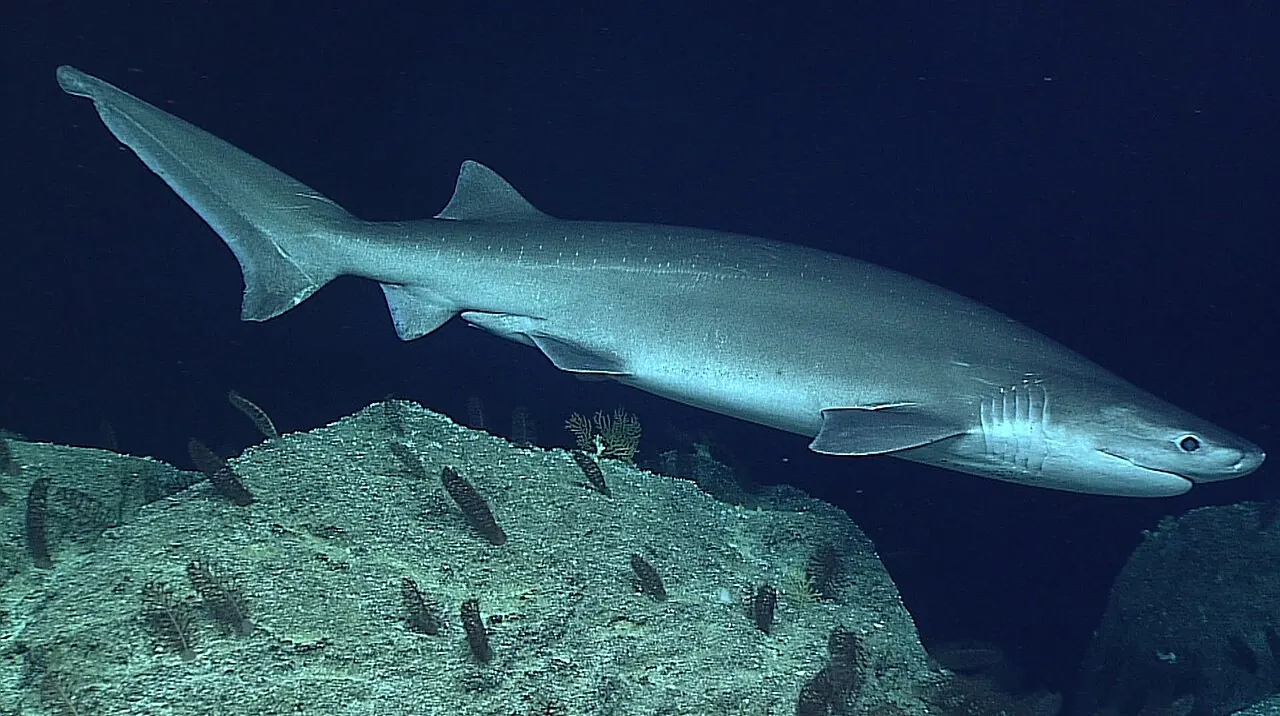
Bluntnose Sixgill Shark
Hexanchus griseus
A huge green-eyed deep-sea shark with six gill slits that rises toward the surface at night and gives birth in places like Puget Sound.
Photo: NOAA / Public domain
3 things to know
- It has six pairs of gill slits, where most sharks have five, and only one dorsal fin, set far back.
- Litters are huge: 47 to 108 pups have been recorded.
- In June 2019 scientists tagged one from a submersible about 520 m (more than 1,700 ft) down off the Bahamas, a first for a deep-sea shark.
- Scientific name
- Hexanchus griseus
- Depth
- 180 m – 1,100 m
591 – 3,609 ft - Size
- Commonly about 3 m (10 ft); the largest reported about 4.8 m (15.8 ft), with some sources giving up to 6 m (20 ft)
- Weight
- Up to about 590 kg (1,300 lb)
- Lifespan
- Unknown: no one has yet found a reliable way to age this shark
- Diet
- Other sharks, rays, chimaeras, bony fish, squid, crabs, shrimp and carrion; large adults also take seals and other marine mammals
- Where
- Patchy across temperate and tropical seas worldwide; in the eastern Pacific from Alaska's Aleutian Islands to Baja California and Chile
- IUCN status
- Near Threatened
- Depth zones
- Sunlight · Twilight · Midnight
Most sharks have five pairs of gill slits. The bluntnose sixgill has six long ones, a single dorsal fin set far back toward the tail, a broad blunt snout and, in the living animal, fluorescent green eyes. Each side of its lower jaw carries six broad, comb-shaped teeth. Adults are commonly around 3 meters (10 feet) long. The biggest reported reach about 4.8 meters (15.8 feet) and 590 kilograms (1,300 pounds). Its body plan closely resembles fossil sharks from some 200 million years ago.
It lives on outer continental shelves, upper slopes, seamounts and mid-ocean ridges around much of the world, usually between about 180 and 1,100 meters (590 and 3,600 feet), and has been reported from the surface to 2,500 meters (8,200 feet). Sixgills often rest near the bottom by day and rise toward the surface at night to feed. They eat almost anything: other sharks, rays, chimaeras, bony fish, squid, crabs and carrion, and big adults take seals and other marine mammals. Litters are huge, 47 to 108 pups, each 60 to 75 centimeters (2 to 2.5 feet) long at birth.
Living so deep makes them hard to study. Dean Grubbs of Florida State University has satellite-tagged more than 20 sixgills since 2005 and has recorded them diving to 5,000 feet (about 1,500 meters). On the night of June 29, 2019, off Eleuthera in the Bahamas, Gavin Naylor of the Florida Museum of Natural History, riding in OceanX's submersible Nadir, put a satellite tag into a male sixgill more than 1,700 feet (about 520 meters) down, the first time a deep-sea shark had been tagged from a submersible.
The Salish Sea, including Washington's Puget Sound, is one of the few known places where the species gives birth. Scientists from NOAA's Northwest Fisheries Science Center, the Seattle Aquarium and the Washington Department of Fish and Wildlife have studied young sixgills there for more than 20 years. In a September 2026 NOAA feature, biologist Kelly Andrews described genetic tests on 274 tissue samples showing that females mate with several males and that relatives return to the Salish Sea over years and decades. He also noted that no one has yet been able to determine a sixgill's age.
Sixgills are caught as bycatch and in fisheries for food, fishmeal, oil and sport, and the IUCN lists the species as Near Threatened, in an assessment from 2019.
Sources
- fishbase.se/summary/Hexanchus-griseus.html
- floridamuseum.ufl.edu/discover-fish/species-profiles/bluntnose-sixgill-shark
- floridamuseum.ufl.edu/science/scientists-tag-shark-from-submersible
- fisheries.noaa.gov/feature-story/secrets-salish-seas-sixgill-sharks
- iucnredlist.org/species/10030/495630
- ncei.noaa.gov/maps/benthic-animal-guide



