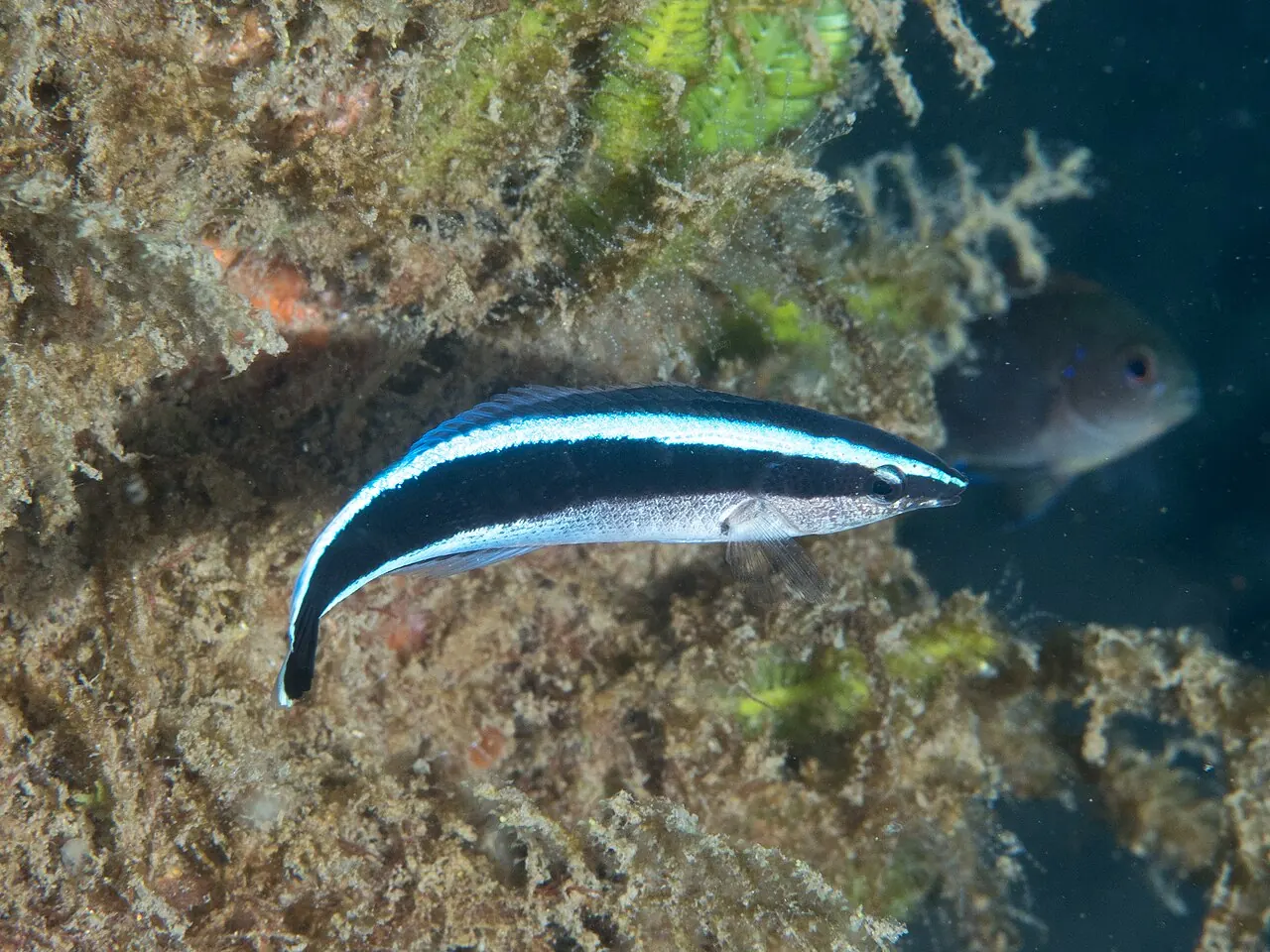
Bluestreak Cleaner Wrasse
Labroides dimidiatus
A small striped reef fish that runs cleaning stations for bigger fish, and the first fish reported to pass the mirror test.
Photo: Rickard Zerpe / CC BY 2.0
3 things to know
- Bigger fish visit its cleaning stations to have parasites picked off.
- A female can become a male when the group's dominant male disappears.
- In lab tests, wrasse scraped off a throat mark they could see only in a mirror.
- Scientific name
- Labroides dimidiatus
- Depth
- 1 m – 30 m
3 – 98 ft - Size
- Up to about 14 cm (5.5 in) long
- Weight
- Not well known
- Lifespan
- Up to about 4 years reported
- Diet
- Parasites, mostly small crustaceans, and mucus picked off other fish
- Where
- Indo-Pacific, from the Red Sea and East Africa to the Line and Marquesas islands, north to southern Japan
- IUCN status
- Least Concern
- Depth zones
- Sunlight
A slim, striped fish no longer than about 14 centimeters (5.5 inches), the bluestreak cleaner wrasse makes its living as a groomer for other fish. It lives in coral-rich lagoons, on reef flats and on outer reefs across the Indo-Pacific, from the Red Sea and East Africa to the Line and Marquesas islands and north to southern Japan. It is usually found 1 to 30 meters (3 to 100 feet) down, though it has been recorded as deep as 100 meters.
Each wrasse works from a cleaning station, a fixed spot on the reef where other fish come to be cleaned. It eats crustacean parasites and mucus off its clients. Among the parasites it removes during the day are gnathiid isopods, tiny crustaceans that feed on fish blood. An unfamiliar visitor is usually greeted with a dance, the wrasse bobbing the back half of its body up and down.
Social life is flexible. A station may be held by an adult pair, by a group of juveniles, or by several females with one dominant male. The species is a protogynous hermaphrodite, meaning individuals start out female. If the dominant male disappears, a female becomes a working male, a switch completed in 14 to 18 days, and sex change in the other direction has also been confirmed. FishBase lists a maximum reported age of 4 years. The species is assessed as Least Concern and is sold in the aquarium trade.
The wrasse has become famous for a mirror. In 2019 Masanori Kohda of Osaka City University and colleagues reported that wrasse given a colored mark on the throat tried to scrape it off, but only when a mirror let them see it. Clear marks, or marks with no mirror present, got no such response. In 2023 the team showed that fish which had passed the test stopped attacking photos of their own faces while still attacking photos of strangers. Whether that adds up to self-awareness is still disputed; the 2023 paper itself says the implications for self-awareness remain controversial.



