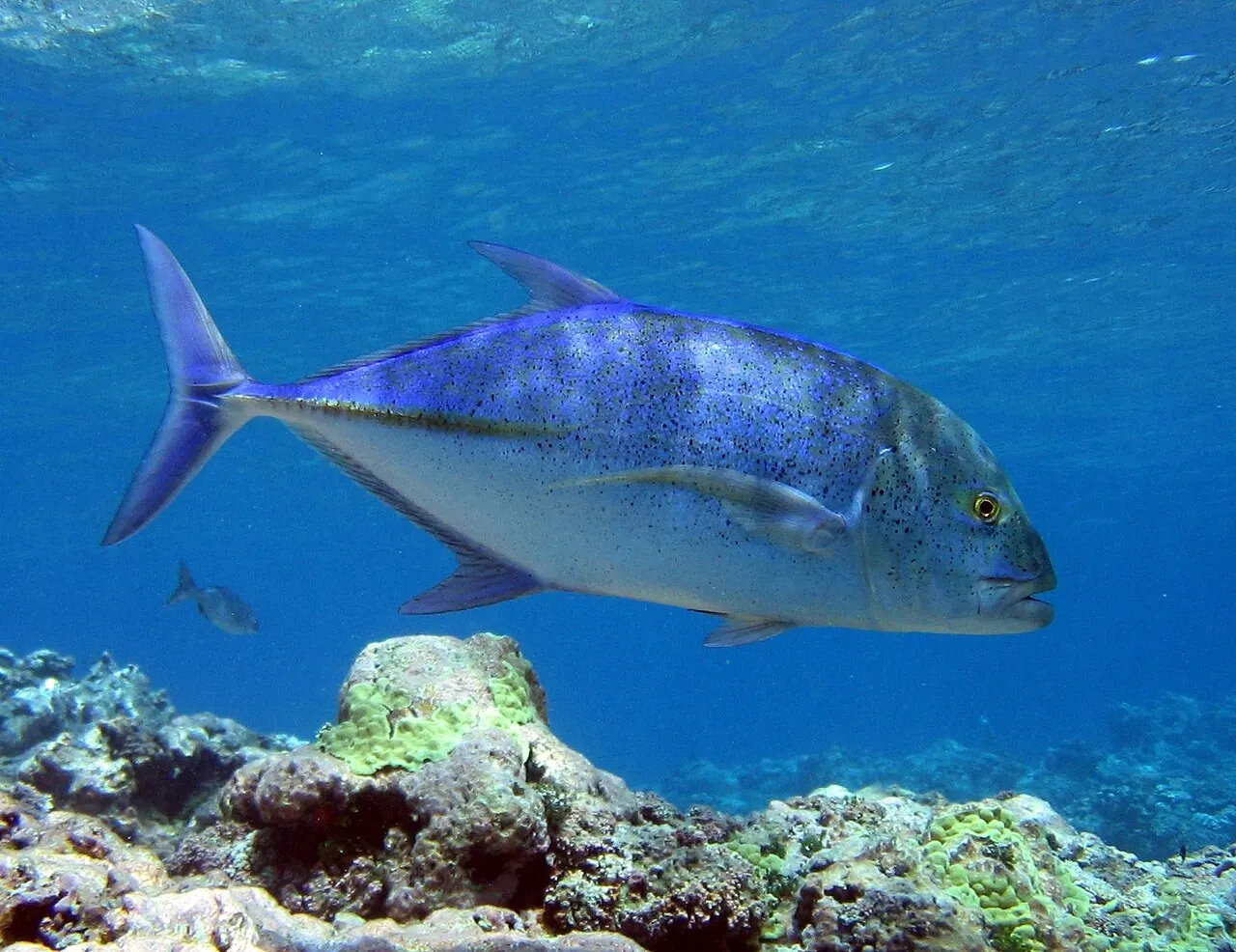
Bluefin Trevally
Caranx melampygus
A fast reef predator with electric blue fins, known in Hawaii as omilu, that eats mostly other fish.
Photo: Dwayne Meadows/NOAA / Public domain
3 things to know
- Its second dorsal fin, anal fin and tail are electric blue.
- A 1991 study estimated that bluefin trevally at French Frigate Shoals ate about 11,000 metric tons of prey a year.
- Fish longer than about 50 cm (20 in) are often toxic to eat.
- Scientific name
- Caranx melampygus
- Depth
- 0 m – 190 m
0 – 623 ft - Size
- Up to 117 cm (3.8 ft) fork length; commonly about 60 cm (2 ft)
- Weight
- FishBase lists a maximum published weight of 43.5 kg (96 lb); Fishes of Australia gives 15 kg (33 lb)
- Lifespan
- At least 24 years, the oldest age found in a 2021 Hawaii study
- Diet
- Mostly other fishes, plus crustaceans
- Where
- Indo-Pacific from the Red Sea and East Africa to Ducie Island, including Hawaii, and the eastern Pacific from Mexico to Panama
- IUCN status
- Least Concern
- Depth zones
- Sunlight
Electric blue fins give the bluefin trevally away. Its second dorsal fin, anal fin and tail are bright blue, and an adult's head and upper body are brassy, washed with blue and peppered with small blue-black spots. FishBase says those spots appear once a fish reaches about 16 to 22 centimeters (6 to 9 inches) and multiply as it grows. Young fish are plain silvery gray with yellow pectoral fins. The largest on record measured 117 centimeters (3.8 feet) to the fork of the tail, though most are around 60 centimeters (2 feet).
It is the most common trevally on coral reefs, from the Red Sea and East Africa across the Indian and Pacific oceans to Ducie Island, and also on the Pacific coast of the Americas from Mexico to Panama. Adults hunt over reefs and in coastal and open water, alone or sometimes in schools, from the surface to 190 meters (620 feet), while juveniles turn up seasonally in shallow sandy water close to shore and even in rivers. Fishes of Australia has video from the Philippines of bluefin trevally hunting in a pack with emperors and groupers.
In Hawaii, where it is called omilu, it has been studied closely. Working in the nearly untouched Northwestern Hawaiian Islands, Anthony Sudekum and colleagues reported in 1991 that fish made up more than 90 percent of its diet. They estimated that a typical bluefin trevally eats a little under 50 kilograms (110 pounds) of prey a year, and that the roughly 230,000 bluefin trevally at French Frigate Shoals ate about 11,000 metric tons between them. They found ripe fish only from April to November, with most spawning from about May to August.
A 2021 study led by Cassandra Pardee aged bluefin trevally from Hawaii and found fish as old as 24 years. Females matured at about 37 centimeters and 4.1 years, males at about 33 centimeters and 2.9 years. FishBase also records a hybrid between this species and the bigeye trevally (Caranx sexfasciatus) in Hawaii.
The bluefin trevally is a prized sport fish and is sold fresh, dried or salted, but FishBase warns that fish longer than about 50 centimeters (20 inches) are often toxic and lists reports of ciguatera poisoning from eating it. The IUCN lists it as Least Concern, from a 2015 assessment.



