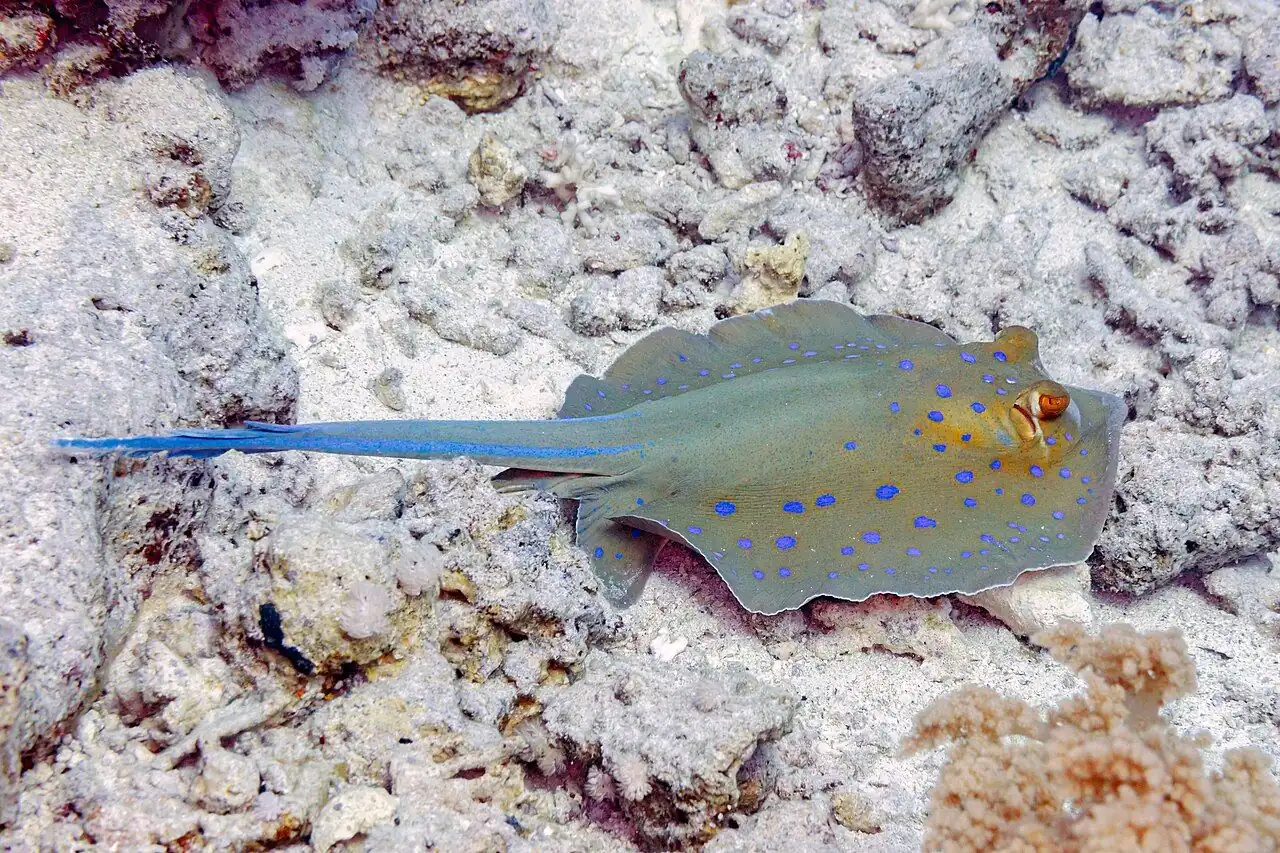
Blue-Spotted Ribbontail Ray
Taeniura lymma
A small reef stingray whose electric-blue spots are made by light-scattering structures in its skin, and whose spot pattern is unique to each ray.
Photo: Diego Delso / CC BY-SA 4.0
3 things to know
- The blue of its spots looks the same from every viewing angle.
- Researchers matched individual rays by their spot patterns in photos taken up to 496 days apart.
- Females give birth to up to seven young per litter.
- Scientific name
- Taeniura lymma
- Depth
- 0 m – 20 m
0 – 66 ft - Size
- Disc up to about 35 cm (14 in) wide; about 70 cm (28 in) long including the tail
- Weight
- Not well documented
- Lifespan
- Unknown
- Diet
- Molluscs, worms, shrimps, crabs and small fishes
- Where
- Indo-West Pacific, from the Red Sea, the Persian Gulf and East Africa to the Solomon Islands, north to southern Japan and south to northern Australia
- IUCN status
- Least Concern
- Depth zones
- Sunlight
Bright blue spots scattered over a green, brown or yellowish oval disc, plus a blue stripe down each side of the tail, make this one of the easiest stingrays to recognize on a reef. The disc reaches about 35 centimeters (14 inches) across. The stout, tapering tail, less than twice the length of the body, ends in a broad fin fold and carries one or two venomous spines.
It lives on coral reefs in the Indo-West Pacific, from the Red Sea, the Persian Gulf and East Africa to the Solomon Islands, north to southern Japan and south to northern Australia, in water no deeper than about 20 meters (66 feet). On the rising tide, groups move up onto shallow sand to feed on molluscs, worms, shrimps, crabs and small fishes. As the tide falls, they scatter to shelter in caves and under ledges, and they are rarely found buried in sand. Females give birth to up to seven young, already marked with blue spots. Juveniles grow up in mangrove and seagrass nurseries where the water can heat up fast, and in a 2012 study Theresa Dabruzzi and colleagues found that young ribbontails prefer higher temperatures than those reported for other sharks and rays.
The blue is structural color. Researchers in Mason Dean's group at City University of Hong Kong reported in Advanced Optical Materials in 2024 that the spots get their color from skin cells holding a stable three-dimensional arrangement of nanoscale spheres, which scatter blue light, over a layer of melanin that absorbs other colors. According to Dean, the spots do not change color with viewing angle.
The pattern is also individual. Ashlie McIvor and colleagues at the Red Sea Research Center of King Abdullah University of Science and Technology in Saudi Arabia tested whether spot patterns could identify rays. Matching photos with software, they correctly identified 90.3 percent of individuals from images taken up to 496 days apart. Physical tags did worse: 27 percent of them were lost, and none stayed on longer than 356 days.
Small ribbontails are popular with home aquarium keepers, though the species does poorly in captivity. It is caught by fisheries over shallow coral reefs and is probably harmed by dynamite fishing, but the IUCN lists it as Least Concern.
Sources
- fishbase.se/summary/Taeniura-lymma.html
- floridamuseum.ufl.edu/discover-fish/species-profiles/taeniura-lymma
- Study: doi:10.1002/adom.202301909
- eurekalert.org/news-releases/1049974
- Study: doi:10.1038/s41598-024-68302-0
- Study: doi:10.1007/s10750-012-1249-z
- api.gbif.org/v1/species/5215810/iucnRedListCategory
- iucnredlist.org/species/116850766/290355127



