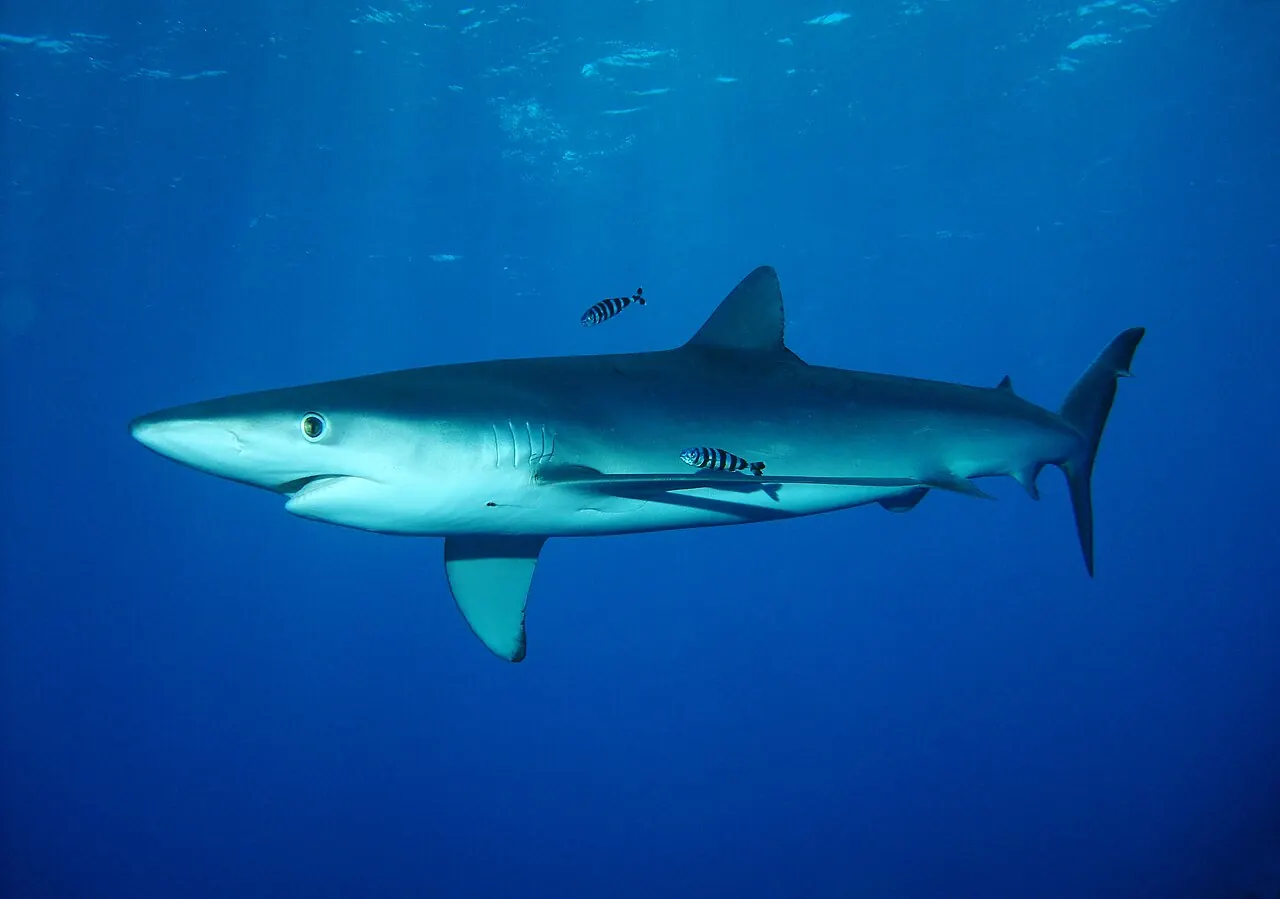
Blue Shark
Prionace glauca
A slender, deep-blue shark of the open ocean, the most heavily fished shark in the world, that dives deep inside warm Gulf Stream eddies.
Photo: Patrick Doll / CC BY-SA 3.0
3 things to know
- Its long pectoral fins are about as long as the distance from its snout to its last gill slit.
- A litter averages about 30 pups, and FishBase reports litters of up to 135.
- An estimated 20 million blue sharks are caught each year, mostly as bycatch.
- Scientific name
- Prionace glauca
- Depth
- 0 m – 350 m
0 – 1,148 ft - Size
- Up to about 3.8 m (12.5 ft) long
- Weight
- Heaviest published about 206 kg (454 lb)
- Lifespan
- About 20 years or more
- Diet
- Small bony fishes such as herring and sardines, squid, cuttlefish and octopus; also seabirds, carrion and garbage
- Where
- Temperate and tropical oceans worldwide, from about 60°N to 50°S
- IUCN status
- Near Threatened
- Depth zones
- Sunlight · Twilight
Deep blue on top and crisp white below, the blue shark is long and slender, with a big eye, a long cone-shaped snout and very long, pointed pectoral fins, roughly as long as the distance from its snout to its last gill slit. The largest grow to about 3.8 meters (12.5 feet). Blue sharks are often seen swimming slowly at the surface with the tips of the dorsal fin and tail out of the water.
They roam temperate and tropical oceans from about 60°N to 50°S, rarely coming near shore except around oceanic islands and where the continental shelf is narrow. They prefer water of 12 to 20°C (54 to 68°F) and go deeper in the tropics to find it, from the surface to about 350 meters (1,150 feet). They also travel far: FishBase records one shark tagged off New Zealand that was caught again 1,200 kilometers (750 miles) off Chile.
Most of the diet is small fish such as herring and sardines, plus squid, cuttlefish and octopus. A study off the US Northeast showed one place they find that food. Camrin Braun of the MIT–Woods Hole Oceanographic Institution Joint Program, Simon Thorrold of Woods Hole and colleagues tagged 15 blue sharks in New England and followed them through the Gulf Stream's swirling eddies for more than 2,000 tracking days. The sharks favored the insides of warm-core eddies, long regarded as low-food "deserts", and dove deep there while foraging. They spent 15 percent of their time in these eddies below 300 meters (980 feet) during the day, against 1.5 percent in cold eddies. Inside the warm eddies, water between 250 and 350 meters was often more than 10°C warmer than usual, and the team, writing in PNAS in 2019, suggested the heat lets the sharks reach the twilight zone's fish without being held back by cold.
Females give birth to live young after 9 to 12 months, with about 30 pups on average and sometimes 80 or more. The Florida Museum describes the blue shark as the most heavily fished shark in the world, with an estimated 20 million caught each year, mostly as bycatch on longlines and driftnets. The IUCN lists it as Near Threatened.



