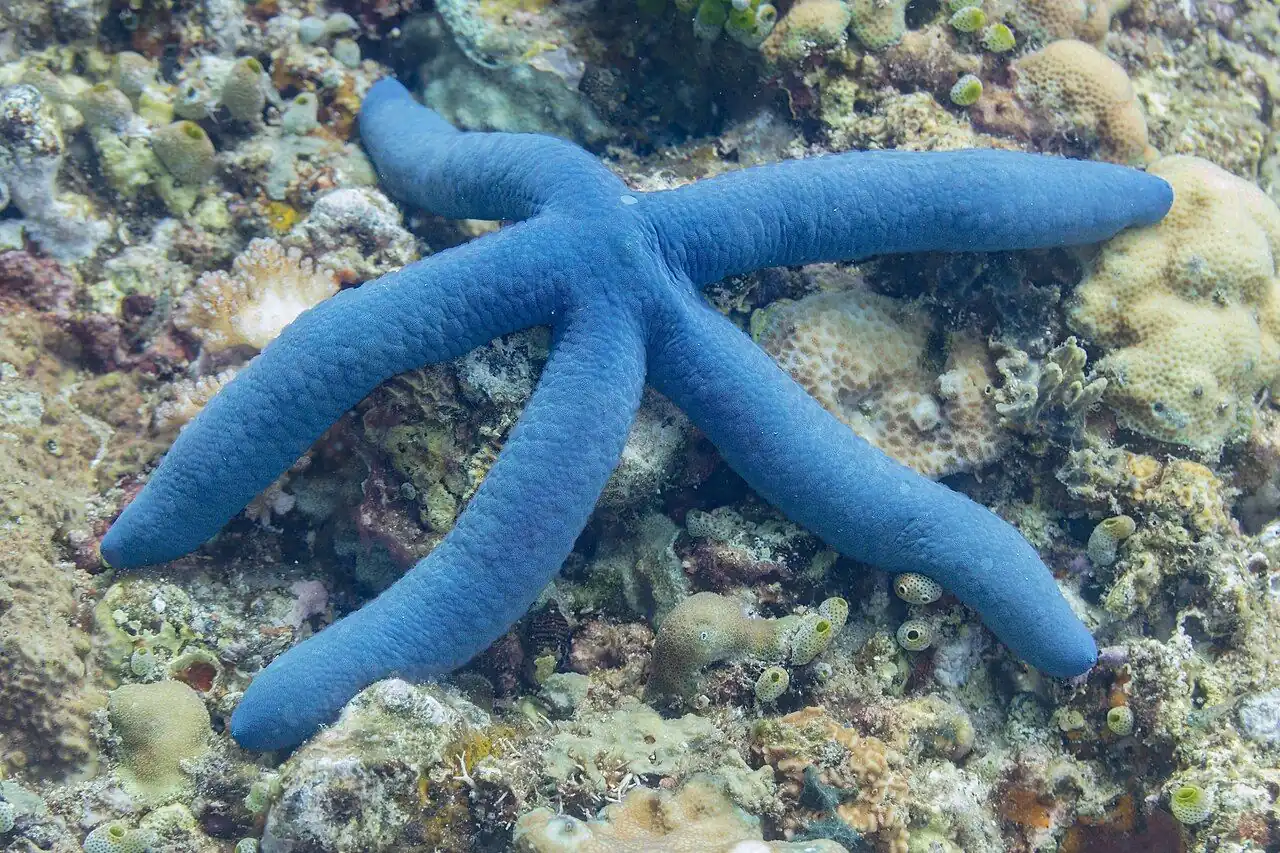
Blue Sea Star
Linckia laevigata
A bright blue Indo-Pacific sea star with long, round-tipped arms, a slow grazer of reef films that spreads as drifting larvae for weeks.
Photo: Diego Delso / CC BY-SA 4.0
3 things to know
- Its blue comes from a pigment called linckiacyanin, mixed with yellow carotenoids.
- Measured in the Philippines, it crawled about 8 cm (3 in) a minute on average.
- Its larvae drift for about a month before settling on a reef.
- Scientific name
- Linckia laevigata
- Depth
- 0 m – 60 m
0 – 197 ft - Size
- Up to about 30–40 cm (12–16 in) across
- Weight
- Unknown
- Lifespan
- Not well known
- Diet
- Detritus, films of algae and bacteria, and small animals living in algal mats
- Where
- Shallow tropical waters of the Indian and Pacific oceans
- IUCN status
- Not Evaluated
- Depth zones
- Sunlight
Few reef animals are as easy to spot as Linckia laevigata. It lies in the open on sunny, shallow reefs, a vivid blue star with five long, smooth, rounded arms and yellowish tube feet. The color comes from a blue pigment called linckiacyanin, mixed with yellow carotenoids, and the balance varies from one animal to the next. Most are bright or light blue, but green, pink and yellow ones also turn up. Big ones reach 30 to 40 centimeters (12 to 16 inches) across.
It lives in the tropical Indian and Pacific oceans, from the shallows down to about 60 meters (200 feet), on rock, dead coral and rubble, and among sponges, seaweed and seagrass. Juveniles hide under corals and rocks. Adults graze slowly, eating detritus and the small animals living in algal mats, and probably turf algae and the film of bacteria on hard surfaces.
In 2008, Mueller, Bos and colleagues timed four common sea stars off Samal Island in the Philippines, laying a tarpaulin on the seafloor so the animals crossed a uniform surface. The blue sea star averaged 8.1 centimeters (about 3 inches) a minute with a mean top speed of 10.6, the slowest of the four. The coral-eating crown-of-thorns starfish averaged 35.3. The authors suggest that an animal grazing food that barely moves has no need for speed.
The sexes are separate, and adults release eggs and sperm into the water, sometimes gathering in groups to spawn. The larvae drift for about 28 to 30 days before settling on a reef, which should carry them far. Yet in 1998 S. T. Williams and J. A. H. Benzie found that color forms, mitochondrial DNA and enzyme variants all divided the species into the same regions within the Indo-West Pacific, a sign that some populations stay apart despite those long-lived larvae. A close relative, Linckia multifora, can reproduce by shedding arms that grow into new stars; whether the blue sea star does this in the wild has not been documented.
It is collected for aquariums, where it often dies, and as a dried curio. The species has not been assessed by the IUCN, and how long it lives in the wild is not well known.



