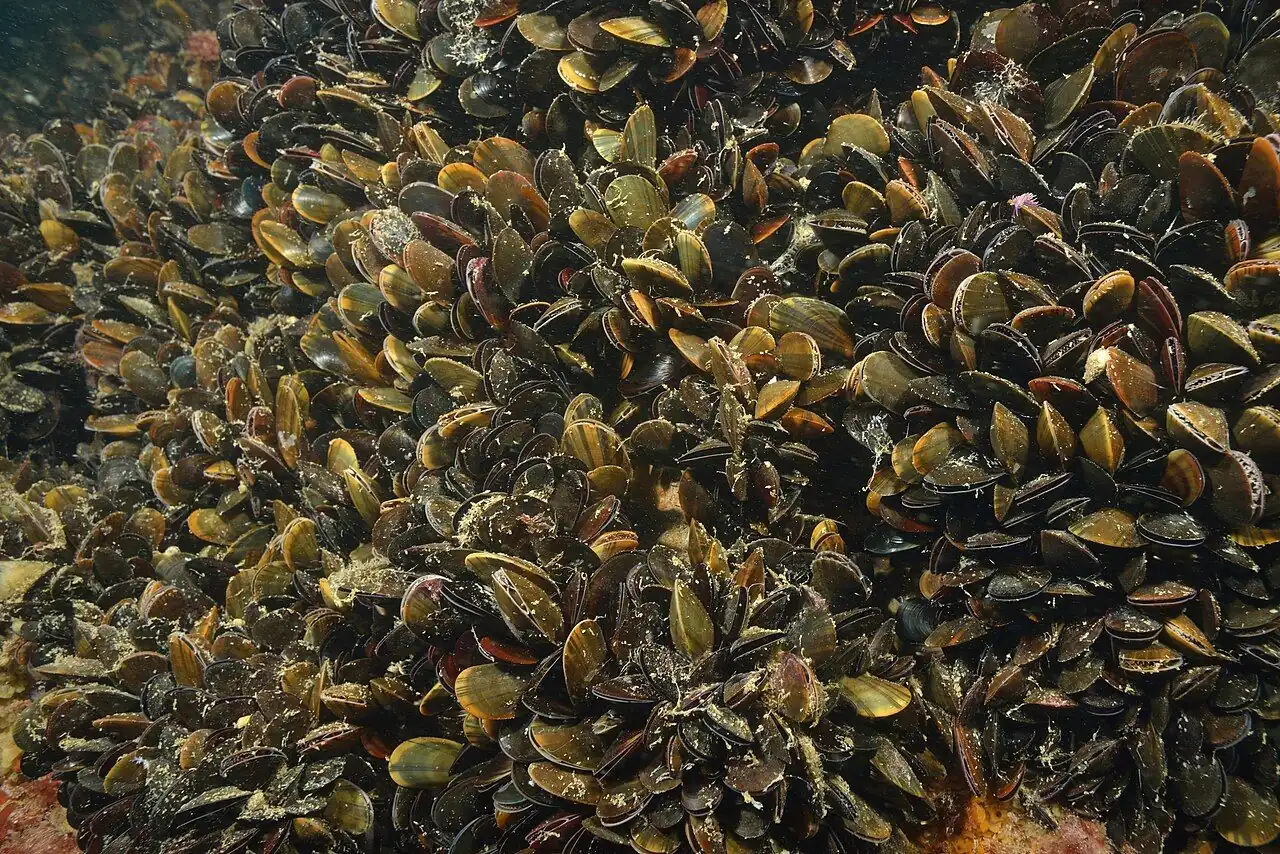
Blue Mussel
Mytilus edulis
A North Atlantic shellfish that ties itself to rock with tough threads, filters seawater, and has lost more than 60% of its numbers in the Gulf of Maine.
Photo: Olivier Dugornay (Ifremer) / CC BY 4.0
3 things to know
- The "beard" on a mussel is its byssal threads, which hold it to rock and to other mussels.
- NOAA's Mussel Watch program has sampled mussels and oysters to track coastal pollution since 1986.
- Wild blue mussels in the Gulf of Maine have declined by more than 60% since the 1970s.
- Scientific name
- Mytilus edulis
- Depth
- 0 m – 10 m
0 – 33 ft - Size
- Usually 5–10 cm (2–4 in) long
- Weight
- Not well known
- Lifespan
- Reported up to 18–24 years, depending on location and habitat
- Diet
- Phytoplankton and other fine particles filtered from the water
- Where
- Coasts of the North Atlantic, in North America and Europe
- IUCN status
- Not Evaluated
- Depth zones
- Sunlight
A blue mussel, Mytilus edulis, holds on with a tuft of strong, slightly elastic byssal threads, known as its "beard," which tie it to rock and to its neighbors. The two matching valves are teardrop-shaped and usually 5 to 10 centimeters (2 to 4 inches) long, purple, blue or dark brown, with growth lines spreading out from the hinge.
The species is native to the North Atlantic, on the coasts of both North America and Europe. It lives mostly between the tides and in the shallow water just below, on open rocky shores and in crevices, where the bound-together animals build dense beds up to five or six layers deep. In the North Pacific, similar mussels include two relatives, M. trossulus and the introduced M. galloprovincialis, and these species can hybridize where they meet.
A mussel feeds by pumping seawater and straining out phytoplankton and other small particles. It also picks up bacteria, metals and other contaminants, which makes it a useful witness. NOAA's National Mussel Watch Program has collected mussels and oysters since 1986 and now samples more than 400 sites on the Atlantic, Pacific and Gulf coasts, plus the Great Lakes, Alaska, Hawaii and Puerto Rico, reading their tissues as a record of what is in the water.
Mussels have separate sexes. Spawning peaks in spring and summer, when a female releases millions of eggs to be fertilized in open water. The larvae drift for about three weeks, the time when predators take the most of them; after they settle, sea stars, gulls and dog whelks prey on them. Survivors have been reported to reach 18 to 24 years.
The IUCN has not evaluated the blue mussel, but in the Gulf of Maine it is fading. A team led by Cascade Sorte of the University of California, Irvine, resurveyed shores spanning more than 400 kilometers (250 miles) of that fast-warming sea and compared them with records going back to the 1970s. In the 2016 study, mussel numbers had fallen by more than 60 percent, and beds that once covered as much as two-thirds of the intertidal zone covered less than 15 percent. Sorte named warming oceans and increased harvesting among the suspected reasons. At the four sites with older community records, the attached community had become increasingly dominated by seaweed.
Sources
- sealifebase.se/summary/Mytilus-edulis.html
- marlin.ac.uk/species/detail/1421
- animaldiversity.org/accounts/Mytilus_edulis
- fisheries.noaa.gov/species/blue-mussel/science
- en.wikipedia.org/wiki/Blue_mussel
- coastalscience.noaa.gov/science-areas/pollution/mussel-watch
- Study: doi:10.1111/gcb.13425
- news.uci.edu/research/why-are-new-englands-wild-blue-mussels-disappearing
- api.gbif.org/v1/species/8288896/iucnRedListCategory



