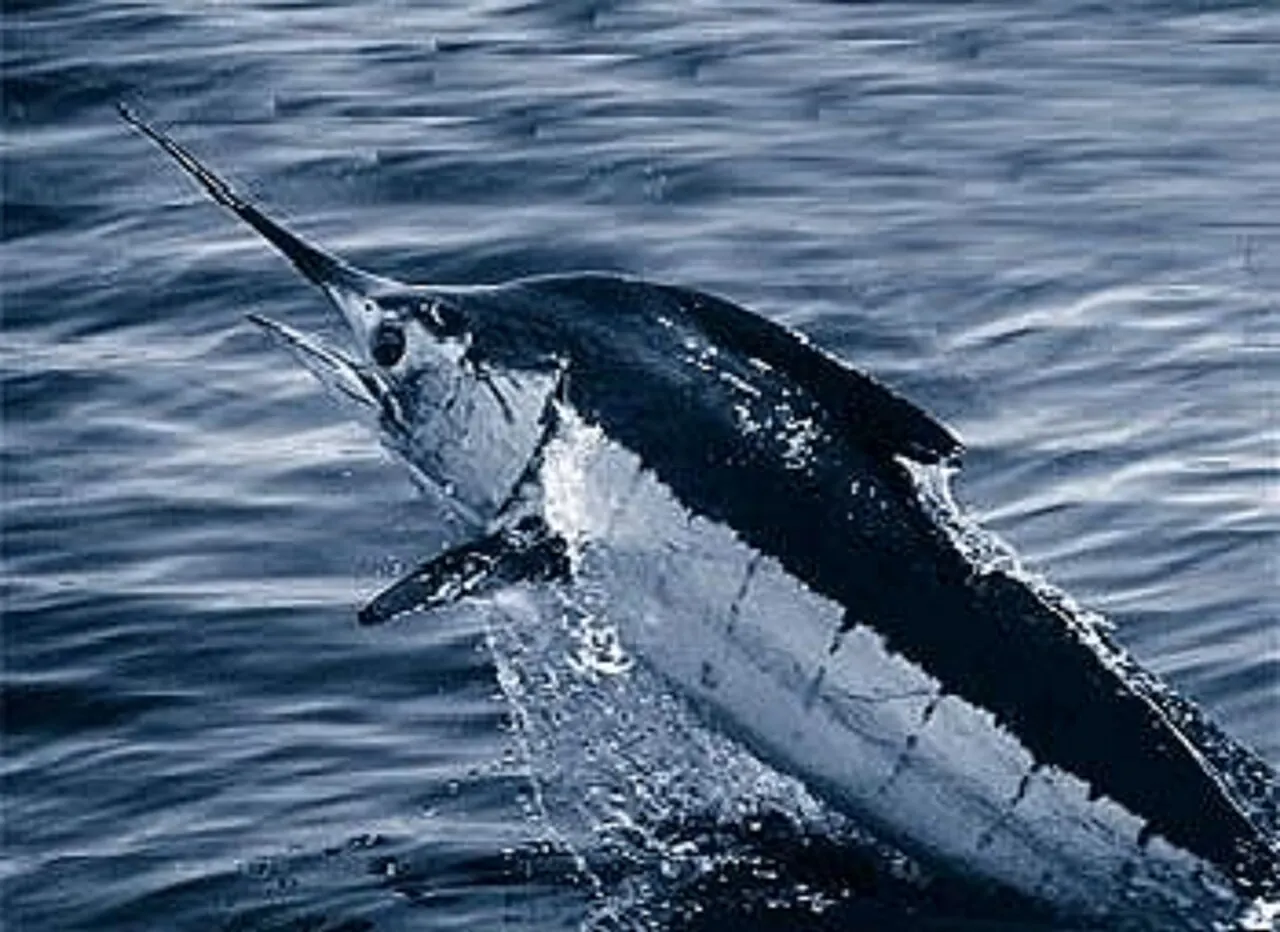
Blue Marlin
Makaira nigricans
The largest billfish, a cobalt-blue hunter of tunas whose females far outgrow the males and which spends most of its time cruising slowly.
Photo: NOAA / Public domain
3 things to know
- Its lateral line forms a net of hexagons along each side.
- Females grow much larger than males and can live about twice as long.
- Tracked blue marlin cruised near the surface at well under 1 mph.
- Scientific name
- Makaira nigricans
- Depth
- 0 m – 100 m
0 – 328 ft - Size
- Commonly about 2.9 m (9.5 ft); more than 3.7 m (12 ft), with FishBase listing up to 5 m (16 ft), including the bill
- Weight
- Largest published weight 636 kg (1,402 lb) per FishBase; NOAA says up to 907 kg (2,000 lb)
- Lifespan
- Females up to about 20 years; males up to about 10 years
- Diet
- Mostly tunas and other open-ocean fish such as mackerels and mahi-mahi; also squid and octopus
- Where
- Tropical and subtropical waters of the Atlantic, Indian and Pacific oceans
- IUCN status
- Vulnerable
- Depth zones
- Sunlight
The Florida Museum of Natural History calls the blue marlin the largest billfish. It is deep cobalt blue on top and silvery white below, with about 15 rows of pale blue spots or stripes down its sides, a tall first dorsal fin that slopes steeply back, and an upper jaw drawn out into a long spear. Its lateral line forms a network of hexagons. That pattern is the main reason some scientists, FishBase among them, treat Indo-Pacific fish as a separate species, Makaira mazara, while others, including NOAA and the IUCN, count one blue marlin across the tropics.
Blue marlin are considered the most tropical billfish. They keep to warm, well-mixed water near the surface, frequently moving between the top and about 100 meters (330 feet), and they are usually found alone. They feed by day, mostly on tunas and other open-ocean fish such as mackerels and mahi-mahi, plus squid. White sharks and shortfin makos eat them, and cookiecutter sharks take bites out of their flesh.
The sexes grow very differently. NOAA says males reach about 7 feet (2.1 meters) and may live 10 years, while females grow much larger and may live 20. Both grow quickly, reaching 3 to 6 feet in their first year or two. Males mature around age 2 and females at 3 to 4, and spawning runs from May to September. FishBase's largest published weight is 636 kilograms (1,402 pounds); NOAA says up to 2,000 pounds.
For all the talk of their speed, tracked blue marlin spent most of their time taking it easy. In a 1992 study, Barbara Block and David Booth of the University of Chicago and Francis Carey of Woods Hole Oceanographic Institution followed three blue marlin weighing 60 to 125 kilograms with acoustic tags, collecting 165 hours of continuous speed data. Within 10 meters of the surface, the fish swam at just 15 to 25 centimeters per second, around half a mile per hour. Short bursts reached 2.25 meters per second (about 5 mph), usually when a fish changed depth. The authors concluded that, like sharks, seals and sea lions, big marlin swim slowly most of the time to save energy.
The IUCN assessed it as Vulnerable in 2021. NOAA's 2021 assessment found the Pacific stock not overfished. Hawaii hosts one of the largest billfish tournaments in the US, and most fish caught in recreational tournaments are tagged and released.



