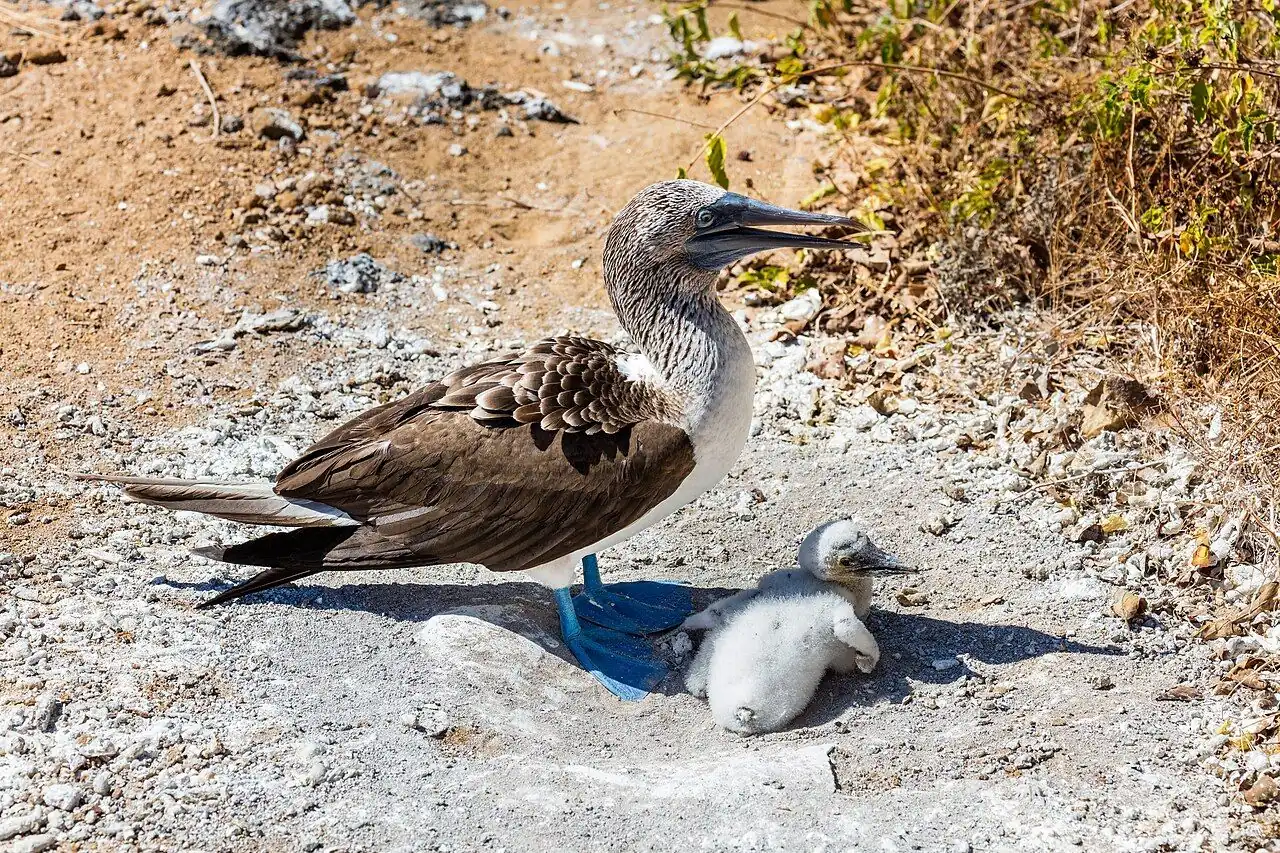
Blue-footed Booby
Sula nebouxii
An eastern Pacific seabird whose bright blue feet show how well it has been eating, and which males flaunt in a strutting courtship dance.
Photo: Diego Delso / CC BY-SA 4.0
3 things to know
- Its nostrils are permanently closed, which helps it swim underwater.
- A male's feet turned duller after 48 hours without food and brightened again when he was fed fish.
- In the Galápagos, adults fell from a rough 20,000 in the 1960s to about 6,400 in 2012.
- Scientific name
- Sula nebouxii
- Depth
- 0 m – 22 m
0 – 72 ft - Size
- About 81 cm (32 in) long on average, with a wingspan up to 1.5 m (4.9 ft)
- Weight
- About 1.5 kg (3.3 lb) on average, up to about 2 kg (4.4 lb); females are larger than males
- Lifespan
- About 17 years on average
- Diet
- Small schooling fish such as anchovies and sardines, plus other fish such as jack mackerel
- Where
- Islands and coasts of the eastern tropical Pacific, from Mexico to northern Peru, including the Galápagos
- IUCN status
- Least Concern
- Depth zones
- Sunlight
Bright blue webbed feet make this eastern Pacific seabird easy to recognize, and females have darker blue feet than males and young birds. The rest of it is brown and white: long, pointed brown wings spanning about 1.5 meters (4.9 feet), a pale cinnamon-brown head streaked with white, and white underparts. Adults average about 81 centimeters (32 inches) and 1.5 kilograms (3.3 pounds), and females are larger than males. Blue-footed boobies breed on islands off the Pacific coasts of Mexico, Central America and northern South America.
The color carries information. In a 2006 study, Alberto Velando, René Beamonte-Barrientos and Roxana Torres showed that the blue comes from arrays of collagen in the skin plus carotenoid pigments from fresh fish. When males went without food for 48 hours their feet turned duller, and when they were fed fish again the feet brightened. In a second experiment the team dulled the feet of some males with water-resistant makeup the day after their mates laid a first egg. Those females then laid smaller second eggs than females whose mates were left alone, which the authors say makes it easier for a brood to shrink to one chick. A courting male struts in front of a female lifting his feet up and down, and also points his bill to the sky with his wings and tail raised.
Boobies hunt small schooling fish such as sardines and anchovies, sometimes in flocks of up to 200 birds. When one spots fish it whistles, and the flock dives together. They plunge from 20 meters (65 feet) or more and hit the water at up to about 97 kilometers per hour (60 mph). Off Peru, Carlos Zavalaga and colleagues logged 4,133 dives by 51 boobies; most were about 4 meters (13 feet) deep, the deepest 22 meters (72 feet).
Females lay two or three eggs. Boobies have no brood patch, so both parents incubate the eggs on their feet, for about 41 to 45 days.
In the Galápagos, David Anchundia, Kathryn Huyvaert and David Anderson counted about 6,400 adults in 2012, against a rough estimate of 20,000 in the 1960s, and long-term data suggest poor breeding began in 1998. They linked it to a natural drop in sardines, the fish that had supported successful breeding. Worldwide, the IUCN lists the species as Least Concern, in a 2020 assessment, with numbers decreasing.



