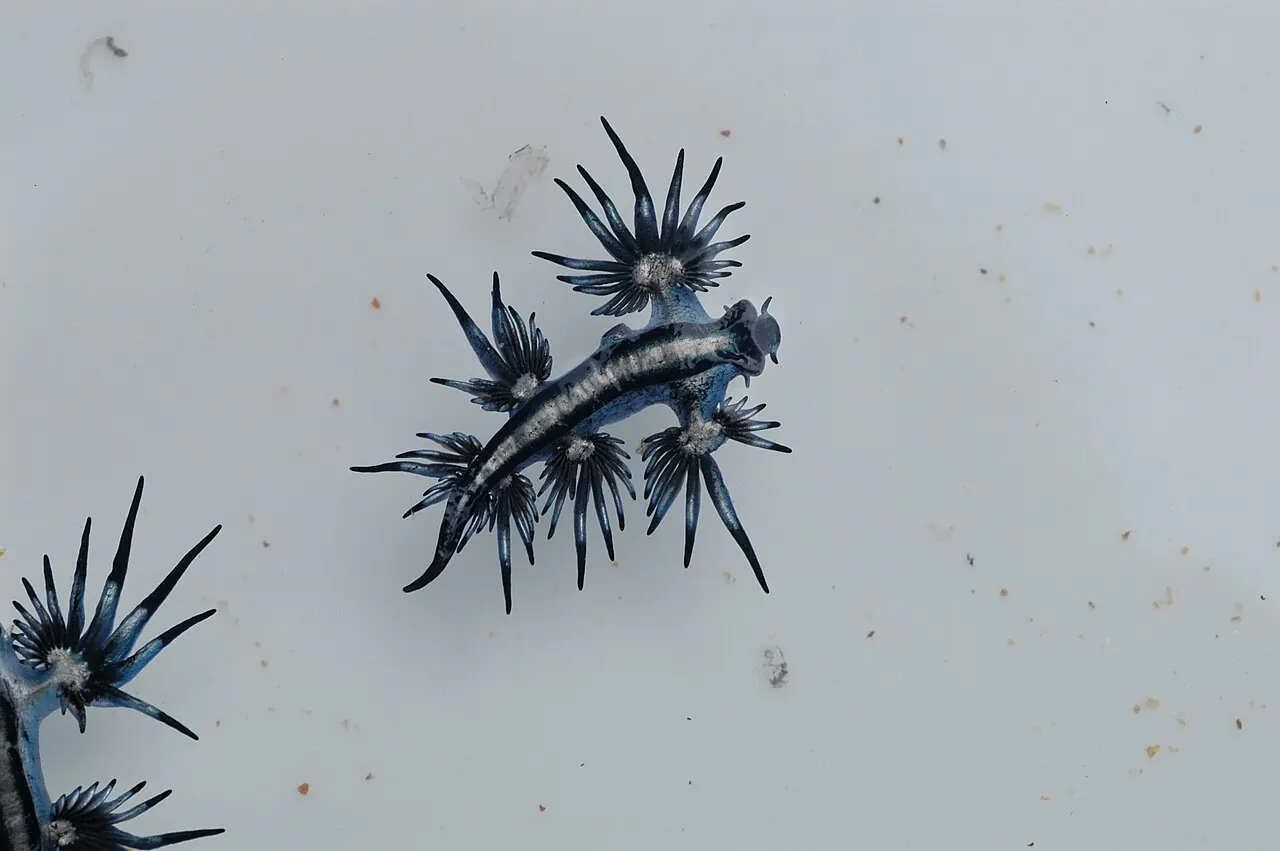
Blue Dragon
Glaucus atlanticus
A thumb-sized sea slug that floats upside down at the surface, eats Portuguese man o' war and keeps its prey's stingers for itself.
Photo: Doug Beckers from Macmasters Beach, Australia / CC BY-SA 2.0
3 things to know
- It floats belly up at the surface, held up by an air bubble in its stomach.
- It stores the stinging cells of the Portuguese man o' war it eats and uses them in its own defense.
- In May 2020 several washed up on Padre Island National Seashore in Texas, and the park told visitors to keep their distance.
- Scientific name
- Glaucus atlanticus
- Depth
- At the surface
- Size
- Up to about 4 cm (1.6 in) long
- Weight
- Unknown
- Lifespan
- Not well known
- Diet
- Mainly Portuguese man o' war; also other floating animals such as Velella and Porpita
- Where
- Warm surface waters of the Atlantic, Pacific and Indian oceans
- IUCN status
- Not Evaluated
- Depth zones
- Sunlight
A blue dragon lives its whole adult life upside down at the top of the ocean. This small sea slug, Glaucus atlanticus, floats belly up, buoyed by a bubble of gas in its stomach, and goes where the currents and winds carry it. Bill Rudman of the Australian Museum called its coloring a textbook case of countershading: the blue side faces the sky and helps hide it from seabirds, while the silvery gray side faces down, hiding it from fish below. It grows to about 4 centimeters (1.6 inches) long, with feathery clusters of appendages called cerata spreading from its flanks.
Its main prey is the Portuguese man o' war, a venomous floating siphonophore, and it also eats other drifting animals such as Velella and Porpita. In 1969, Thompson and Bennett reported in the journal Science that Glaucus and its relative Glaucilla store the man o' war's stinging cells, called nematocysts, and use them for their own defense. Like most aeolid sea slugs, Rudman noted, they keep the stolen stingers in small sacs at the tips of their cerata, and they appear to pick out the most venomous ones.
Like other nudibranchs, each blue dragon is both male and female, and two partners mate with each other. Little is known about how long they live in the wild.
The species turned out to be simpler than its close relatives. In 2013 and 2014, Celia Churchill, Ángel Valdés, Diarmaid Ó Foighil and colleagues compared the DNA and anatomy of these floating slugs. G. atlanticus proved to be one species found in warm waters around the world, recognizable by a silver stripe down the middle of its foot. Its Indo-Pacific relative, long treated as one species, G. marginatus, turned out to be four genetically distinct species, three of which the team named in 2014. Changes in the reproductive organs set several of them apart.
Because it drifts, it sometimes washes ashore. In May 2020, visitors to Padre Island National Seashore in Texas began finding blue dragons on the beach, and the park posted a warning to admire them and keep their distance. Touching one can release the stored stinging cells.
Sources
- sealifebase.se/summary/Glaucus-atlanticus.html
- seaslugforum.net/glauatla.htm
- Study: doi:10.1126/science.166.3912.1532
- Study: doi:10.1098/rspb.2013.1224
- Study: doi:10.1071/IS13038
- en.wikipedia.org/wiki/Glaucus_atlanticus
- cbsnews.com/texas/news/serpentine-creatures-texas-blue-dragons-padre-island-seashores
- click2houston.com/news/texas/2020/05/10/rare-blue-dragons-are-washing-up-on-the-padre-i…



