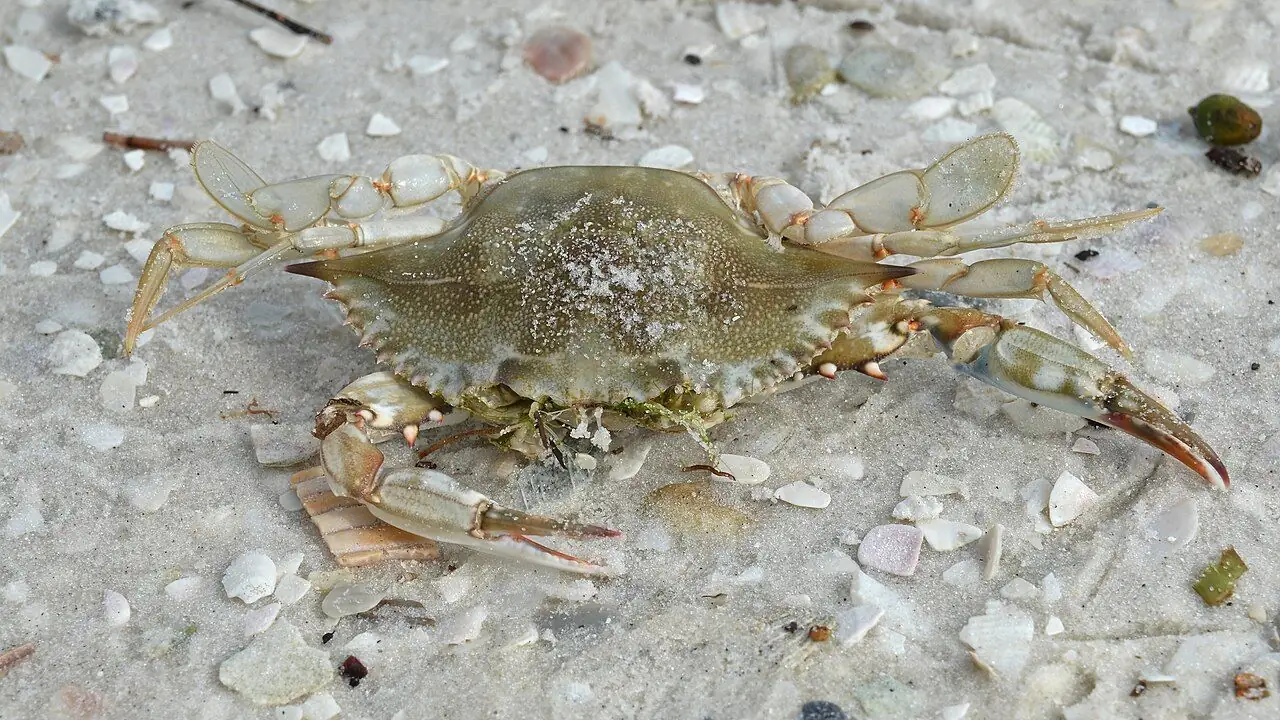
Blue Crab
Callinectes sapidus
The beautiful savory swimmer of Chesapeake Bay, with paddle-shaped back legs, and now an invader raiding clam farms in Italy.
Photo: Ryan Hodnett / CC BY-SA 4.0
3 things to know
- Its scientific name, Callinectes sapidus, translates as beautiful savory swimmer.
- Mature females have red tips on their bright blue claws.
- One brood can hold 750,000 to 3.2 million eggs.
- Scientific name
- Callinectes sapidus
- Depth
- 0 m – 35 m
0 – 115 ft - Size
- Shell up to about 23 cm (9 in) across, tip to tip
- Weight
- Usually about 150 g (1/3 lb); the Chesapeake Bay record is 0.5 kg (1.1 lb)
- Lifespan
- Generally 3 to 4 years
- Diet
- Clams, oysters, mussels, small crustaceans, dead fish, detritus and smaller blue crabs
- Where
- Western Atlantic from Nova Scotia to Argentina, including the Gulf of Mexico; introduced to the eastern Atlantic, the Mediterranean and Black Seas and the Indo-Pacific
- IUCN status
- Not Evaluated
- Depth zones
- Sunlight
NOAA Fisheries translates Callinectes sapidus as "beautiful savory swimmer." The shell is blue to olive green and up to about 23 centimeters (9 inches) from tip to tip, with nine teeth along each side, the last one a strong spine. The claws are bright blue, and mature females add red tips. The rear legs end in flat paddles, which is what makes it a swimming crab.
The native range runs along the Atlantic coast of the Americas from Nova Scotia to Argentina, including the Gulf of Mexico. It lives in bays and estuaries, mostly shallower than 35 meters (115 feet), and eats nearly anything: clams, oysters, mussels, smaller crustaceans, freshly dead fish, plant and animal detritus, and smaller or soft-shelled blue crabs. In Chesapeake Bay, where it is the most valuable fishery and Maryland's state crustacean, males favor the fresher upper bay and its rivers while females gather in saltier water toward the mouth.
Mating is tied to the female's last molt. A male cradles her for several days while she prepares to molt, mates with her once she does, and keeps guarding her until her new shell hardens. She then migrates to the bay mouth and produces 750,000 to 3.2 million eggs per brood. The larvae spend four to eight weeks developing in coastal ocean water before returning to the estuary. Crabs mature at 12 to 18 months, and NOAA says they generally live three or four years. A typical adult weighs about 150 grams (a third of a pound); the largest blue crab caught in Chesapeake Bay weighed 0.5 kilograms (1.1 pounds) and measured 27.2 centimeters (10.72 inches) across.
Outside its home range it has become a costly invader. SeaLifeBase lists introductions to the eastern Atlantic, the Mediterranean and Black Seas and the Indo-Pacific. In Italy's Po Delta lagoons on the northern Adriatic, Sara Bonanomi, Emanuele Rossetti and Ernesto Azzurro reported in 2026 that its rapid spread had severely disrupted farming of Manila clams. Farmers answered with perimeter fences, predator-exclusion nets and daily trapping, which allowed a partial recovery, though clam production remained far below pre-invasion levels, and new export markets for the crab helped offset the losses.
The blue crab has not been assessed for the IUCN Red List.



