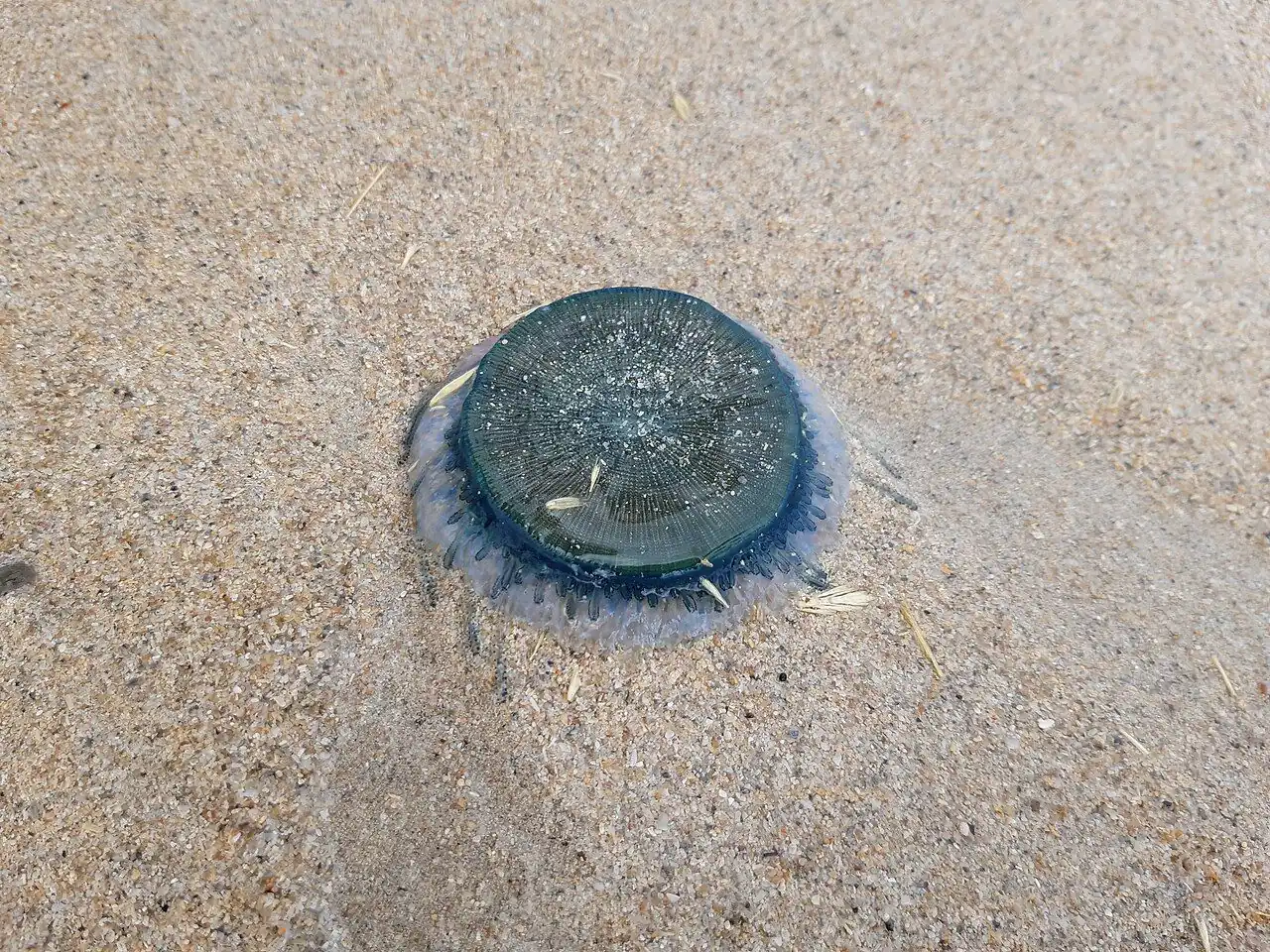
Blue Button
Porpita porpita
A coin-sized floating colony of polyps, related to the by-the-wind sailor, that may drift on the open ocean for years.
Photo: Calistemon / CC BY-SA 4.0
3 things to know
- A blue button is a colonial hydrozoan, a colony of polyps sharing one float, not a jellyfish.
- Its float grows by adding rings at the outer edge, like the rings of a tree.
- A 2026 University of Tokyo study estimated that a colony with a 23-millimeter radius was about five years old.
- Scientific name
- Porpita porpita
- Depth
- At the surface
- Size
- Float about 2–5 cm (0.8–2 in) across; whole colony up to about 6 cm (2.4 in)
- Weight
- Unknown
- Lifespan
- Not well known; a 2026 University of Tokyo study estimates colonies may live for several years
- Diet
- Small drifting plankton
- Where
- Ocean surface in tropical and subtropical waters of the Atlantic, Indian and Pacific oceans; has washed ashore at Galveston, Texas
- IUCN status
- Not Evaluated
- Depth zones
- Sunlight
A blue button is a firm, flat disc that floats on the sea surface, ringed with short, bright blue strands. It is often called a jellyfish, but it is a colonial hydrozoan: a colony of small polyps, called zooids, that share one float. The University of California Museum of Paleontology counts it and the by-the-wind sailor, Velella, as the only accepted genera in this small group, the chondrophores. The float is reinforced with a chitin-like material and divided into gas-filled chambers. Around it, zooids split the work. Dactylozooids catch food and defend the colony, gonozooids handle reproduction, and a single gastrozooid at the center digests food for all of them.
The float is usually 2 to 5 centimeters (0.8 to 2 inches) across, and the whole colony can reach about 6 centimeters (2.4 inches). The blue strands end in knobs of stinging cells. The sting is not strong, but it can irritate skin.
Blue buttons drift in tropical and subtropical waters of the Atlantic, Indian and Pacific oceans, feed on plankton at the surface, and are usually found only when onshore winds push them onto beaches. In July 2023 Texas wildlife officials reported them washing up at Galveston Island State Park, and a local naturalist group told beachgoers to look but not touch.
They are hard to keep alive, so how long they live was a guess. In a study published in Scientific Reports in May 2026, Kohei Oguchi, Daiki Wakita and colleagues at the University of Tokyo's Misaki Marine Biological Station collected colonies from rock pools on the Miura Peninsula, south of Tokyo, and kept 10 alive for up to 21 days in a 30-centimeter tub of filtered seawater, feeding them small shrimp. Using a growth model often applied to fish and coral, they estimated that a colony with a 4-millimeter radius was about 3 months old, a 12-millimeter one about a year, and a 23-millimeter one about five years on average. The university's announcement says blue buttons may live for several years adrift, against earlier estimates of under a year; the paper itself says the colonies persist for months to a few years. They also saw that the float grows by adding new rings at its outer edge, like the rings of a tree.
The blue button has not been assessed for the IUCN Red List.
Sources
- ucmp.berkeley.edu/cnidaria/chondrophorina.html
- u-tokyo.ac.jp/focus/en/press/z0508_00455.html
- Study: doi:10.1038/s41598-026-49897-y
- nature.com/articles/s41598-026-49897-y
- biodiversity.org.au/afd/taxa/Medusa_porpita
- surg.org.au/species/porpita-porpita-linnaeus-1758
- npr.org/2023/07/09/1186664798/blue-button-jellyfish-texas-beaches
- sealifebase.se/summary/Porpita-porpita.html
- api.gbif.org/v1/species/5185632/iucnRedListCategory



