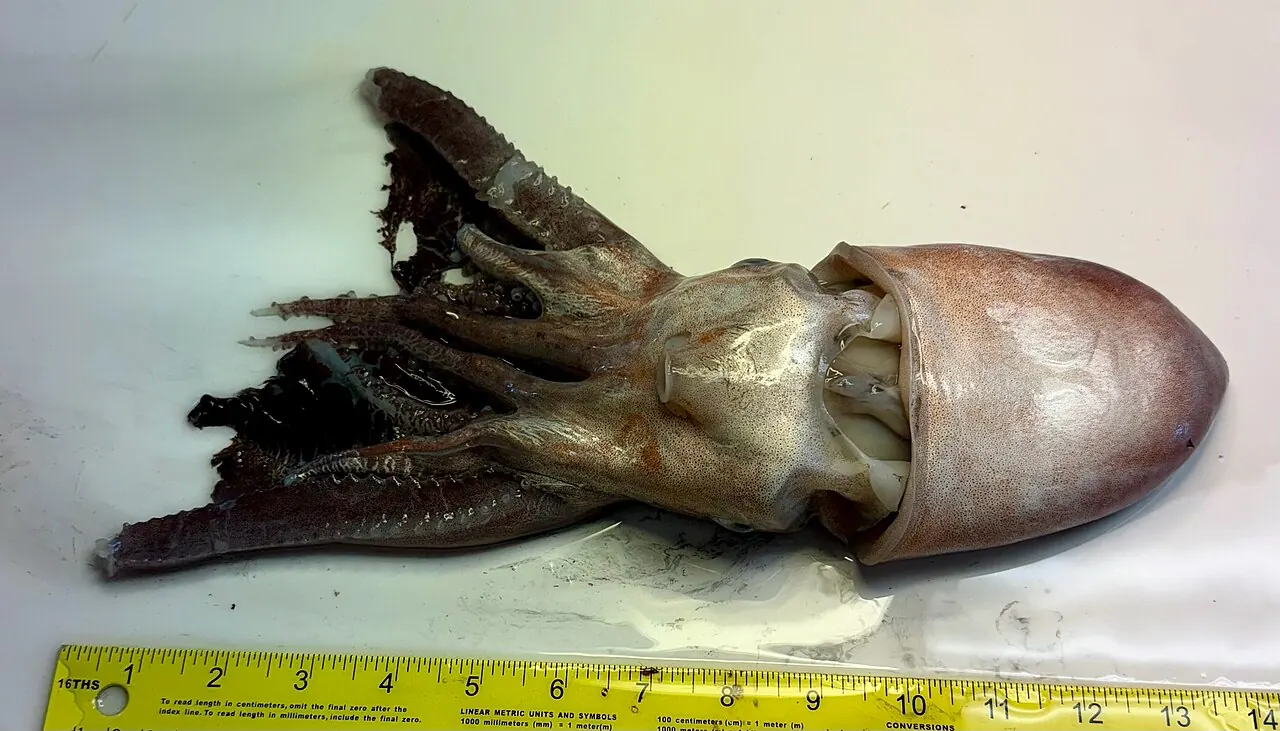
Blanket Octopus
Tremoctopus violaceus
A warm-water octopus whose females grow to 2 m and unfurl a cape-like web, while the males stay about 2.4 cm long.
Photo: toffner (iNaturalist) / CC BY 4.0
3 things to know
- Females are estimated to outweigh males at least 10,000 to 1.
- Young blanket octopuses have been found carrying pieces of Portuguese man o' war tentacles on their arms.
- Scientists first reported seeing a live male in the wild in 2002, off the Great Barrier Reef.
- Scientific name
- Tremoctopus violaceus
- Depth
- 0 m – 250 m
0 – 820 ft - Size
- Females up to about 2 m (6.6 ft) long; males about 2.4 cm (1 in)
- Weight
- Large females estimated at up to about 10 kg (22 lb); males no more than about a quarter of a gram
- Lifespan
- Not well known; one nearly mature female was about 161 days old
- Diet
- Females eat pteropods (swimming sea snails) and small fish
- Where
- Warm waters of the Atlantic, including the Gulf of Mexico and Caribbean, and the Mediterranean; Pacific animals may be a separate species
- IUCN status
- Least Concern
- Depth zones
- Sunlight · Twilight
Female blanket octopuses are named for the long, see-through webs stretched between their upper arms, which they can unfurl like a cape. A female can grow to 2 meters (6.6 feet). The males are tiny. On a night dive in open water off the Great Barrier Reef, Mark Norman and David Paul photographed a living male just 2.4 centimeters (about an inch) long. Writing in 2002 with Julian Finn and Tom Tregenza, they called it the first encounter with a live male and estimated that females outweigh males at least 10,000 to 1, probably as much as 40,000 to 1. National Geographic reported that the male weighed no more than a quarter of a gram.
That 2002 paper called the animal Tremoctopus violaceus. DNA work since then suggests the Pacific animals may belong to a separate species, T. gracilis. In 2021 a team led by María de Lourdes Jiménez-Badillo found that a female from the southwestern Gulf of Mexico differed from Pacific "violaceus" by about as much as separate species usually do, and a study of Mediterranean females led by Blondine Agus found they matched the Gulf animal. On that view T. violaceus is an animal of the warm Atlantic and the Mediterranean, which matches the range the IUCN lists for it, with the United States among the countries named.
It drifts in open water. Juveniles have been collected from the surface to 250 meters (820 feet), and the species is seen at the surface at night. Females are reported to eat pteropods, small swimming sea snails, and small fish. In 1963 Everet Jones described immature blanket octopuses with fragments of Portuguese man o' war tentacles stuck to the suckers of their upper arms and suggested they used the stinging tentacles as weapons. The tiny male Norman's team saw was clutching tentacle pieces too. They suggested that carrying stinging tentacles, along with sexual selection, may help explain why the sexes differ so much in size.
Like its relatives the argonauts, the male mates by passing the female a detachable arm. The largest of the Mediterranean females, 875 grams and close to maturity, carried four sperm packets, a sign of more than one partner. Counting the growth rings in its beak as one a day, it was about 161 days old. The IUCN lists the species as Least Concern, from a 2014 assessment.
Sources
- Study: doi:10.1080/00288330.2002.9517126
- web.archive.org/web/20050114090729/http://news.nationalgeographic.com/news/2003/02/0212…
- Study: doi:10.1126/science.139.3556.764
- Study: doi:10.3897/zookeys.1012.55718
- Study: doi:10.3390/ani12010080
- pmc.ncbi.nlm.nih.gov/articles/PMC8749848
- sealifebase.se/summary/Tremoctopus-violaceus.html
- iucnredlist.org/species/174487/1415800
- en.wikipedia.org/wiki/Blanket_octopus
- marinespecies.org/aphia.php
- web.archive.org/web/20250922184357/http://www.tolweb.org/Vitreledonella_richardi/20195



