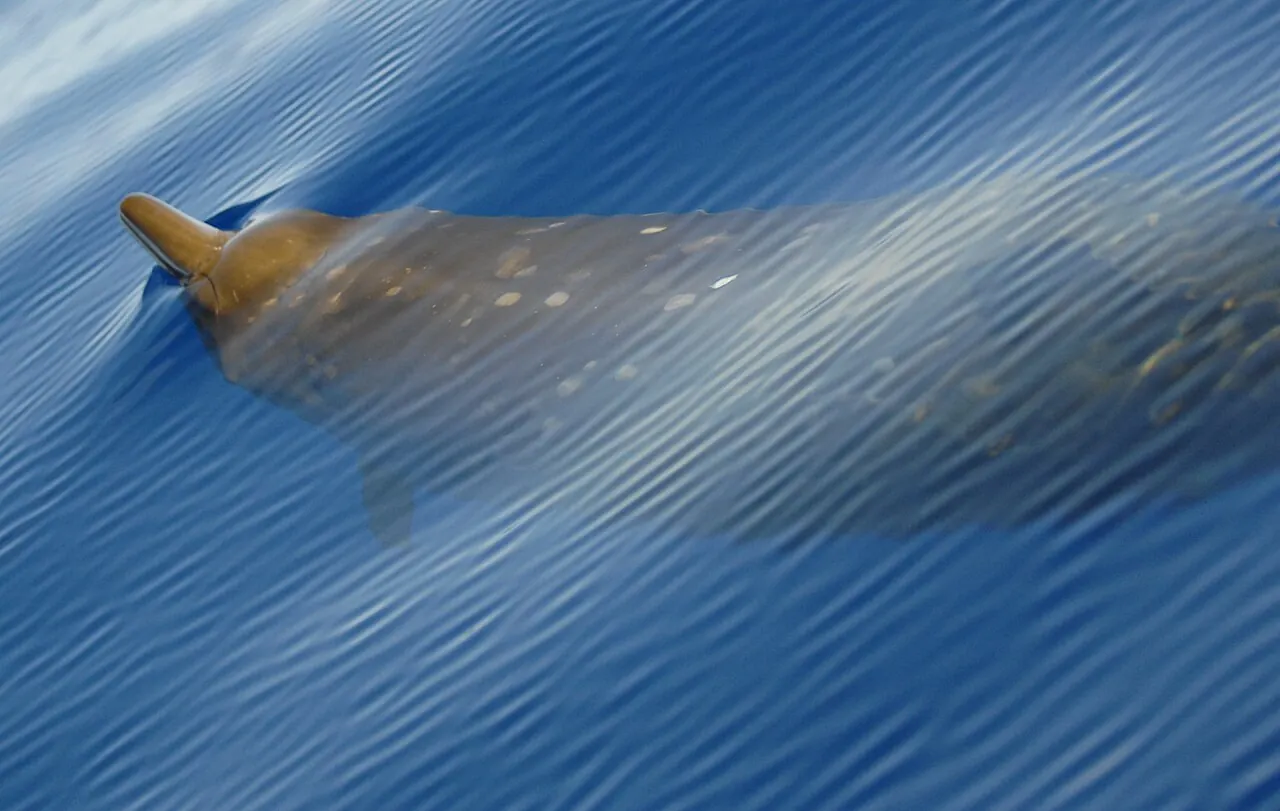
Blainville's Beaked Whale
Mesoplodon densirostris
A deep-diving beaked whale whose males grow tusk-like teeth on an arched jaw, and whose snout is made of the densest bone known.
Photo: NOAA Photo Library / Public domain
3 things to know
- Males have two tusk-like teeth that rise from a high arch in the lower jaw.
- The bone of its snout is the most highly mineralized, stiffest and hardest bone known.
- Tagged whales in one study averaged 835 m (2,740 ft) and 47 minutes on their foraging dives.
- Scientific name
- Mesoplodon densirostris
- Depth
- 0 m – 1,000 m
0 – 3,281 ft - Size
- About 4.6–6.1 m (15–20 ft) long
- Weight
- About 820–1,040 kg (1,800–2,300 lb)
- Lifespan
- Unknown
- Diet
- Small fish and squid, taken by suction on deep dives
- Where
- Deep offshore waters of tropical to temperate seas worldwide
- IUCN status
- Least Concern
- Depth zones
- Sunlight · Twilight
The lower jaw of an adult male Blainville's beaked whale rises in a high arch, and from the top of each side erupts a large, forward-pointing, tusk-like tooth. Females and young whales have a gentler curve. Males fight over access to females. Adults are 4.6 to 6.1 meters (15 to 20 feet) long and weigh 820 to 1,040 kilograms (1,800 to 2,300 pounds), and NOAA gives no estimate of lifespan because it is unknown.
The nickname "dense-beaked whale" is literal. In 1997 Zioupos and colleagues tested bone from the snout and reported in the Journal of Zoology that it was the most highly mineralized, stiffest and hardest bone known. It was also weak in bending, which made them doubt it helps in fights. They suggested the density might matter for producing sonar signals.
No other whale in its genus has a range as wide. It lives in deep offshore water of tropical to temperate seas around the world, alone or in groups of three to seven, and uses suction to catch small fish and squid. Regular dives last 20 to 45 minutes and commonly reach 490 to 1,000 meters (1,600 to 3,300 feet), and NOAA notes dives of more than 54 minutes and down to 1,400 meters (4,600 feet). When Tyack and colleagues put recording tags on three of these whales, their foraging dives averaged 835 meters (2,740 feet) and 47 minutes, with about 92 minutes between one deep dive and the next.
The species has stranded in the Bahamas after naval sonar use. At a naval underwater range near Andros Island, an array of seafloor hydrophones can hear the whales' clicks across the whole range. In a 2011 study, Tyack's team found that during sonar exercises the whales were heard mostly at the edges, on average 16 kilometers (10 miles) from the sonar, and moved back into the center over two to three days once the exercises ended. Tagged whales played simulated sonar, killer whale calls or plain noise stopped clicking and made unusually long, slow ascents, at sound levels well below those regulators used to define disturbance. The IUCN lists the species as Least Concern, and it is protected under the US Marine Mammal Protection Act.



