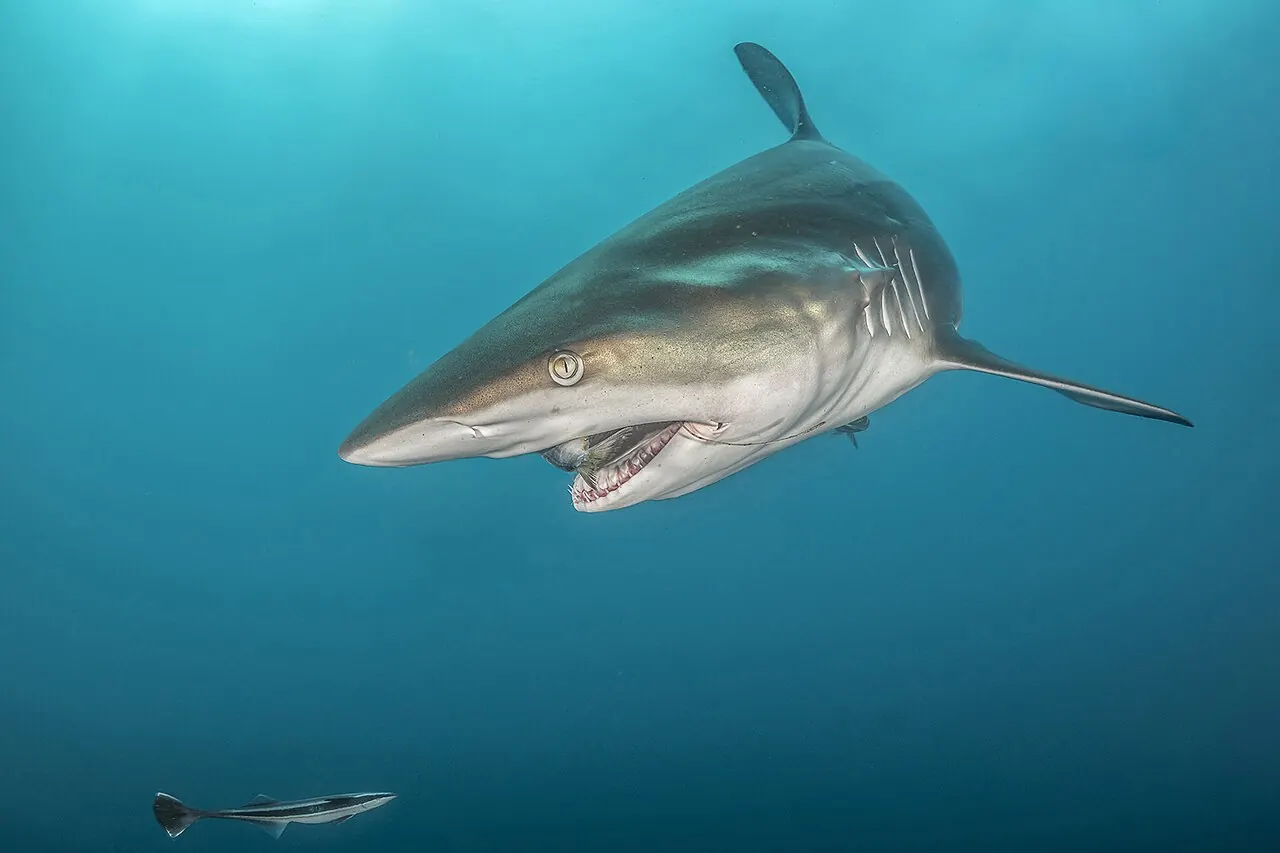
Blacktip Shark
Carcharhinus limbatus
A fast coastal shark with black-tipped fins that spins out of the water while feeding and winters by the tens of thousands off Florida.
Photo: Borut Furlan / CC BY-SA 4.0
3 things to know
- It often leaps and spins out of the water while chasing schools of small fish.
- An aerial survey counted 12,128 blacktips in one strip of Palm Beach County coast in 2011.
- Its anal fin is plain white, which separates it from the look-alike spinner shark.
- Scientific name
- Carcharhinus limbatus
- Depth
- 0 m – 30 m
0 – 98 ft - Size
- Commonly about 1.5 m (4.9 ft) long; up to about 2.5 m (8 ft)
- Weight
- Adults average about 18 kg (40 lb); the rod-and-reel record is 122 kg (270 lb)
- Lifespan
- At least 15.5 years (oldest observed)
- Diet
- Small schooling fishes such as menhaden, mullet, herring and sardines; also other bony fishes, small sharks, rays, squid and crustaceans
- Where
- Tropical and subtropical coasts worldwide; in the US from the Gulf of Mexico and Florida north to Virginia, straying to Cape Cod, and off Southern California and Hawaii
- IUCN status
- Vulnerable
- Depth zones
- Sunlight
Blacktip sharks feed by charging through schools of small fish near the surface, and they often carry the chase into the air, leaping clear and sometimes spinning three or four times before falling back. They are stocky, gray to brown above and white below, with a white band along each flank and black tips on the pectoral, dorsal and pelvic fins and the lower lobe of the tail. The anal fin stays white, which is how to tell a blacktip from the very similar spinner shark. Adults average about 1.5 meters (5 feet) and 18 kilograms (40 pounds).
Blacktips live along tropical and subtropical coasts worldwide, mostly in the top 30 meters (100 feet) of water, around river mouths, bays, mangroves, estuaries and reef drop-offs. NOAA Fisheries says they are common from Virginia through Florida and found year-round in the Gulf of Mexico, and they have been known to migrate as far north as Cape Cod.
Blacktips eat mostly small schooling fish such as menhaden, mullet, herring and sardines, plus other bony fish, small sharks, rays, squid and crustaceans. Females give birth after an 11 to 12 month pregnancy, in shallow nurseries; in the Atlantic, NOAA reports an average of three pups per litter. The oldest blacktip observed was 15.5 years old. A captive female has reproduced without a male.
Because they hunt in shallow water, blacktips meet swimmers and surfers, and the Florida Museum says they account for roughly 20 percent of shark bites in Florida waters, usually minor. NOAA rates both US stocks, Atlantic and Gulf of Mexico, as not overfished. Worldwide the picture is worse: the IUCN's 2020 assessment lists the species as Vulnerable, with a decreasing population.
Each winter, tens of thousands of migrating blacktips crowd into the shallows of southeast Florida, where a narrow shelf and the nearby Gulf Stream push them close to shore. From 2011 to 2014, Stephen Kajiura and Shari Tellman of Florida Atlantic University flew a survey about every two weeks along Palm Beach County, filming a strip 200 meters (660 feet) wide from shore. In 2011 they counted 12,128 sharks in that strip. Big numbers appeared only when the water was cooler than 25°C (77°F), and by April and May the count had fallen to about 1 percent of the peak. The authors offered the counts as a baseline for checking whether warming seas shorten the sharks' trip south.



