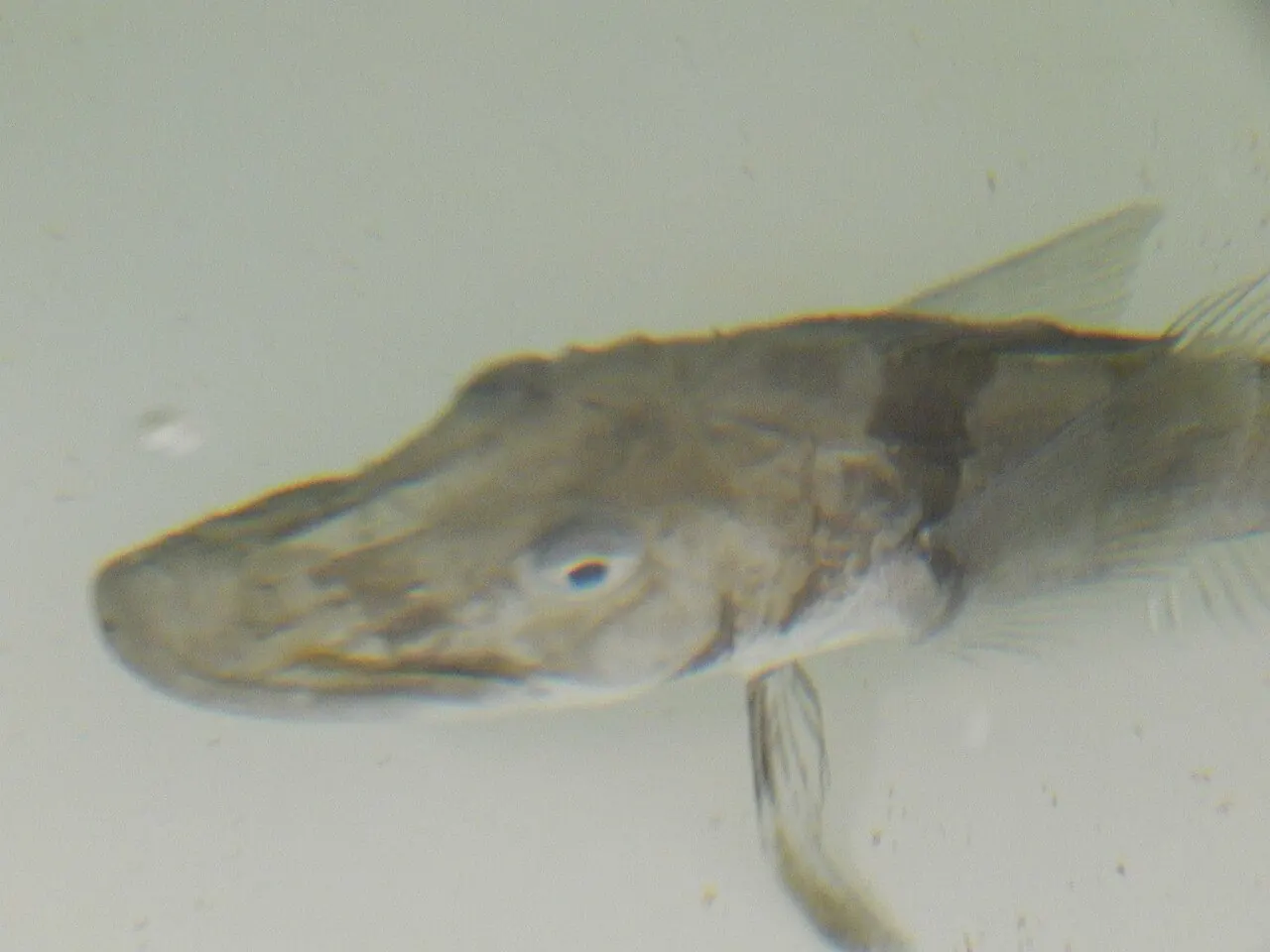
Blackfin Icefish
Chaenocephalus aceratus
An Antarctic fish with colorless blood: it has no red blood cells and no working hemoglobin, and makes up for it with a huge heart.
Photo: Ambiederman / CC BY-SA 4.0
3 things to know
- Icefishes are the only vertebrates known to lack functional hemoglobin genes and red blood cells.
- Its blood can carry less than a tenth as much oxygen as the blood of related red-blooded Antarctic fishes.
- Its genome, published in 2019, lacks some of the genes that keep daily body rhythms in other fishes.
- Scientific name
- Chaenocephalus aceratus
- Depth
- 5 m – 770 m
16 – 2,526 ft - Size
- Commonly about 50 cm (20 in); up to 72 cm (28 in)
- Weight
- Up to 3.7 kg (8.2 lb)
- Lifespan
- Up to about 17 years, based on one ear-stone study
- Diet
- Mostly fish and krill
- Where
- Southern Ocean around Bouvet Island, the Scotia Sea including South Georgia, and the northern Antarctic Peninsula
- IUCN status
- Vulnerable
- Depth zones
- Sunlight · Twilight
The blood of a blackfin icefish is colorless. Icefishes, the Antarctic family Channichthyidae, are the only vertebrates known to lack both red blood cells and working hemoglobin genes, according to a 2019 genome paper by Bo-Mi Kim and colleagues. The blackfin is a long, pale fish with a long, flattened snout, and FishBase lists it at up to 72 centimeters (28 inches) and 3.7 kilograms (8.2 pounds).
Without hemoglobin, oxygen travels only dissolved in the blood plasma, so each unit of icefish blood carries less than 10 percent of the oxygen that the blood of red-blooded Antarctic relatives can. Icefishes make up for it with enormous hearts that pump more blood per beat, wide vessels and extra mitochondria in their muscles. The oddity has been on record since 1954, when J. T. Ruud described these vertebrates without red cells or blood pigment in the journal Nature. In a 2006 review, Sidell and O'Brien argued that losing hemoglobin brought no clear advantage and raised the energy cost of pumping blood. Kim's team notes that cold Antarctic water holds a relatively high concentration of dissolved oxygen.
The 2019 genome, from a female caught at 20 to 30 meters in Marian Cove near Korea's King Sejong Station, turned up more surprises: expanded families of antifreeze and ice-protection genes, extra copies of genes that help control oxidative stress, and missing genes that regulate daily rhythms in other fish. Other blackfins for the project were trawled up and kept alive in aquariums at Palmer Station.
Blackfin icefish live around Bouvet Island, South Georgia and the Scotia Sea and the northern Antarctic Peninsula, from 5 to 770 meters (16 to 2,530 feet) deep, the full recorded range given by FishBase and the IUCN, which publish no narrower usual range. They eat mostly fish and krill. Females spawn once a year. In 2005 William Detrich and colleagues used a remotely operated vehicle off Bouvet Island to film six fish, all apparently male, guarding nests of eggs at 141 to 148 meters (463 to 486 feet). An ear-stone study along the southern Scotia Ridge put the maximum lifespan at 17 years.
The IUCN listed the species as Vulnerable in 2023, with a decreasing population, citing fishing and climate change, including shifting habitat and temperature extremes.
Sources
- fishbase.se/summary/Chaenocephalus-aceratus.html
- iucnredlist.org/species/241133178/241133181
- antarctica.gov.au/about-antarctica/animals/fish
- Study: doi:10.1038/s41559-019-0812-7
- Study: doi:10.1038/173848a0
- Study: doi:10.1242/jeb.02091
- Study: doi:10.1111/jfb.70344
- Study: doi:10.1007/s00300-005-0010-8
- nora.nerc.ac.uk/id/eprint/1746
- commons.wikimedia.org/wiki/File:C._aceratus.jpg



