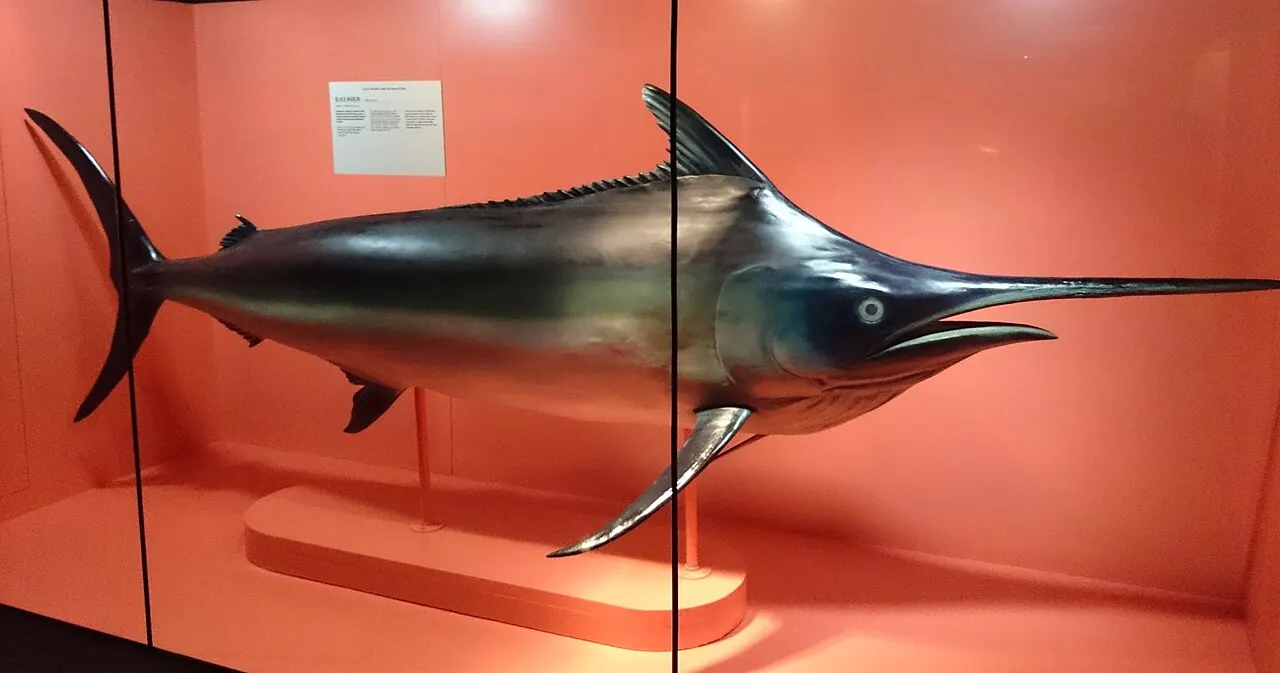
Black Marlin
Istiompax indica
A heavyweight marlin of the Indian and Pacific oceans with pectoral fins that cannot fold flat, and a 1,560-pound rod-and-reel record from 1953.
Photo: Nkansah Rexford / CC BY 3.0
3 things to know
- Its pectoral fins stick out from the body and cannot be folded flat against it.
- The all-tackle record fish, caught off Peru in 1953, weighed 1,560 pounds.
- Black marlin gather off Australia's Great Barrier Reef each October and November to spawn.
- Scientific name
- Istiompax indica
- Depth
- 0 m – 200 m
0 – 656 ft - Size
- Up to about 4.5 m (15 ft) long, including the bill
- Weight
- Over 700 kg (1,540 lb); the rod-and-reel record is 1,560 lb (708 kg)
- Lifespan
- Not well known; may exceed 15 years
- Diet
- Fish, especially small tunas, plus squid, cuttlefish, octopus and large crustaceans
- Where
- Tropical and subtropical Indian and Pacific oceans; strays reach the Atlantic around the Cape of Good Hope
- IUCN status
- Data Deficient
- Depth zones
- Sunlight
On a black marlin, the pectoral fins stick straight out from the sides like stiff blades. Unlike a blue marlin's, they cannot be pressed flat against the body, which is how the Australian Museum tells the two apart. The body is heavy and only slightly flattened, dark blue above and silvery white below, usually without markings, though some show pale blue vertical stripes. The bill is stout and round in cross section, and the first dorsal fin is lower than the body is deep.
This is the marlin of the Indian and Pacific oceans. A few turn up in the Atlantic, presumably after swimming around the Cape of Good Hope. Black marlin stay mostly in surface water above the thermocline and often come close to land, hunting near islands and coral reefs. They eat squid, cuttlefish, octopus and large crustaceans, but mostly small tunas such as skipjack and yellowfin. The bill is used to stun or slash prey before it is swallowed. Age is hard to read from marlin ear bones, and Fishes of Australia says the maximum may exceed 15 years.
The species grows to about 4.5 meters (15 feet) and 700 kilograms (1,540 pounds). On August 4, 1953, off Cabo Blanco, Peru, Alfred Glassell Jr. landed a 1,560-pound (708-kilogram) black marlin. The International Game Fish Association lists it as the all-tackle record for the species, and IGFA says the fish hangs at the Smithsonian Institution.
When Michael Domeier of the Marine Conservation Science Institute in Fallbrook, California, and Peter Speare of the Australian Institute of Marine Science studied black marlin off the Great Barrier Reef, the 25 large females they obtained from Lizard Island fishing tournaments weighed 295 to 525 kilograms, and the 3 males 59 to 158. Their 2012 paper confirmed that the marlin that gather off the reef each October and November, most of all between Cairns and the Ribbon Reefs, are there to spawn: ovaries showed it, and so did larvae from less than a day to about two weeks old caught nearby. From 67 satellite tags deployed between 2002 and 2009, they tentatively traced adults dispersing across the Coral Sea toward Papua New Guinea, the Solomon Islands, New Caledonia, Fiji and other island nations.
A female's ripe ovaries have been counted at about 40 million eggs. The IUCN lists the black marlin as Data Deficient.



