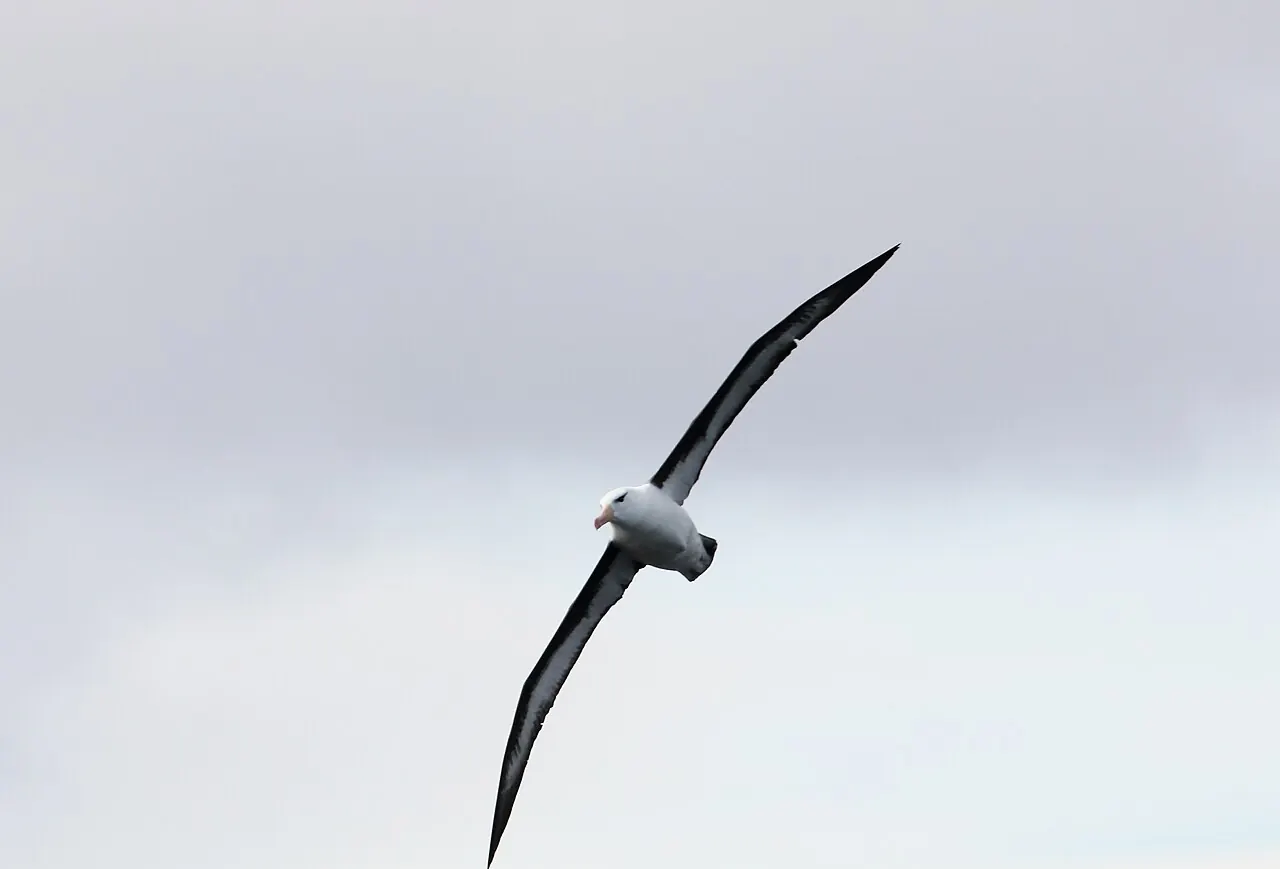
Black-browed Albatross
Thalassarche melanophris
The world's most numerous albatross, a Southern Ocean bird with a dark eyebrow that suffered heavy losses on fishing hooks before numbers rose again.
Photo: Dominic Sherony / CC BY-SA 2.0
3 things to know
- About 70 percent of all black-browed albatrosses breed in the Falkland Islands.
- Depth recorders on nine birds at South Georgia logged no dive deeper than 6 m (20 ft).
- The IUCN moved it from Endangered to Near Threatened in 2013 and now lists it as Least Concern.
- Scientific name
- Thalassarche melanophris
- Depth
- 0 m – 6 m
0 – 20 ft - Size
- About 80–95 cm (31–37 in) long, with a wingspan of 2.1–2.5 m (7–8 ft)
- Weight
- About 3–5 kg (6.5–11 lb)
- Lifespan
- 30 years or more
- Diet
- Krill, fish and squid, plus salps and jellyfish; scavenges behind fishing boats
- Where
- Southern Ocean and southern temperate seas; about 70 percent breed in the Falkland Islands, others in southern Chile, South Georgia and subantarctic islands
- IUCN status
- Least Concern
- Depth zones
- Sunlight
A dark smudge of feathers through each eye gives the black-browed albatross a permanent frown, and its name. Adults are white on the head and body with dark upper wings, back and tail, and carry a big yellow-orange hooked bill with a pinkish-red tip. They are 80 to 95 centimeters (31 to 37 inches) long with wings 2.1 to 2.5 meters (7 to 8 feet) across, small for an albatross, and weigh 3 to 5 kilograms (6.5 to 11 pounds).
With about 3 million birds, it is the world's most numerous albatross, according to New Zealand Birds Online. Around 70 percent breed in the Falkland Islands; other colonies are in southern Chile, South Georgia and on subantarctic islands such as Kerguelen, Heard and Macquarie. Nests are pillars of mud and guano on clifftop terraces, reused each year. A pair lays one egg in September or October, and the parents share about 70 days of incubation and 130 days of chick rearing. Birds first breed at about 10 years old and live 30 years or more.
They catch krill, fish and squid at or just below the surface and follow whales, dolphins and fishing boats. Just how shallow they feed was measured by L. K. Bentley and colleagues from the University of Cambridge and the British Antarctic Survey, who fitted depth recorders to nine birds raising chicks on Bird Island, South Georgia, in the 2009–10 summer. The loggers counted 329 dives deeper than 1 meter. The average was about 1.5 meters (5 feet), the deepest 6 meters (20 feet), two birds never dived, and no dives happened in darkness. The authors say this supports rules requiring longline boats to set their hooks at night.
Hooks were the species' main problem. Deaths in longline and trawl fisheries, especially in the South Atlantic, drove the declines that once had it listed as Endangered. Falklands surveys in 2010 showed growth of at least 4 percent a year since 2005, the IUCN downgraded the bird to Near Threatened in 2013, and its 2018 assessment lists it as Least Concern and increasing.
Strays sometimes reach the North Atlantic. The British Trust for Ornithology describes one nicknamed Albert that first appeared on the Bass Rock in 1967 and then returned to Hermaness, Shetland, almost every year from 1972 to 1995.
Sources
- antarctica.gov.au/about-antarctica/animals/flying-birds/black-browed-albatross
- nzbirdsonline.org.nz/species/black-browed-mollymawk
- acap.aq/news/news-archive/2012-news-archive/black-browed-albatrosses-are-doing-better-t…
- Study: doi:10.1007/s00227-021-03841-y
- nora.nerc.ac.uk/id/eprint/528028/1/Bentley2021_Article_DivingBehaviourOfAlbatrossesIm.pdf
- bto.org/understanding-birds/birdfacts/black-browed-albatross
- iucnredlist.org/species/22698375/132643647



