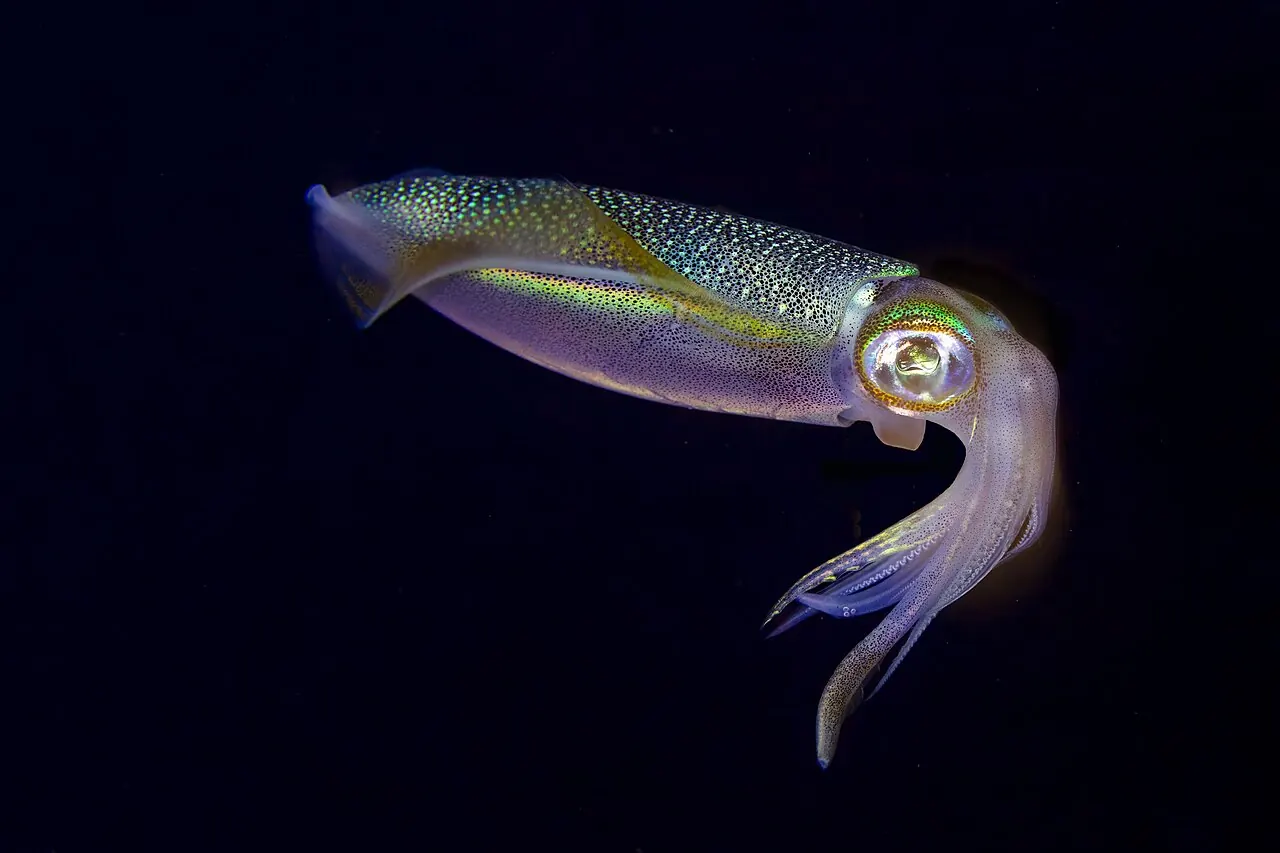
Bigfin Reef Squid
Sepioteuthis lessoniana
A fast-growing, short-lived reef squid of the Indian Ocean and western Pacific, with fins along most of its body, that may be several species.
Photo: Diego Delso / CC BY-SA 4.0
3 things to know
- Its thick fins run along most of its mantle, giving it a cuttlefish-like outline.
- Growth rings showed adults in the Philippines were only about 2 to 4 months old.
- In lab tests it responded to sounds from 400 to 1,500 hertz.
- Scientific name
- Sepioteuthis lessoniana
- Depth
- 0 m – 100 m
0 – 328 ft - Size
- Mantle up to about 40 cm (16 in) long
- Weight
- Not well known
- Lifespan
- Under a year to about a year
- Diet
- Mollusks, fish and prawns
- Where
- Indian Ocean and western Pacific, from Japan to Australia and New Zealand and west to East Africa and the Red Sea; introduced to the Mediterranean
- IUCN status
- Data Deficient
- Depth zones
- Sunlight
The thick oval fins of the bigfin reef squid run along most of the length of its mantle, so from above it looks a bit like a cuttlefish. The mantle can reach about 40 centimeters (16 inches). It lives in warm coastal waters of the Indian Ocean and western Pacific, from Japan to Australia and New Zealand and west to East Africa and the Red Sea, among rocky reefs, seaweed and estuaries, from the surface to about 100 meters (330 feet). It has also been introduced to the Mediterranean. Mostly active at night, it moves deeper or stays close to reefs, rocks, seagrass or floating driftwood by day. It is a strict carnivore that seizes live prey with its two tentacles, mainly mollusks, fish and prawns, and bigger squid sometimes eat smaller ones.
It grows fast and dies young. Miriam Balgos and Daniel Pauly counted the daily growth rings in the statoliths, tiny balance stones, of squid from northwestern Luzon in the Philippines. Adults with mantles 62 to 315 millimeters long were only 62 to 132 days old and grew about half a millimeter a day. In Japan, Yuzuru Ikeda's team found that wild squid lived about a year, while those raised in tanks matured sooner and died at 189 to 247 days. At the University of Texas Medical Branch in Galveston, Leigh Walsh and colleagues reported in 2002 that they had raised the species through seven generations in captivity.
Whether cephalopods can hear sounds above 400 hertz was still debated in 2009, when Marian Hu and colleagues tested this squid and the common octopus with the auditory brainstem response method, which had already been used on fish, crustaceans, amphibians, reptiles and birds. The squid responded to sounds from 400 to 1,500 hertz, the octopus only up to 1,000, and the squid's thresholds were generally lower.
The name may cover more than one animal. In Shark Bay, Western Australia, Lianos Triantafillos and Mark Adams compared 40 squid from two sites and found that four from the oceanic site differed genetically from the rest, which they read as most likely two cryptic species in that area. The squid is caught commercially for food. The IUCN lists it as Data Deficient, from an assessment made in 2014 and published in 2019.
Sources
- sealifebase.se/summary/Sepioteuthis-lessoniana.html
- iucnredlist.org/species/163376/1003553
- Study: doi:10.2305/IUCN.UK.2019-2.RLTS.T163376A1003553.en
- en.wikipedia.org/wiki/Bigfin_reef_squid
- Study: doi:10.2989/025776198784126331
- Study: doi:10.1017/S175526720900061X
- Study: doi:10.1016/S0044-8486(02)00126-6
- Study: doi:10.1016/j.cbpa.2009.02.040
- Study: doi:10.1016/j.icesjms.2005.06.004



