Bigeye Thresher
Alopias superciliosus
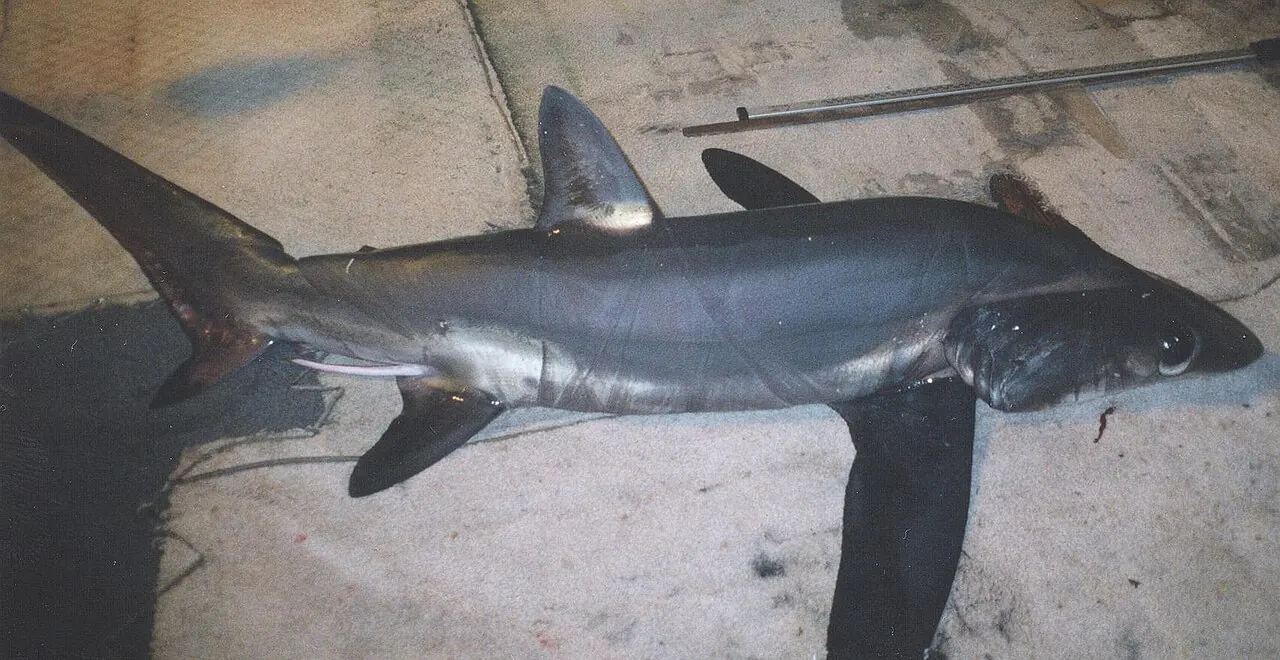
A thresher shark with huge upward-looking eyes that spends its days hundreds of meters down and rises toward the surface at night.
Photo: PIRO-NOAA Observer Program / Public domain
3 things to know
- Its eyes are huge and point upward, and the top of its head has grooves.
- A tagged bigeye thresher in the Gulf of Mexico spent 84 percent of its daytime 300 to 500 m (980 to 1,640 ft) down.
- A net of blood vessels in each eye socket may buffer its eyes and brain from the temperature swings of its daily dives.
- Scientific name
- Alopias superciliosus
- Depth
- 0 m – 500 m
0 – 1,640 ft - Size
- Adults commonly 3.35 to 4 m (11 to 13 ft) including the tail; up to 4.88 m (16 ft)
- Weight
- Up to about 364 kg (802 lb)
- Lifespan
- About 20 years (maximum reported age)
- Diet
- Open-ocean fishes such as lancetfishes, herring, mackerel and small billfishes; bottom fishes such as hake; squid
- Where
- Tropical and temperate seas worldwide; in US waters from New York to Florida, off California and south of the Hawaiian Islands; also tracked in the Gulf of Mexico
- IUCN status
- Vulnerable
- Depth zones
- Sunlight · Twilight
All three thresher sharks have the same long, whip-like upper tail lobe, which can be about half the shark's total length. What sets the bigeye apart is its head. Its eyes are enormous and set high, looking upward, and grooves run along the top of the head behind them. The body is purplish-gray to brownish-gray above and cream below, and unlike the common thresher, the pale belly does not extend up over the bases of the pectoral fins. Adults are commonly 3.35 to 4 meters (11 to 13 feet) long including the tail, and the largest reported was 4.88 meters (16 feet).
Bigeye threshers live in tropical and temperate seas around the world, mostly in the open ocean. In US waters they are found from New York to Florida, off California and south of the Hawaiian Islands. They eat open-ocean fish such as lancetfish, herring, mackerel and small billfish, bottom fish such as hake, and squid, and they stun prey with the tail.
Those big eyes suit a daily commute. In 2000 and 2003, Kevin Weng and Barbara Block of Stanford University's Hopkins Marine Station put pop-up satellite tags on two bigeye threshers, one in the Gulf of Mexico and one off Kona, Hawaii. The Gulf shark spent 84 percent of its daytime between 300 and 500 meters (980 and 1,640 feet) deep, in water of about 6 to 12°C (43 to 54°F), and 80 percent of its nights between 10 and 100 meters (33 and 330 feet). Both sharks followed that day-deep, night-shallow pattern. The authors also described a dense network of blood vessels, a rete mirabile, in each eye socket. They suggested it could buffer the eyes and brain from the large temperature changes of each trip.
Bigeye threshers grow slowly. Males mature at about 9 to 10 years and females at 12 to 14, and the maximum reported age is about 20. Embryos feed on unfertilized eggs inside the mother, and a litter holds only 2 to 4 pups, usually two, born about 0.6 to 1.4 meters (2 to 4.6 feet) long, depending on the source.
It is caught on longlines and in gillnets, and off the US it is a nuisance bycatch of the swordfish longline fishery. Retention is prohibited in US Atlantic commercial shark fisheries, and the IUCN's 2018 assessment lists the bigeye thresher as Vulnerable.
Sources
- floridamuseum.ufl.edu/discover-fish/species-profiles/alopias-superciliosus
- fishbase.se/summary/Alopias-superciliosus.html
- spo.nmfs.noaa.gov/sites/default/files/pdf-content/2004/1021/weng.pdf
- fisheries.noaa.gov/atlantic-highly-migratory-species/commercial-atlantic-shark-fishery-…
- iucnredlist.org/species/161696/894216
- api.gbif.org/v1/species/2420813/iucnRedListCategory



