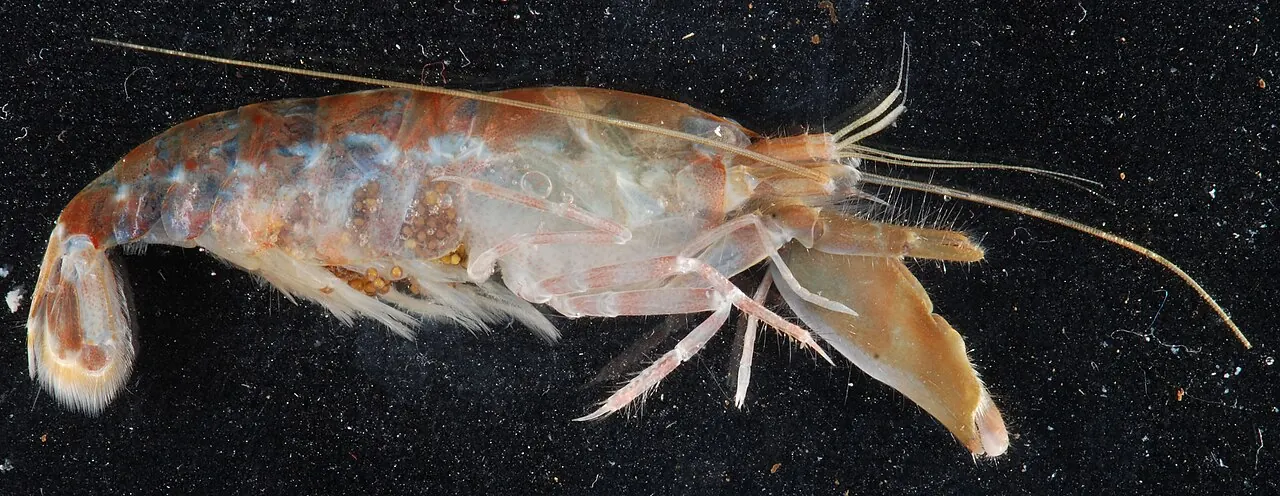
Bigclaw Snapping Shrimp
Alpheus heterochaelis
A small shrimp of US coasts whose oversized claw fires a jet of water, opening a bubble that collapses with a crack and a flash of light.
Photo: Smithsonian Environmental Research Center / CC BY 2.0
3 things to know
- The crack of its snap comes from a collapsing bubble, not the claw.
- The collapsing bubble briefly reaches at least 5,000 kelvin inside.
- It snaps more often in warmer water.
- Scientific name
- Alpheus heterochaelis
- Depth
- 0 m – 79 m
0 – 259 ft - Size
- Usually 3 to 5.5 cm (1.2 to 2.2 in) long
- Weight
- Not well known
- Lifespan
- Not well known
- Diet
- Small animals such as worms, crustaceans and small fish, stunned or killed with its snap
- Where
- Western Atlantic, from Chesapeake Bay and North Carolina south through the Gulf of Mexico and the Caribbean to Brazil
- IUCN status
- Not Evaluated
- Depth zones
- Sunlight
One claw on Alpheus heterochaelis is far bigger than the other. Adults usually measure 3 to 5.5 centimeters (about 1 to 2 inches), and the snapping claw can be on either side. The body is partly see-through, blue-green to gray with darker speckles, with orange on the head, the tail tip and the big claw, according to the University of Michigan's Animal Diversity Web. Males and females look alike, except that the male's snapping claw is slightly larger.
It lives in the western Atlantic, from Chesapeake Bay and North Carolina south to Florida, through the Gulf of Mexico and the Caribbean, and as far as Brazil. It lives in shallow, quiet water in bays and estuaries, and SeaLifeBase has records as deep as 79 meters (260 feet). By day it hides under rocks and shells, and it is common on oyster reefs and on muddy bottoms with oyster clumps. It copes with water from brackish to very salty, and in salt marshes it has been reported sharing the burrows of mud crabs.
The big claw locks open, then snaps shut so fast that it shoots out a jet of water. In 2000, a team led by Michel Versluis and Detlef Lohse of the University of Twente in the Netherlands filmed this species with high-speed cameras and an underwater microphone. They showed that the jet tears open a vapor bubble and that the crack comes when the bubble collapses, not when the claw closes. A year later the team found the collapsing bubble gives off a brief flash of light, which means the gas inside reaches at least 5,000 kelvin. The snap stuns or kills prey such as worms, crustaceans and small fish, and the shrimp also snap at each other in fights over territory.
Many live in male-female pairs. In one study, about two-thirds of those collected were paired. A female can mate only in a short window after she molts, and the eggs develop for about four weeks before hatching. Colonies of snapping shrimp are noisy enough to dominate the sound of shallow coasts, and a 2022 study led by Ashlee Lillis found that this species snaps more in warmer water. How long it lives in the wild is not well documented. It has not been assessed for the IUCN Red List.



