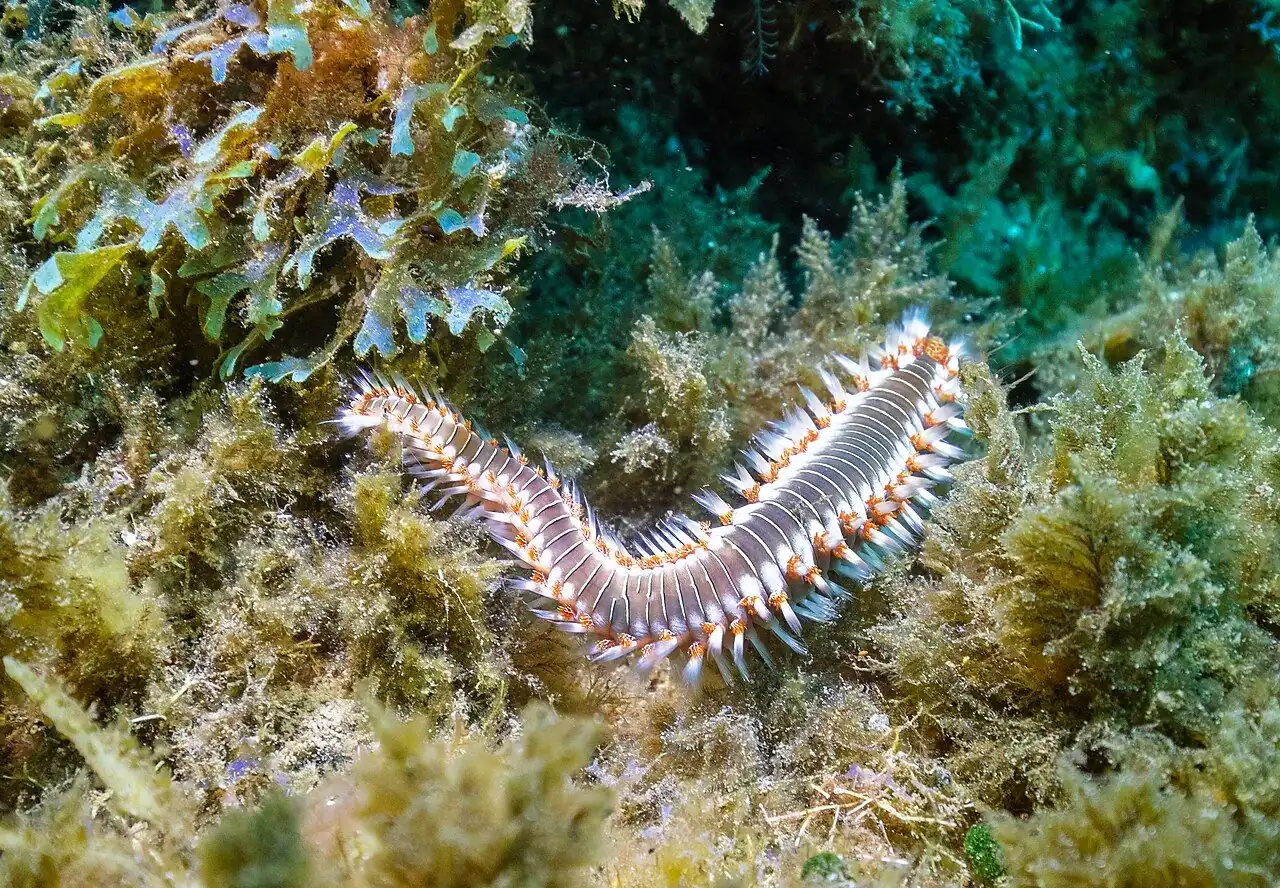
Bearded Fireworm
Hermodice carunculata
A coral-eating reef worm with tufts of brittle white bristles that break off in skin and burn. A 2018 study found venom-like genes.
Photo: Diego Delso / CC BY-SA 4.0
3 things to know
- Its white bristles break off in skin and cause an intense burning sensation.
- It feeds on corals, including the stinging fire coral.
- Worms kept in low-oxygen water regrew larger gills than worms in normal seawater.
- Scientific name
- Hermodice carunculata
- Depth
- 3 m – 109 m
10 – 358 ft - Size
- Up to about 30 cm (12 in) long, according to the Smithsonian
- Weight
- Unknown
- Lifespan
- Unknown
- Diet
- Corals, including fire coral
- Where
- Tropical and warm Atlantic, including the Caribbean, Gulf of Mexico and Gulf of Guinea, and the Mediterranean Sea
- IUCN status
- Not Evaluated
- Depth zones
- Sunlight
Do not pick up a bearded fireworm. Tufts of white bristles line its long, segmented body. They are made of calcium carbonate and break off on contact. Lodged in human skin, they cause an intense burning sensation, according to the Smithsonian's Ocean portal, which shows one from St. John in the US Virgin Islands about 15 centimeters (6 inches) long and notes they can grow to twice that length.
The fireworm lives on reefs across the warm Atlantic and in the Mediterranean, and SeaLifeBase records it from about 3 to 109 meters (10 to 358 feet) deep. It is a coral predator. The Smithsonian photo shows one feeding on fire coral, which stings swimmers, apparently without trouble.
Whether fireworms are truly venomous has been an open question, partly because no venom gland had been found. In a study published in 2018, Aida Verdes, Danny Simpson and Mandë Holford of Hunter College and the American Museum of Natural History in New York read the active genes of three fireworm species, including a bearded fireworm collected in the Bahamas. They found 34 groups of genes resembling 13 known classes of animal toxins, mostly linked to blood clotting, inflammation and allergic reactions, the same processes disrupted by fireworm stings. The authors said the toxins still need to be confirmed, but that fireworms appear to be venomous animals that use a mix of toxins for defense.
The species is also unusually uniform. Some researchers had revived a separate species name, Hermodice nigrolineata, for eastern Atlantic worms because they have different numbers of gill filaments. When Joseph Ahrens and colleagues compared DNA from the Caribbean, the Gulf of Mexico, the Mediterranean and the Gulf of Guinea in 2013, they found low genetic divergence and concluded it is one species across the Atlantic. They suspected the gill differences track how much oxygen is in the water. A 2020 lab study by Noelle Lucey, Mary Collins and Rachel Collin fits that idea. They copied the swings in oxygen they had measured on shallow reefs in Almirante Bay, Panama. After their gills were clipped, worms exposed to low oxygen 16 times over eight weeks regrew significantly larger gills than worms kept in normal seawater, and they kept up higher breathing rates after the low-oxygen spells.
The bearded fireworm has not been evaluated for the IUCN Red List.



