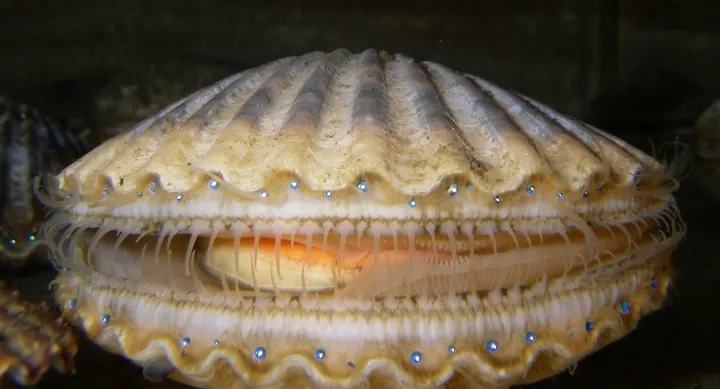
Bay Scallop
Argopecten irradians
A short-lived scallop of US seagrass beds that swims to get around and keeps watch with dozens of tiny eyes along the edges of its shell.
Photo: Rachael Norris and Marina Freudzon / Public domain
3 things to know
- A bay scallop has dozens of eyes along the edges of its shell, and each one forms an image mainly with a concave mirror.
- Most bay scallops live about two years and spawn only once.
- Since 2019, summer die-offs have cut the biomass of adult bay scallops in New York by 90 to 99 percent.
- Scientific name
- Argopecten irradians
- Depth
- 0 m – 10 m
0 – 33 ft - Size
- Shell up to about 7.5 cm (3 in) long
- Weight
- Not well known
- Lifespan
- Usually no more than about 2 years
- Diet
- Fine food particles filtered from the water
- Where
- US Atlantic and Gulf coasts, from Cape Cod, Massachusetts, to Laguna Madre, Texas
- IUCN status
- Not Evaluated
- Depth zones
- Sunlight
Along the gap between a living bay scallop's two valves runs a fringe of sensory tentacles, and among them sit dozens of small eyes. Each eye forms its image mainly with a concave mirror and covers a field of view of 90 to 100 degrees. In a 2021 study, Daniel Chappell, Tyler Horan and Daniel Speiser of the University of South Carolina showed bay scallops black stripes in different positions, then set stripes turning around them. The scallops pointed their tentacles toward the stripes and followed the moving ones with waves of tentacle extension, evidence that they can locate what they see across an arc of at least 270 degrees.
Argopecten irradians lives along US Atlantic and Gulf coasts from Cape Cod, Massachusetts, to Laguna Madre, Texas, mostly in estuaries and near-shore water 0.3 to 10 meters (1 to 33 feet) deep, with records to 18 meters (59 feet). Its shell reaches about 7.5 centimeters (3 inches). Eelgrass beds are its preferred home: the blades hide it from crabs, fish and gulls, and the slower water there lets food particles collect where it can filter them out. Young scallops hang onto the blades with byssal threads, while adults get around mainly by swimming, unusual among bivalves.
Bay scallops mature at one year and generally live no more than two, so most spawn only once. Each is a hermaphrodite that works first as a male and then as a female, releasing sperm and eggs at different times, so it rarely fertilizes itself. One scallop can release about five million eggs, and around Long Island spawning peaks in June and July.
That short life makes populations fragile. Eelgrass die-offs in the 1930s and 1980s, from wasting disease and then brown tide, sent harvests crashing, and in New York's Peconic Bays the scallops were nearly wiped out. Hatchery-raised scallops brought landings back above 45,000 kilograms (100,000 pounds) in 2017 and 2018. Then, starting in 2019, summer die-offs cut adult scallop biomass in New York by 90 to 99 percent. A 2023 study led from Stony Brook University by Emmanuelle Pales Espinosa and Bassem Allam described a new parasite, Bay Scallop Marosporida, found in the kidneys of every scallop examined in early checks of the die-offs; the authors wrote that their results strongly suggest it plays a major role in the collapse. The IUCN has not evaluated the species.
Sources
- Study: doi:10.1098/rspb.2021.1730
- pmc.ncbi.nlm.nih.gov/articles/PMC8580434
- extapps.dec.ny.gov/fs/programs/dfw/SWAP2025/Marine%20Invertebrates/Bay%20scallop.pdf
- sealifebase.se/summary/Argopecten-irradians.html
- Study: doi:10.1038/s41598-023-33514-3
- seagrant.sunysb.edu/articles/r/23850
- api.gbif.org/v1/species/2285856/iucnRedListCategory



