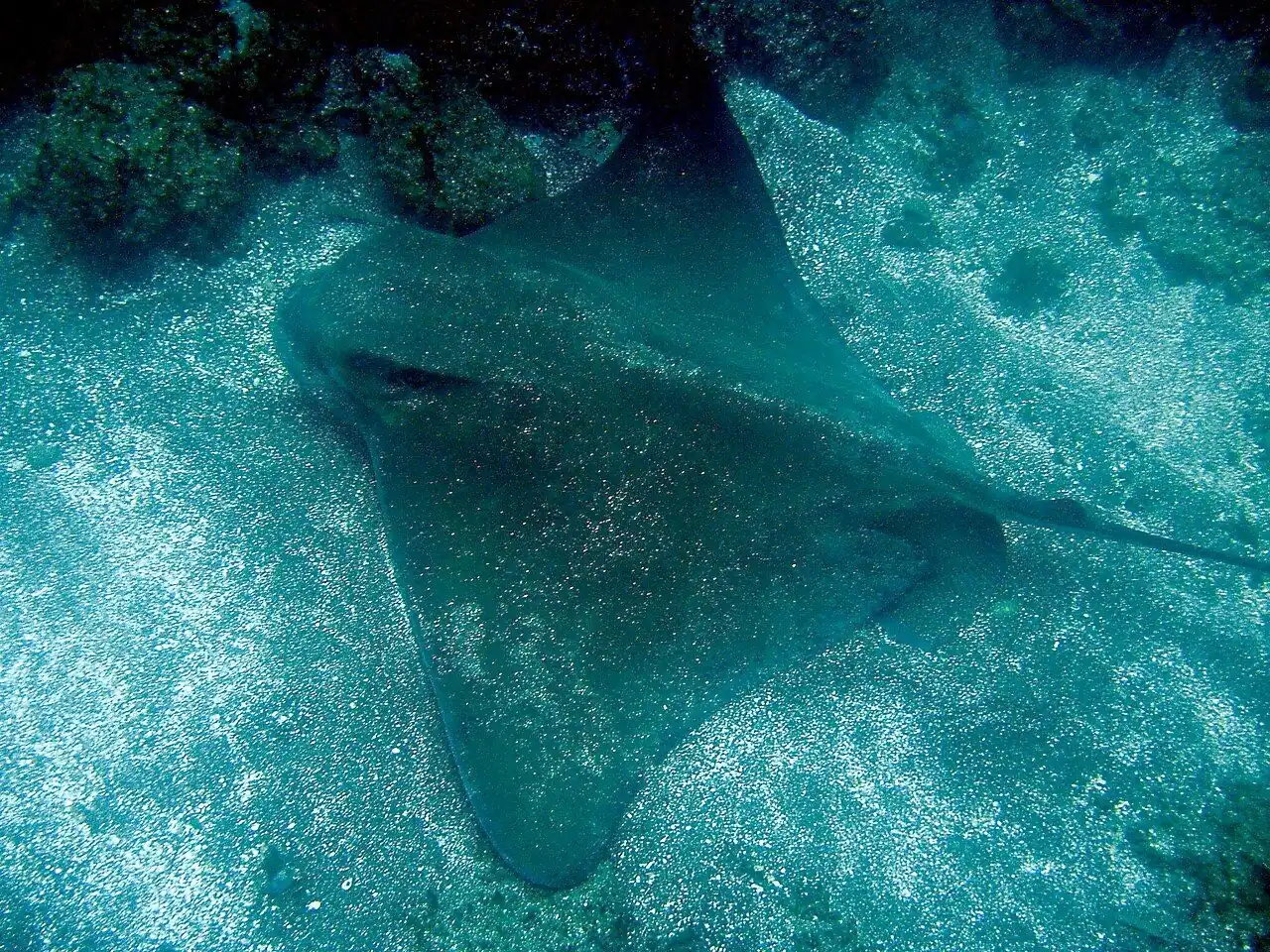
Bat Ray
Myliobatis californica
A big, dark eagle ray of California's bays, sloughs and kelp beds that digs clams out of the sand by flapping its wings.
Photo: Claire Fackler, CINMS, NOAA / Public domain
3 things to know
- It digs prey out of the sand by flapping its wings and pushing in with its snout.
- Tracked rays in Tomales Bay, California, moved toward warm, shallow water from early morning to mid-afternoon and back toward cooler, deeper water after that.
- Litters range from 2 to 12 pups, depending on the size of the mother.
- Scientific name
- Myliobatis californica
- Depth
- 0 m – 108 m
0 – 354 ft - Size
- Disc commonly about 1 m (3.3 ft) wide; up to about 1.8 m (6 ft)
- Weight
- Up to about 82 kg (181 lb) on record; the Florida Museum gives close to 91 kg (200 lb)
- Lifespan
- At least 23 years
- Diet
- Clams and other bivalves, snails, worms, shrimps, crabs and small fishes
- Where
- Eastern Pacific from Oregon to the Gulf of California, plus the Galápagos Islands
- IUCN status
- Least Concern
- Depth zones
- Sunlight
A bat ray swims on long, pointed wings, with its head bulging out in front of its body. Its smooth skin is dark brown or black above and white below, and its whip-like tail, at least as long as the body is wide, carries a venomous barbed spine near its base. Females grow larger than males, and the biggest bat rays reach about 1.8 meters (6 feet) across.
It lives in the eastern Pacific from Oregon to the Gulf of California and around the Galápagos Islands, in sandy and muddy bays and sloughs, on rocky bottoms and in kelp beds. It is mostly a shallow-water animal, but FishBase records it as deep as 108 meters (354 feet). Bat rays eat clams, snails, worms, shrimps, crabs and small fish. A hunting ray flaps its wings to clear away sand and roots in with its snout, then crushes the shells, spits them out and eats the soft parts. A study of more than 500 bat rays in Humboldt Bay, California, found that clams were the main prey. That taste for shellfish makes it unpopular with oyster growers, who have trapped bat rays for many years.
Mating happens in spring or summer. After 8 to 12 months, a female moves into shallow water to give birth to 2 to 12 pups, each about 30 centimeters (1 foot) across. Males mature at about 2 years and females at 5 to 6, and bat rays live at least 23 years.
Temperature seems to steer their daily movements. Scott Matern and Joseph Cech of the University of California, Davis, and Todd Hopkins tracked 11 bat rays with ultrasonic tags in Tomales Bay, California, a bay 20 kilometers (12 miles) long whose shallow inner end swings widely in temperature while its outer end stays ocean-like. Their swimming speed did not change with the tide or the time of day, but their direction followed the clock. From about 2:50 a.m. to 2:50 p.m. they moved toward the warmer, shallower inner bay, and for the next 12 hours they moved back toward the cooler, deeper outer bay. In the study, published in 2000, the team argued that the rays were regulating their body temperature by choosing where to be.
Bat rays are not fished commercially but are caught as bycatch. The IUCN lists the species as Least Concern.



