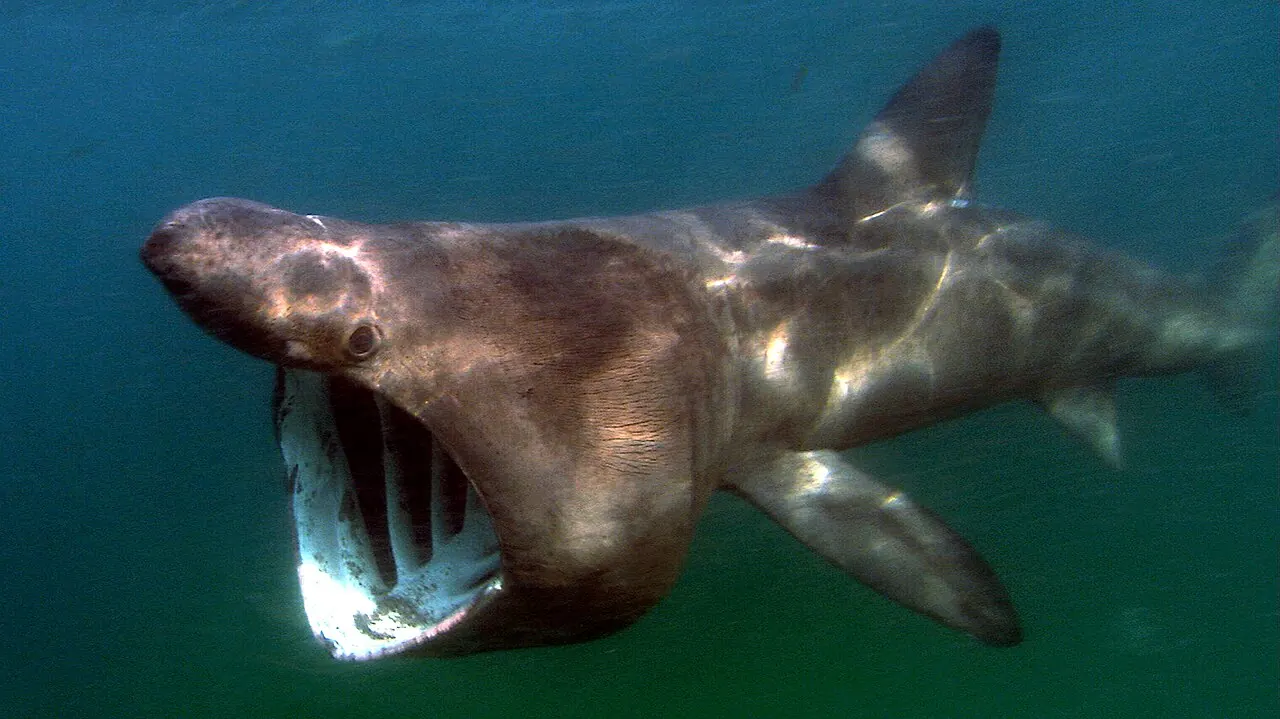
Basking Shark
Cetorhinus maximus
The world's second-largest fish, a filter feeder that cruises with its mouth agape and was tracked from New England to South America.
Photo: Green Fire Productions / CC BY 2.0
3 things to know
- Its gill rakers can strain up to 2,000 tons of water an hour.
- Its liver can make up a quarter of its body weight.
- Basking sharks tagged off southern New England swam to the Caribbean and on into the Southern Hemisphere.
- Scientific name
- Cetorhinus maximus
- Depth
- 0 m – 1,000 m
0 – 3,281 ft - Size
- Adults average 6.7–8.8 m (22–29 ft) long; up to about 12 m (40 ft)
- Weight
- Heaviest published about 4 metric tons (8,800 lb)
- Lifespan
- Not well known; thought to live up to about 50 years
- Diet
- Zooplankton: small crustaceans, invertebrate larvae, and fish eggs and larvae
- Where
- Cool and temperate seas worldwide; in the western Atlantic from Newfoundland to Florida, and in the eastern Pacific from the Gulf of Alaska to the Gulf of California
- IUCN status
- Endangered
- Depth zones
- Sunlight · Twilight
Second in size only to the whale shark, the basking shark can reach about 12 meters (40 feet), and adults average 6.7 to 8.8 meters (22 to 29 feet). Its gill slits almost circle the head, the snout is cone-shaped, and the enormous mouth stretches back past the small eyes. Up to a quarter of its weight is liver, rich in squalene, a light, oily substance that helps it stay close to neutral buoyancy.
It feeds by swimming slowly with that mouth wide open. Water flows over the gill rakers, which strain out zooplankton such as small crustaceans and fish eggs and larvae, as much as 2,000 tons of water an hour by the Florida Museum's figure. The whale shark and the megamouth, the other two big filter-feeding sharks, help water in with suction or pumping; the basking shark relies on swimming alone. Its name comes from its habit of cruising at the surface with its back awash and dorsal fin showing, as if sunning itself.
Basking sharks live in cool and temperate seas around the world. Off the US Atlantic coast they appear between North Carolina and New York in spring, move north to New England and Canada in summer, then vanish in autumn. They were thought to stay in temperate latitudes until Greg Skomal of the Massachusetts Division of Marine Fisheries and colleagues fitted satellite tags to sharks feeding off southern New England. As the team reported in Current Biology in 2009, tagged sharks traveled to the Bahamas, the Caribbean and on to South America and into the Southern Hemisphere. In those warm waters they descended to twilight-zone depths and sometimes stayed there for weeks to months.
Breeding is barely known. Only one pregnant female has been recorded, and she reportedly gave birth to five live young and one stillborn, each 1.5 to 2 meters (5 to 6.5 feet) long. Pregnancy may last three years or more, and females may not mature until 12 to 16 years old.
Once hunted worldwide for oil, meat, fins and livers, basking sharks are depleted in many areas. In 1997 the US National Marine Fisheries Service banned fishing for basking sharks in federal Atlantic waters. Rotting carcasses, with their small skulls, have often been mistaken for sea monsters; one hauled up by Japanese fishermen in 1977 was at first believed to be a plesiosaur. The IUCN lists the species as Endangered.



