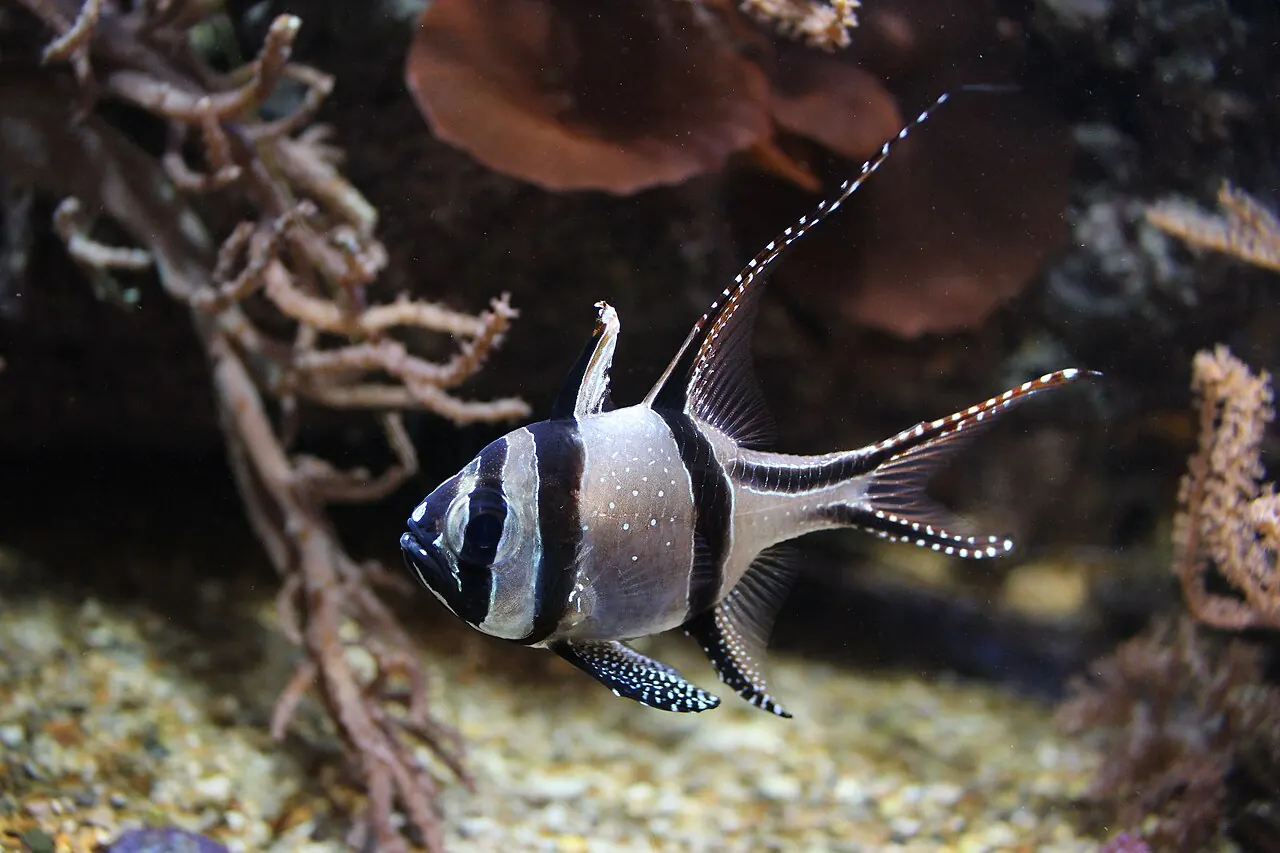
Banggai Cardinalfish
Pterapogon kauderni
A small Indonesian cardinalfish whose fathers brood the young in their mouths, now Endangered and US-listed after heavy aquarium collecting.
Photo: Holger Krisp / CC BY 3.0
3 things to know
- Males brood the eggs and newly hatched young in their mouths.
- The young skip the drifting larval stage that most reef fish go through.
- NOAA Fisheries listed it as threatened under the Endangered Species Act in 2016.
- Scientific name
- Pterapogon kauderni
- Depth
- 1 m – 2 m
3 – 7 ft - Size
- Up to about 8.6 cm (3.4 in) long
- Weight
- Up to about 11 g (0.025 lb)
- Lifespan
- About 2.5 to 3 years; up to 5
- Diet
- Mainly copepods, plus other small plankton
- Where
- Native only to the Banggai Archipelago, Indonesia; introduced populations elsewhere in Indonesia, including Lembeh Strait
- IUCN status
- Endangered
- Depth zones
- Sunlight
The Banggai cardinalfish grows to about 8.6 centimeters (3.4 inches) long and weighs up to about 11 grams. It has contrasting black and light bars and white spots over a silvery body. NOAA notes that the dot pattern differs from fish to fish, enough to identify individuals.
In the wild it lives only in Indonesia's Banggai Archipelago, in calm, shallow water among coral reefs and seagrass, mostly 1 to 2 meters (3 to 7 feet) deep and recorded to 16 meters. Groups of 2 to 60 hover above long-spined sea urchins, with the smallest fish staying closest, and retreat among the spines when threatened. Juveniles also shelter in sea anemones. The fish feeds mainly on copepods.
The male does the brooding. He takes the large eggs, about 2.5 millimeters across, into his mouth and keeps the young there after they hatch, releasing them at about 8 millimeters long as fully formed juveniles. Newly hatched young have no drifting larval period, so they start life close to where they were released. NOAA's listing rule describes a small population split into genetically distinct groups. Lifespan is about 2.5 to 3 years, with a maximum of 5.
That small range met a big market. In a count of marine fish imported into the United States in 2005, Rhyne and colleagues ranked it the 10th most common species. NOAA's 2016 listing rule records the toll: before 2003, collectors from Bone Baru needed about a day to catch 2,000 fish, but by 2007 the same catch took a week, and around Banggai Island catch rates fell from about 1,000 fish an hour in 2000 to between 25 and 330 in 2004. Local populations have disappeared where the urchins and anemones the fish shelter in were also harvested.
NOAA Fisheries listed the species as threatened under the Endangered Species Act in a rule published January 20, 2016, and the IUCN lists it as Endangered, from a 2007 assessment. Discarded or escaped fish have started populations outside the native range near trade centers, including Palu Bay, Luwuk Harbor and Lembeh Strait, where NOAA calls the introduced population invasive. Captive breeding in the United States and Thailand may ease pressure on wild fish, though NOAA said how much is unknown.



