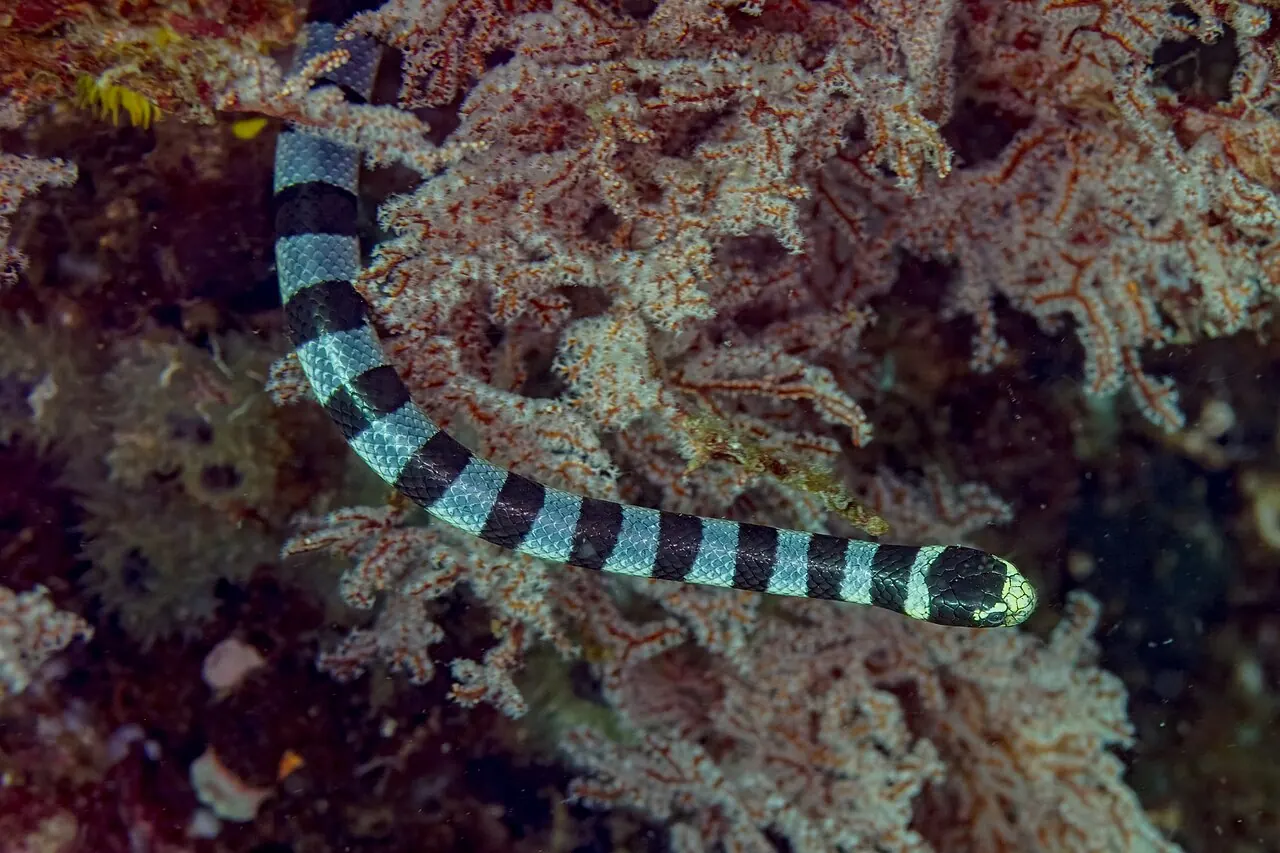
Banded Sea Krait
Laticauda colubrina
A ringed, amphibious sea snake that hunts eels on reefs but comes ashore to digest, shed its skin, lay eggs and drink fresh water.
Photo: Diego Delso / CC BY-SA 4.0
3 things to know
- It mates on shore and lays its eggs in crevices.
- Females eat large conger eels one at a time, while males often take several smaller moray eels per hunt.
- Kraits moved between two Fijian islands 5.3 km (3.3 miles) apart returned home almost immediately.
- Scientific name
- Laticauda colubrina
- Depth
- 0 m – 10 m
0 – 33 ft - Size
- Up to about 1.5 m (5 ft) long; females grow much larger than males
- Weight
- Unknown
- Lifespan
- Unknown
- Diet
- Eels: adult females mainly large conger eels, males smaller moray eels
- Where
- Indo-Pacific, from the Bay of Bengal and Taiwan to Australia and the islands of Oceania
- IUCN status
- Least Concern
- Depth zones
- Sunlight
Bold black rings circle the bluish body of the banded sea krait, and its black head has a yellow snout and upper lip, which is why it is also called the yellow-lipped sea krait. It grows to about 1.5 meters (5 feet). For a sea snake it spends a lot of time out of the water.
It ranges from the Bay of Bengal and Taiwan to Australia and the islands of Oceania, around fringing reefs, mangroves and coral islands, usually in shallow water. SeaLifeBase gives a depth range of 0 to 10 meters (33 feet). Kraits hunt eels in shallow coastal water, then come back to land to digest their meals and shed their skin. Mating happens on shore, and females lay clutches of up to 10 eggs in crevices. On land the snakes shelter in vegetation, under rocks and in crevices and caves.
Males and females eat differently. Working in Fiji, Shetty and Shine found that adult females grow much larger than males and have longer, wider heads for their body length. Females fed mainly on large conger eels and took a single eel per hunting trip, while males ate smaller moray eels and often several at a time. The same researchers marked kraits on two small Fijian islands 5.3 kilometers (3.3 miles) apart and found the two populations almost entirely separate. Snakes moved to the other island returned home almost immediately after release, which means resort building or hunting for the skin trade on one island would hit that island's kraits hard rather than spreading thin.
Fresh water is another tie to land. In 2008 Harvey Lillywhite and colleagues reported that sea kraits of three species, dehydrated either in air or in seawater, refused to drink seawater but drank fresh or slightly brackish water. In the wild, kraits can become badly dehydrated and are far more abundant where fresh water is available, which may explain why their populations are so patchy. The team expects reduced dry-season rainfall in the tropics to affect them.
The IUCN lists the banded sea krait as Least Concern, in an assessment last carried out in 2009.



