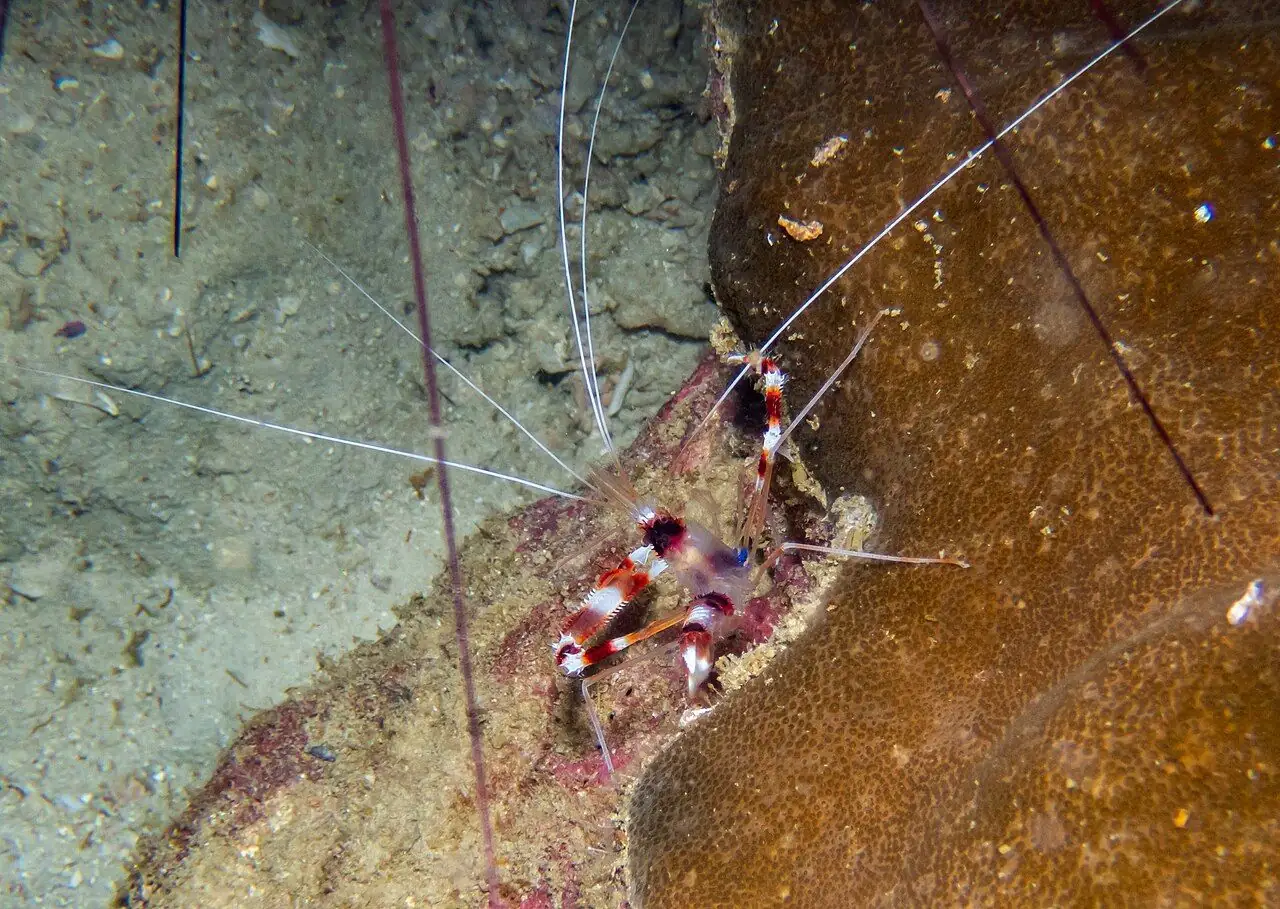
Banded Coral Shrimp
Stenopus hispidus
A spiny red-and-white shrimp found in warm seas worldwide that cleans parasites from fish and lives in long-lasting pairs.
Photo: portioid / CC BY-SA 4.0
3 things to know
- It waves its long white antennae to attract fish that it then cleans.
- Pairs may stay in the same spot for months or even years.
- It can drop a threatened claw and grow a new one.
- Scientific name
- Stenopus hispidus
- Depth
- 1 m – 200 m
3 – 656 ft - Size
- Up to about 6.2 cm (2.4 in) long, not counting antennae longer than the body
- Weight
- Unknown
- Lifespan
- Not well known
- Diet
- Parasites, injured tissue and food scraps picked from fish, plus small invertebrates
- Where
- Indo-Pacific from the Red Sea and South Africa to Hawaii; western Atlantic from North Carolina and Bermuda to Brazil
- IUCN status
- Not Evaluated
- Depth zones
- Sunlight
Red and white bands cross the body and the big claws of the banded coral shrimp, and its two pairs of long, white antennae stretch farther than its whole body. Tiny spines cover its shell, tail and claws. The claws sit on the enlarged third pair of legs, and a shrimp under threat can drop one and later grow it back. Adults reach about 6.2 centimeters (2.4 inches), according to Animal Diversity Web.
It has a huge range. SeaLifeBase lists it from the Red Sea and South Africa across the Indo-Pacific to Hawaii and Easter Island, and in the Atlantic from North Carolina and Bermuda through the Caribbean to São Paulo, Brazil. It hides in crevices, under coral and rock ledges and even inside discarded tires and buckets. SeaLifeBase gives its depth range as 1 to 200 meters (3 to 656 feet); Animal Diversity Web, citing studies from 1961 and 1984, says it is found in 2 to 4 meters (7 to 13 feet) of water, usually just beyond the surf.
It is a cleaner. From the mouth of its cave or ledge, it waves its white antennae to attract fish, then removes and eats parasites, injured tissue and leftover food from them. It also eats small crustaceans and other invertebrates.
Banded coral shrimp usually live in male-female pairs, which may form while the shrimp are still young and stay in the same spot for days, months or even years. Limbaugh and colleagues, reporting in 1961, never saw one move more than half a meter (1.6 feet) unless disturbed, and even then the partners tried to stay together. A 1977 paper in Animal Behaviour by Victor R. Johnson Jr. is titled "Individual recognition in the banded shrimp." A shrimp molts every 3 to 8 weeks, and the female mates with her partner right after she molts. Her eggs, carried under her tail, hatch about 16 days later at 28°C (82°F), usually at night, and the larvae pass through nine stages and may delay settling until they reach suitable habitat. How long the shrimp lives is not well known, and it has not been evaluated for the IUCN Red List.



