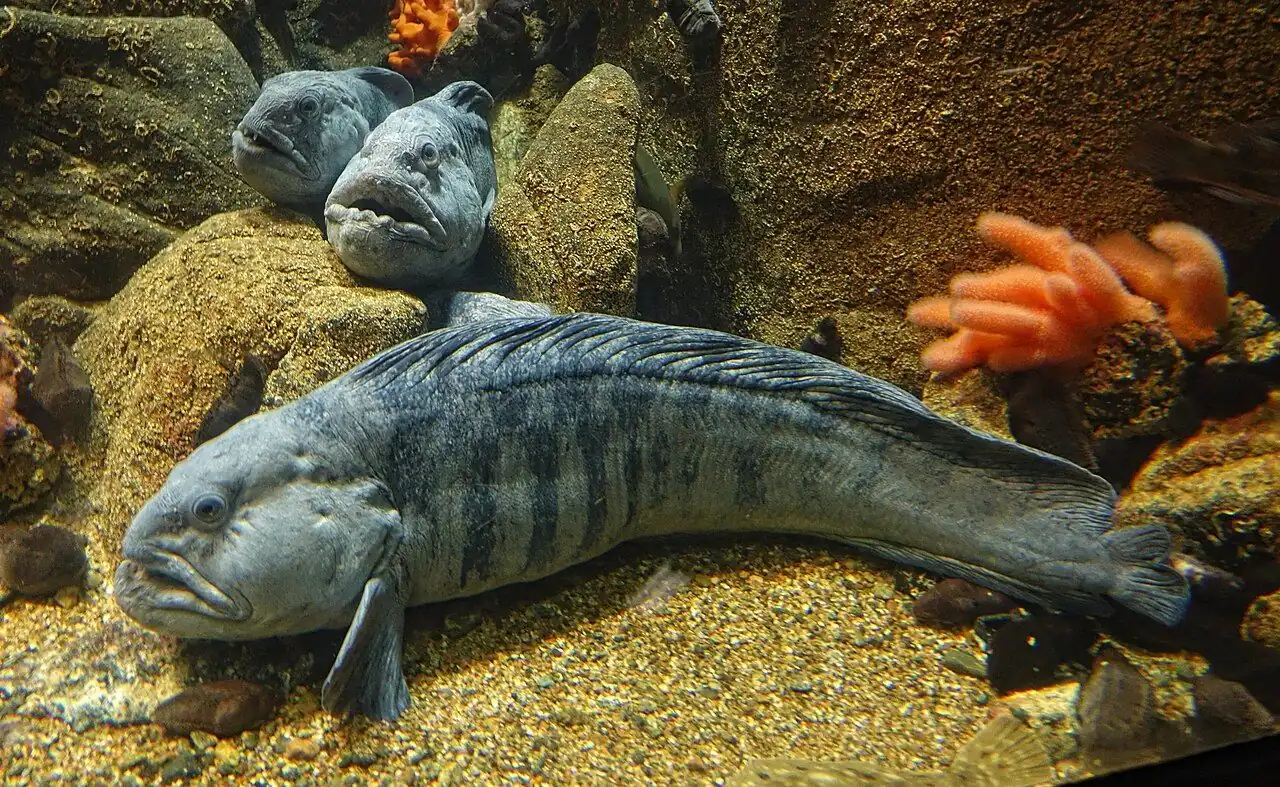
Atlantic Wolffish
Anarhichas lupus
A cold-water fish with fangs and molars that crushes urchins and crabs, mates by internal fertilization, and is off-limits to US fishing boats.
Photo: Bjørn Christian Tørrissen / CC BY-SA 4.0
3 things to know
- Adult wolffish lose their teeth and replace them all at once.
- Male wolffish guard their egg masses for about 3 to 9 months.
- Boats with a federal groundfish permit may not keep Atlantic wolffish.
- Scientific name
- Anarhichas lupus
- Depth
- 27 m – 173 m
89 – 568 ft - Size
- Up to about 1.5 m (4.9 ft) long
- Weight
- Up to about 23.6 kg (52 lb)
- Lifespan
- Up to about 22 years
- Diet
- Hard-shelled bottom animals such as scallops, crabs and sea urchins, plus some fish
- Where
- North Atlantic: in the west from Labrador and western Greenland to Cape Cod, rarely New Jersey; in the east from Spitsbergen and the White Sea to the British Isles and the northern Bay of Biscay, plus Iceland and southeastern Greenland
- IUCN status
- Not Evaluated
- Depth zones
- Sunlight
The front of an Atlantic wolffish's mouth bristles with long, canine-like teeth, some of which jut from the mouth, and behind them sit rows of broad, molar-like teeth on the jaws and the roof of the mouth. William and Katherine Bemis described in 2015 how the system works: the fangs grab shellfish, crabs, sea urchins and, less often, fish, and the molars crush them. Adults also replace their teeth in an unusual way, losing them and growing new ones all at once. The body is long and tapering, with a big rounded head, and is bluish or greenish gray, sometimes almost black or reddish brown, with 10 to 15 dark bars. FishBase gives a maximum of 150 centimeters (4.9 feet) and 23.6 kilograms (52 pounds).
Wolffish live in cold water on both sides of the North Atlantic, from Labrador and western Greenland to Cape Cod in the west, and from Spitsbergen and the White Sea to the northern Bay of Biscay in the east, including Iceland. They have been found in water as cold as -1.9°C (28.6°F) off Newfoundland. In spring, adults in US waters mostly stay between about 27 and 173 meters (90 and 570 feet), on rocky bottoms. NOAA describes them as sedentary loners that eat scallops, hermit crabs, Jonah crabs and sea urchins.
Their breeding is unusual for a fish. Males and females pair up in the spawning season, which peaks in September and October, and fertilization happens inside the female. In the Gulf of Maine, adults have been seen sheltering, some with egg masses, in boulder reefs 50 to 100 meters (165 to 330 feet) down. The male guards the eggs for about 3 to 9 months until they hatch, and barely eats while he does. Wolffish start breeding at 5 to 6 years old and can live to about 22.
Slow growth, late maturity and few eggs leave them vulnerable. After a 2008 petition from the Conservation Law Foundation and two scientists, NOAA studied whether to list the Atlantic wolffish under the Endangered Species Act, and in 2009 decided that listing was not warranted, though US numbers had fallen from a peak in the early 1980s. Its 2017 assessment still found the US stock overfished. Vessels with a federal groundfish permit may not fish for, keep or land the species. The IUCN has no global assessment; its 2015 European assessment rated the species Data Deficient.
Sources
- fisheries.noaa.gov/species/atlantic-wolffish
- fishbase.se/summary/Anarhichas-lupus.html
- govinfo.gov/content/pkg/FR-2009-11-06/pdf/E9-26573.pdf
- Study: doi:10.1643/OT-14-141
- iucnredlist.org/species/18155993/44739312
- api.gbif.org/v1/species/8006460/iucnRedListCategory
- commons.wikimedia.org/wiki/File:Anarhichas-lupus-Atlanterhavsparken.jpg



